
Lieferung heute & morgen

Qualitätsgarantie

Willkommens-Angebote freischalten: KOSTENLOSE Lieferung | Bis zu 80 % RABATT | Kostenlose 30-Tage-JoyPlus-Testphase
App herunterladen
An electric kettle is a staple in every kitchen. But the selection is vast, and not every model delivers on its promises. Before you make a decision, it's helpful to know the typical weak points that often only become apparent after a few weeks of use. As your Joybuy Product Recommendation Officer, I'll help you separate the best from the rest and find an appliance that truly meets your needs.
Many appliances look impressive at first glance, but a closer look often reveals flaws that complicate daily use. Pay special attention to these three points:
To avoid a bad buy, you should base your decision on objective criteria. The following three aspects are crucial for the longevity and functionality of your new kettle.
The kettle's material has a direct impact on taste, durability, and maintenance.
The power, specified in watts, determines how fast-boiling an appliance is. Models with 2200 to 2400 watts bring water to a boil quickly, which saves time, especially in the morning. A device with lower wattage (e.g., 1500 watts) takes a bit longer, which may not be an issue in a quieter household or office.
The capacity should match your household. A 1.7L kettle is ideal for families or if you regularly need larger quantities of water for pasta or tea. For single households, couples, or the office, a more compact 1.0-litre model is often sufficient.
Modern kettles do more than just heat water. Consider which of these features offer real value for you:
Instead of presenting an overwhelming list, we have selected a few models from our range that are tailored to specific user profiles.
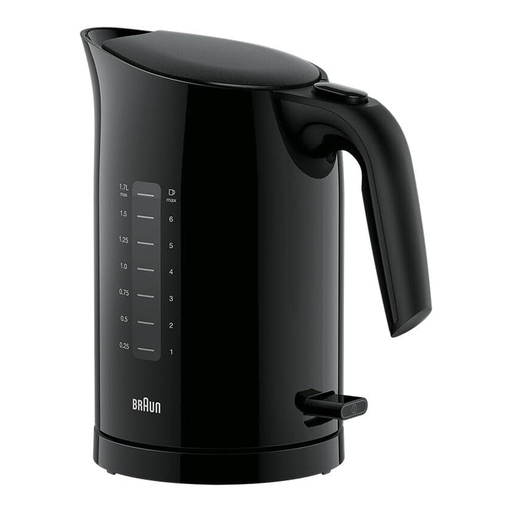
Why it's a great fit: With a 1.7-litre capacity and a rapid-boil system that heats 200 ml of water in 45 seconds (according to the manufacturer), this appliance is designed for the needs of a busy household. The dual water level indicator makes it equally convenient for both right- and left-handed users.
The removable, washable limescale filter and the large lid opening make cleaning easier and help prevent stubborn limescale build-up.
The 3-way safety system with automatic shut-off ensures peace of mind in a family home.
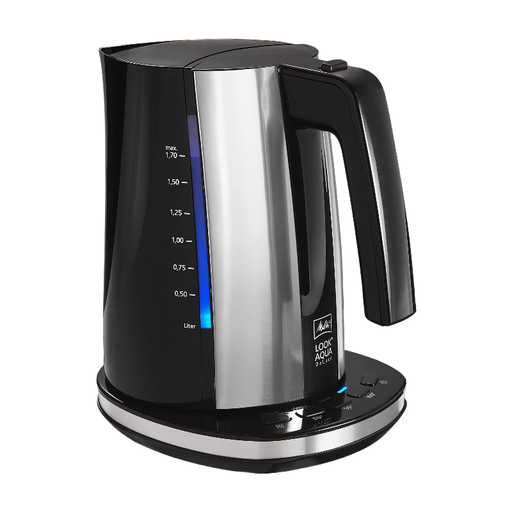
Why it's a great fit: This model is aimed at users who value precise water temperature. The three selectable levels (80°C, 95°C, 100°C) are ideal for different types of tea. The 30-minute keep-warm function adds extra convenience.
Instead of a variable, often imprecise control, this appliance offers three clearly defined temperature levels, minimising the risk of misinterpretation and inaccurate results.
The combination of precise temperature settings and a keep-warm function offers superior functionality for sophisticated hot beverage preparation.
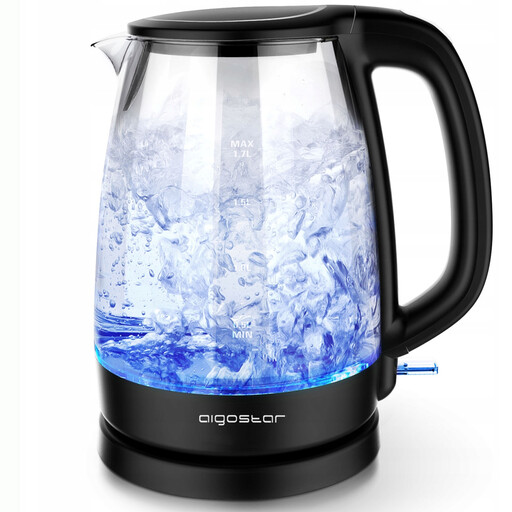
Why it's a great fit: The borosilicate glass body, combined with the blue LED illumination during the boiling process, makes this kettle a real eye-catcher. The glass is taste-neutral, and the stainless steel heating plate ensures hygienic and efficient heating.
By using glass and stainless steel for all parts that come into contact with water, it completely avoids the pitfall of inferior plastics that could impart a taste.
The combination of aesthetic design and health-safe materials (glass, stainless steel) appeals to users who prioritise both style and quality.
We have compiled a complete, up-to-date list of products that meet strict selection criteria and German safety standards. Here you will also find a selection of practical and durable plastic models.
The frequency depends on the water hardness in your area and how often you use it. As a rule of thumb, with daily use in a hard water area, descaling every one to two months is advisable. Visible white deposits at the bottom are a clear sign that it's time for a clean.
Not necessarily. A kettle with a high wattage (e.g., 2200 W) heats the water with more power, but it does so in a much shorter time than a model with a lower wattage (e.g., 1500 W). Therefore, the total energy consumption to heat the same amount of water is very similar for both types of appliances. The main advantage of a powerful device is the time saved.
Both materials are excellent choices for taste-neutral water. Stainless steel is more robust and resistant to knocks. Glass offers an appealing look and allows you to watch the boiling process, but it is more fragile. The decision ultimately comes down to your personal priority between durability and aesthetics.
I hope this guide helps you make your decision.
Your Joybuy Product Recommendation Officer