
Lieferung heute & morgen

Qualitätsgarantie

Willkommens-Angebote freischalten: KOSTENLOSE Lieferung | Bis zu 80 % RABATT | Kostenlose 30-Tage-JoyPlus-Testphase
App herunterladen
An electric kettle is a staple in almost every kitchen. Whether for your morning tea, a quick coffee, or preparing meals, this appliance is a daily companion. However, the market is vast, and the differences are in the details. From material and power to special features like precise temperature control, there are many criteria to consider.
This article serves as a guide to help you navigate the options. It introduces various features and presents a selection of models to make your decision for the right electric kettle easier.
To find the right appliance for your needs, you should consider a few fundamental characteristics. These determine not only the handling and durability but also everyday safety.
The material of the kettle affects its durability, the taste of the water, and its appearance.
The power, measured in watts, determines how quickly the water heats up. A fast-boil kettle typically has a power rating of 2000 to 3000 watts. With this, one litre of water often boils in under three minutes.
The capacity should suit your household. For singles or couples, models with 1 to 1.5 litres are sufficient. Families or frequent users are well-served with a 1.7-litre kettle to prepare multiple cups at once.
For lovers of green tea, white tea, or pour-over coffee, a kettle with temperature control is a worthwhile investment. Different types of tea develop their optimal aroma at different temperatures—for example, green tea at around 80°C, and black tea at 100°C. Precise temperature selection is also helpful for preparing baby formula. Such devices often double as a tea maker with a keep-warm function.
Here is a selection of models that cover different needs—from a solid entry-level device to a feature-rich all-rounder.
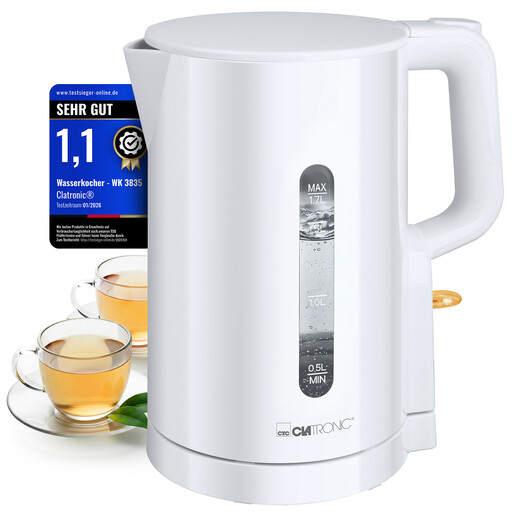
Why it stands out: This model focuses on essential functions and delivers reliable performance for daily use. With its simple handling and basic safety features, it's a practical choice for any household.
Pros:
Who is it for? This model is ideal for budget-conscious users, students, and anyone looking for a straightforward and functional kettle for everyday use.
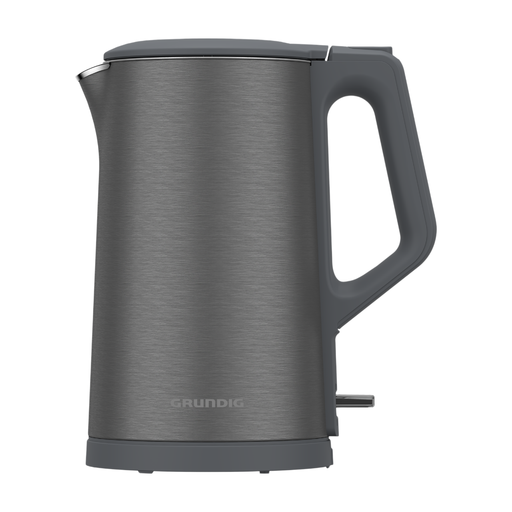
Why it stands out: The Grundig WK 7340 combines a modern design in a dark stainless steel finish with a well-thought-out safety concept. The double-walled cool-touch surface is a clear feature for enhanced safety.
Pros:
Who is it for? A great choice for families with children and safety-conscious users who value a robust appliance with a modern look.
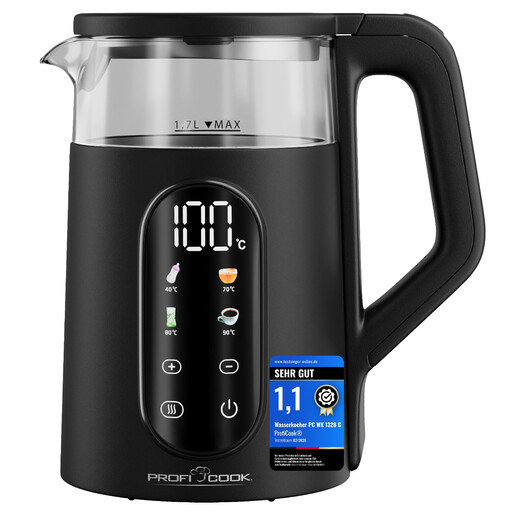
Why it stands out: This model is a glass kettle that combines functionality and design. The precise temperature setting via a touch display makes it the ideal tool for discerning tea and coffee drinkers.
Pros:
Who is it for? Perfect for tea and coffee connoisseurs who value the correct brewing temperature. The exact temperature setting is also a great advantage for parents preparing baby formula.
The models presented already cover a broad spectrum. However, if you are specifically looking for other devices with particular features, such as a variable temperature kettle with different designs or functions, you may find the right product in our wider selection.
Discover more kettles with temperature control here
1. How many watts should a fast-boil kettle have? For rapid boiling, models with a power rating between 2000 and 2400 watts are a good choice. Devices with up to 3000 watts are even faster but consume more energy for a short period. Most models for home use fall within this powerful range and heat one litre of water in about two to three minutes.
2. Is a stainless steel or glass kettle better? Both materials have their advantages. Stainless steel is very robust, easy to clean, and resistant to impacts. Glass is taste-neutral and visually appealing, as the boiling process is visible. However, limescale deposits are also more visible on glass models. Both materials are considered safe and durable choices, especially compared to basic plastic models.
3. Why is a kettle with temperature control useful? Precise temperature selection is not just beneficial for tea connoisseurs. Green tea (approx. 70–80°C) or white tea (approx. 85°C) can taste bitter if brewed with boiling water. The right temperature is also crucial for preparing baby formula (often 40–50°C) or instant coffee. Additionally, heating to a temperature lower than 100°C can save energy when boiling water is not required.