
Lieferung heute & morgen

Qualitätsgarantie

Willkommens-Angebote freischalten: KOSTENLOSE Lieferung | Bis zu 80 % RABATT | Kostenlose 30-Tage-JoyPlus-Testphase
App herunterladen
An electric kettle is part of the everyday kitchen equipment in many British households. Whether you need it for tea, filter coffee, instant meals or hot water for cooking, kettles vary considerably in terms of operation, materials, power consumption and safety features.
However, several common marketing pitfalls can lead to the wrong choice. A high wattage does not automatically mean the right solution for every kitchen. A large capacity can also be impractical if you usually heat only one cup. And with stainless steel or glass models, it is worth taking a closer look at the lid, heating element and cleaning requirements.
A 2200-watt kettle can generally heat water quickly. However, the actual time also depends on the amount of water added, the starting temperature, the design and the heating technology. A model with maximum power is not necessarily required for a single cup. With a 1.7-litre kettle, on the other hand, higher power can be useful if several cups are regularly prepared at the same time.
A 1.7-litre kettle is suitable for families or several hot drinks prepared one after another. For individuals, a compact kettle with a capacity of 1 or 1.5 litres may take up less space. It is important to check the minimum and maximum fill markings. If too little water is added, the boil-dry or overheating protection may activate. If it is overfilled, there is a risk that hot water will spill from the spout when it boils.
A stainless steel kettle may be made from different materials inside and out. In a glass kettle, the container is often made from heat-resistant safety glass, while the base is made from stainless steel. If you want to minimise plastic contact with the water, check the specific product description carefully. The models mentioned here are explicitly described as using BPA-free materials; this should not, however, be interpreted as having any medical or health benefit.
The following guide values are useful for everyday needs:
Also check the dimensions, weight and position of the water-level indicator. A clearly visible scale makes it easier to heat only the amount you need. In everyday use, this can help avoid unnecessary waiting time and additional electricity consumption.
Models with 1850 to 2200 watts at 220–240 volts are designed for normal household use. A 2200-watt kettle can be practical when heating larger amounts of water. However, running costs depend not only on the rated power, but above all on the operating time and the amount of water heated.
If you only need one cup, measure the amount of water as accurately as possible. A kettle with a keep-warm function is useful if you want the water to remain at a particular temperature for an extended period. However, this function continues to use energy for as long as it is active.
A temperature-controlled kettle offers more choice than a basic boiling model. Depending on the drink, you may be able to select temperatures such as 40, 60, 70, 80, 90 or 100 °C. This is particularly useful for tea drinkers and coffee lovers who use different brewing methods.
Pay attention to how the controls work. A digital display shows the temperature directly, while an integrated thermometer may only provide an indication. If the kettle has a keep-warm function, the length of time for which the temperature is maintained should be stated. The product specifications for the following Midea models specify a duration of up to 60 minutes.
A kettle with automatic switch-off ends the heating process as soon as the selected temperature or boiling point is reached. A kettle with overheating protection or boil-dry protection is designed to interrupt operation when there is too little or no water.
Other practical features include:
Automatic switch-off does not replace safe use. The kettle should be placed on a stable, dry and heat-resistant surface. Unplug the kettle and disconnect the base from the mains before cleaning.
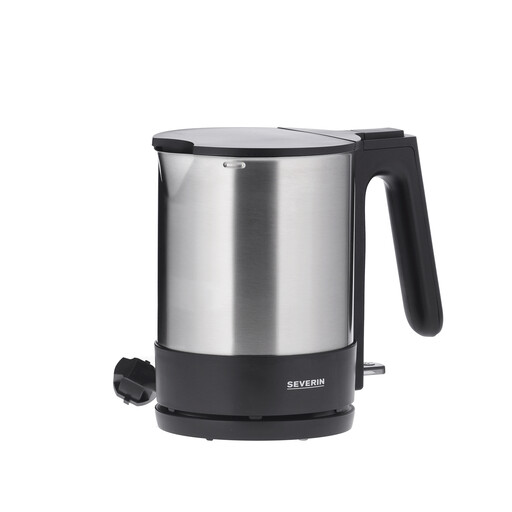
Why this product suits the profile: This 1.7-litre model combines a visible water-level indicator with 2200 watts and a 360-degree base. It is ideal for straightforward everyday use without additional temperature settings.
The scale helps you fill it accurately, while the product specifications list automatic switch-off and overheating protection.
1.7-litre capacity, 2200 watts, concealed heating element and cable storage.
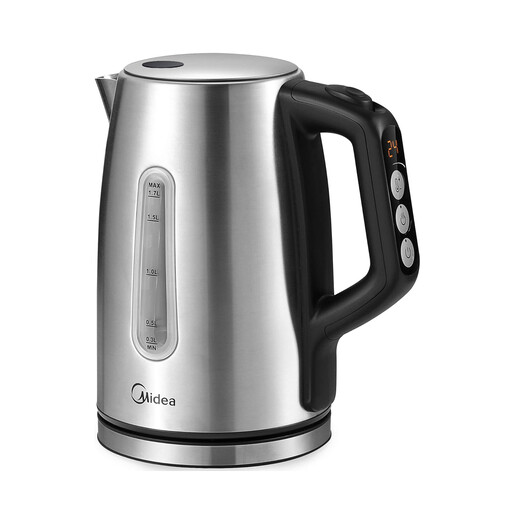
Why this product suits the profile: The six selectable temperature levels from 40 to 100 °C and the keep-warm function of up to 60 minutes are well suited to households with different beverage routines.
The temperature selection means you do not have to heat the water to boiling point for every use. The description also lists automatic switch-off and boil-dry protection.
Stainless steel housing, six temperature levels, 2200 watts, BPA-free design according to the product information and a limescale filter.
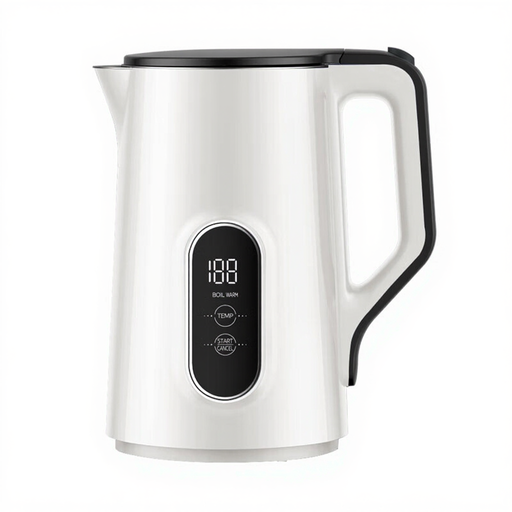
Why this product suits the profile: The seven temperature settings from 45 to 100 °C, digital display and keep-warm function of up to one hour are designed for tea and coffee drinkers with different brewing preferences.
The digital display makes the selected temperature easy to check. According to the product description, the BPA-free plastic parts do not come into contact with the water; a Strix thermostat and automatic switch-off are also listed.
1.5 litres, 2200 watts, double-walled construction, digital temperature display and 1-hour keep-warm function.
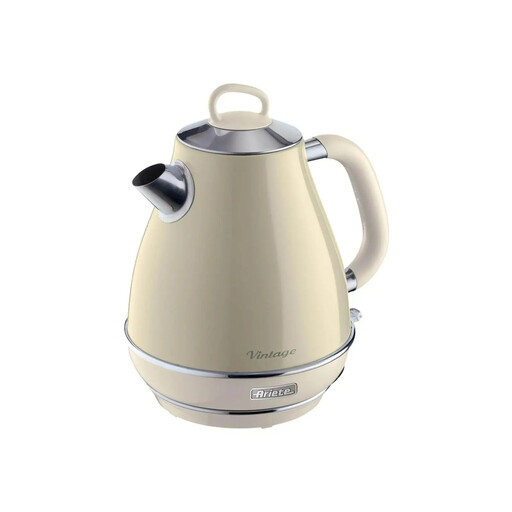
Why this product suits the profile: This beige stainless steel model, with a visible water-level indicator, tea filter and 1.7-litre capacity, is a good match for kitchens where the kettle remains permanently on the worktop.
The visible scale supports controlled filling. The product specifications list automatic switch-off, a limescale protection system and a 360-degree base.
1.7 litres, 2000 watts, cordless 360-degree base, stainless steel housing and removable tea filter.
We have put together a complete, regularly updated list of products that fully meet these strict selection criteria and the safety regulations applicable in the EU.
Limescale can affect heating performance and cleaning. Depending on the hardness of your water, the interior should be descaled regularly. Only use the products specified in the relevant instructions. The kettle must not be immersed in water; the base, plug and cable must also be kept dry.
A cordless kettle is not technically completely cable-free: the cable is located on the base station. The container can be lifted off separately and placed on a 360-degree base. Before each use, make sure the underside and base are dry and that the lid is properly closed.
Consumption depends on the power rating, amount of water and heating time. A 2200-watt appliance theoretically uses 2.2 kWh in one hour; however, a complete boiling cycle takes considerably less time. If you only need one cup, using the right amount of water saves more in everyday use than choosing a particular wattage alone.
It is not possible to give a fixed lifespan in general terms. It is influenced by factors including water hardness, frequency of use, descaling and the quality of the switch, lid and heating element. Regular cleaning, correct filling and using clean water can help maintain reliable everyday performance.
Glass gives you a direct view of the water level and heating process. Stainless steel is less transparent and, depending on the design, may be double-walled or heat-insulated on the outside. The key considerations are not just appearance, but also access for cleaning, the handle, weight, water-level indicator and the documented safety features.