
Lieferung heute & morgen

Qualitätsgarantie

Willkommens-Angebote freischalten: KOSTENLOSE Lieferung | Bis zu 80 % RABATT | Kostenlose 30-Tage-JoyPlus-Testphase
App herunterladen
An electric kettle is a staple in many German homes, offices and student apartments. Whether you use it for tea, coffee, instant meals or hot water in the morning, models vary considerably in capacity, materials, safety features and ease of use.
At first glance, many models look alike. However, certain common purchasing decisions can create unnecessary inconvenience later on. The key consideration is therefore not simply the wattage or eye-catching LED lighting, but the combination of the right capacity, reliable automatic shut-off and effortless cleaning.
An electric kettle with 2,200 watts can heat water quickly at full power. However, the actual heating time also depends on the amount of water added, its starting temperature and the heating technology used. For a single cup, a large 1.7-liter kettle is not always practical: regularly heating more water than necessary increases energy consumption without providing any additional benefit.
A glass electric kettle lets you see the water level and the boiling process. Limescale deposits are also clearly visible. Hard tap water may therefore require more frequent cleaning. Glass and stainless-steel models should ideally have a removable limescale filter or an interior that is easy to access.
Borosilicate glass is described as a heat-resistant material in several product listings. Nevertheless, glass remains more vulnerable to impacts than plastic or stainless steel. Do not place the appliance near the edge of the worktop, and never use it if visible cracks are present.
An electric kettle with LED lighting primarily provides a visual operating indicator. A temperature display or temperature control, on the other hand, can be useful if you prepare different types of tea. If you only need boiling water for coffee or instant meals, you can usually do without these features.
Terms such as health kettle or multifunctional tea kettle often refer to additional programmes for tea, keeping water warm or specific preparations. They should not be interpreted as medical or health-related claims. Instead, check which programmes you will genuinely use in everyday life.
The right capacity depends on how you typically use the kettle:
An 1.7-litre electric kettle should not automatically be filled to the maximum mark. A single cup requires considerably less water. A clearly legible water-level indicator makes it easier to measure the right amount accurately.
Standard electric kettles for German households operate at 220 to 240 volts. Power ratings of approximately 1,850 to 2,200 watts are common among larger models. Higher power can speed up heating, but it also places greater demand on the socket. Use a suitable, correctly installed socket and avoid unsuitable extension leads.
Running costs can be estimated roughly as follows: energy consumption in kilowatt-hours = power in kilowatts × operating time in hours. The less water you heat and the less often the kettle keeps water warm after boiling, the lower its energy consumption will be.
With a BPA-free electric kettle, the claim applies to specific plastic components. The relevant product description is decisive. Models with a concealed heating element are generally easier to clean inside than appliances with an exposed heating coil.
Look for the following features:
“Cordless” does not mean that most models run on a battery. It generally refers to a cordless electric kettle with a removable jug and power supplied through the base.
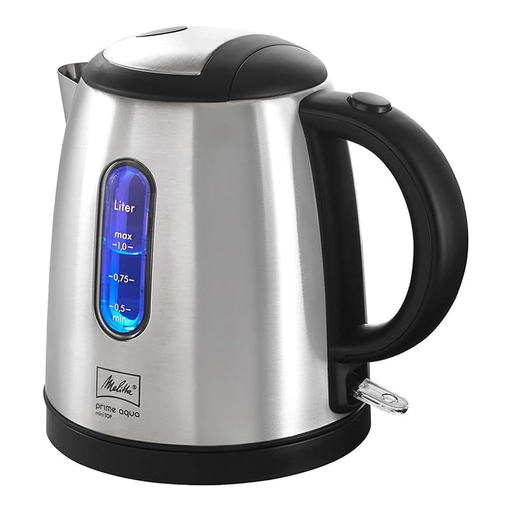
Why this model is a good fit: Its compact capacity is well suited to singles, students and smaller kitchens. It is specified with 2,200 watts, a 360-degree base, dual-sided water-level indicators and blue LED lighting.
The 1-litre capacity helps prevent unnecessarily heating large amounts of water. According to the product information, it features automatic shut-off, a lift-off switch and boil-dry protection.
Compact dimensions, removable limescale filter and one-handed operation with push-button lid opening.
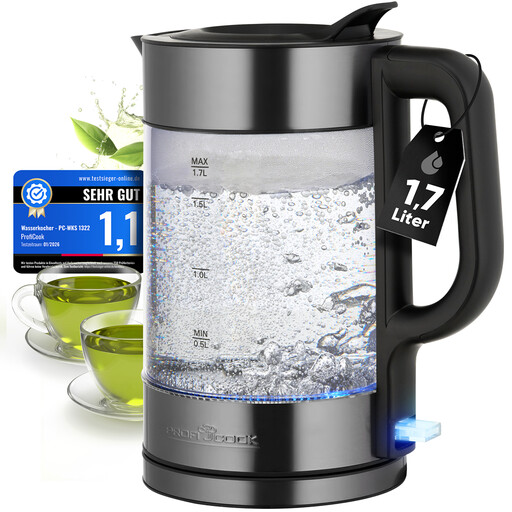
Why this model is a good fit: Families and offices benefit from the larger capacity, glass jug, illuminated water-level indicator and power rating ranging from 1,850 to 2,200 watts.
The water-level indicator helps with accurate filling. According to the product description, it provides automatic and manual shut-off, boil-dry protection and a concealed heating element.
BPA-free according to the supplier, a 360-degree base with cable storage and one-handed operation.
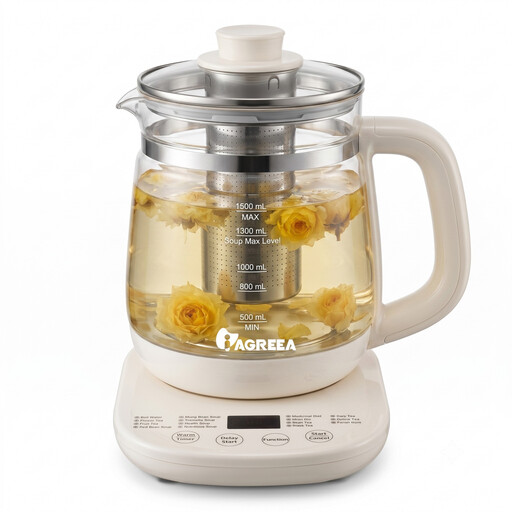
Why this model is a good fit: For users who prepare tea, fruit infusions or drinks that need to be kept warm, the product information lists 14 programmes, six temperature settings between 40 and 90 °C, and a stainless-steel filter.
The temperature selection offers more practical control than a simple LED indicator. According to the supplier, the wide opening and removable components make cleaning easier.
Keep-warm function, delayed start, touch controls and 1.5-litre capacity for several servings.
Our selection of products takes into account key criteria such as capacity, materials, power and safety features for everyday use in Germany.
Descale the electric kettle regularly, taking the water hardness in your region into account. Use only suitable descaling products and rinse the jug thoroughly afterwards. Never immerse the base, cable or electrical connections in water.
Fill the appliance only between the minimum and maximum marks. Do not open the lid while the water is boiling, as hot steam may escape. Unplug the kettle after use, particularly if it will not be needed for an extended period.
This depends on the power rating, amount of water and operating time. A 2,200-watt model uses considerably less energy during a short heating cycle than when keeping water warm continuously. Whenever possible, heat only the amount of water you actually need.
There is no universally applicable fixed lifespan. Regular descaling, careful handling of glass and observing the fill markings can help maintain reliable everyday performance. If the kettle has cracks, a damaged cable, or unusual smells or noises, stop using it.
Yes, generally speaking. Limescale is visible in glass kettles, making it easier to identify at an early stage. With hard water, a removable filter and regular maintenance are particularly important. Also check whether the interior is easy to access and whether the manufacturer’s cleaning instructions suit your household.