
Lieferung heute & morgen

Qualitätsgarantie

Willkommens-Angebote freischalten: KOSTENLOSE Lieferung | Bis zu 80 % RABATT | Kostenlose 30-Tage-JoyPlus-Testphase
App herunterladen
Deciding to mince your own meat is often the first step toward gaining more control and freshness in your kitchen. An electric meat grinder for home use promises just that: the ability to turn high-quality cuts of meat into fresh burger patties, meatballs, or the base for a perfect bolognese. However, the market is filled with appliances whose marketing claims often create more confusion than clarity. Before you make a purchase, it's crucial to understand the common pitfalls that can lead to an unused appliance collecting dust in your kitchen cabinet.
As your Joybuy Product Recommendation Officer, I'm here to help you separate the wheat from the chaff. We'll focus on the facts and what an appliance truly needs to deliver in daily use.
The 2 most common pitfalls when buying a meat grinder:
To avoid a bad purchase, you should focus on a few crucial technical features. These determine whether an electric meat grinder will meet your needs and serve you well in the long run.
As mentioned, the nominal power (specified in watts) is the key figure for continuous load capacity. For normal home use, meaning processing a few kilograms of meat per week, a nominal power between 300 and 800 watts is generally more than sufficient. This level of power is enough to reliably process even tougher, more sinewy cuts of meat.
Another important feature is the reverse function. If meat or sinew gets caught and jams the auger, this function allows you to briefly reverse the rotation to clear the blockage without having to disassemble the entire unit.
The components that come into direct contact with the meat are crucial for the final result and the appliance's durability.
A good electric meat grinder with accessories significantly expands its range of uses. A sausage stuffer attachment is essential if you plan to make your own sausages. The kebbe attachment (also called a kibbeh attachment) allows you to prepare the traditional stuffed meat dumplings from Middle Eastern cuisine. Make sure these accessories are sturdily built and easy to assemble.
Instead of making a one-size-fits-all recommendation, we have identified models that suit different needs and kitchen profiles.
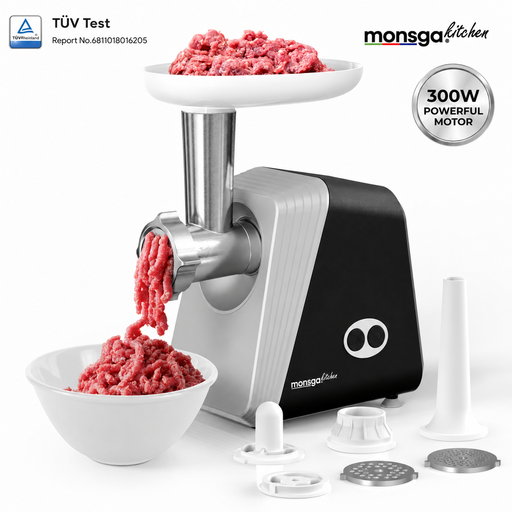
Why This Fits Their Persona: Ideal for anyone who wants to try making their own minced meat without immediately investing in an expensive professional-grade machine. This appliance provides all the basic functions needed to get started in the world of fresh meat processing.
The power rating is transparent, stating 300W of nominal power (up to 1200W peak power). The included accessory kit, with a sausage stuffer and kebbe attachment, prevents the need for expensive additional purchases.
Complete starter package: Includes 3 grinding plates for different textures and a reverse function to easily clear jams.
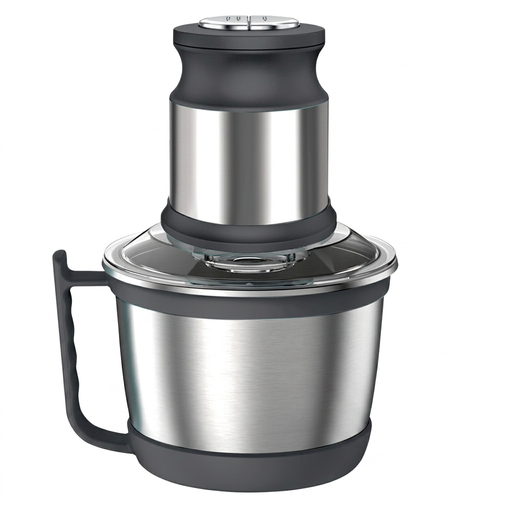
Why This Fits Their Persona: Perfect for families who process larger quantities and want an appliance that can chop not only meat but also vegetables for salsas or pesto. Its large capacity is ideal for meal prep.
This model is an all-purpose food chopper. Cleaning is often less complicated than with classic meat grinders, thanks to its large, open bowl, which avoids long feed tubes and numerous small parts.
Large 3-litre capacity and a powerful 800-watt motor for efficiently processing larger quantities of meat and vegetables.

Why This Fits Their Persona: For home cooks looking for a space-saving and cost-effective solution. This appliance combines a fully-featured stand mixer for kneading and whisking with a meat grinder and blender attachment.
Instead of buying a separate, potentially lower-quality appliance, the meat grinder function is integrated into a robust stand mixer with a powerful 1300-watt motor designed for various tasks.
Maximum versatility: Knead dough, whip cream, blend smoothies, and grind meat—all with a single motor base. This saves space and money.
We have compiled a complete, up-to-date list of products that fully meet these strict selection criteria and relevant safety regulations.
Proper cleaning is crucial for hygiene and longevity. After each use, disassemble all removable parts that came into contact with food (feed tray, auger, blade, grinding plates). Wash them by hand in warm water with mild dish soap. The motor housing must never be submerged in water; simply wipe it with a damp cloth. Dry all parts completely before reassembling or storing the unit to prevent rust. Always check the manufacturer's instructions to see if any parts are dishwasher-safe—most are not.
No, not automatically. To make sausages, you need a special sausage stuffer attachment. This is a tapered tube onto which the sausage casing is threaded. Most home-use kits include such an attachment, but it's important to verify this before buying if sausage making is a primary reason for your purchase.
Focus on the nominal power, not the peak power. For typical home use, where you might process meat for burgers, bolognese, or sausages a few times a month, a nominal power of 300 to 800 watts is generally perfectly adequate. Appliances in this power range can handle most types of boneless meat easily and without overheating.