
Lieferung heute & morgen

Qualitätsgarantie

Willkommens-Angebote freischalten: KOSTENLOSE Lieferung | Bis zu 80 % RABATT | Kostenlose 30-Tage-JoyPlus-Testphase
App herunterladen
The decision to make your own ground meat, burger patties, or sausages at home is a commitment to freshness and quality. An electric meat grinder is the essential tool for the job. However, the market is flooded with models whose marketing claims often promise more than the technology can deliver. Before you make a purchase, it's crucial to understand the common pitfalls to avoid a poor investment.
Many appliances advertise impressively high wattage ratings but fail when processing tougher cuts of meat. Other models turn out to be unhygienic because their components are made from unsuitable materials that rust after a short time. Another frequent shortcoming is an accessory kit that is useless in practice, causing more frustration than joy.
This guide will help you navigate these issues and identify the features that define a reliable meat grinder for home use.
To avoid buyer's remorse, don't be swayed by marketing buzzwords. Instead, focus on verifiable technical specifications and material properties. Three aspects are particularly important here.
A common misunderstanding concerns the motor's power rating. Many manufacturers prominently advertise the peak power (e.g., 2000 watts). However, this value only indicates the maximum power the motor can draw for a brief moment before it jams or burns out. It is not an indicator of continuous performance.
Far more meaningful is the rated power, which is often in the fine print. It describes the actual power during continuous operation. A heavy-duty meat grinder for regular home use should have a rated power of at least 500 to 800 watts. This ensures the appliance can process larger quantities of meat or tougher pieces reliably and without overheating.
The components that come into direct contact with food determine the appliance's safety, hygiene, and lifespan. Look for the following materials:
A good meat grinder with accessories significantly expands its functionality. The right attachments are what allow you to get creative, for example, by making your own ground meat or preparing sausages. Important accessories include:
Based on the criteria mentioned, we present a model suitable for users who value versatility and a solid set of features.
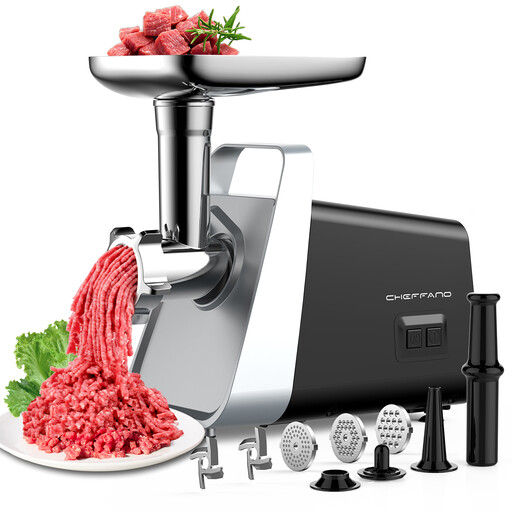
Why This Fits Their Persona: This model is aimed at home users who want to do more than just grind meat, but also make their own sausages and international specialities like Kebbe. It's designed as an all-in-one package for creative kitchen projects.
The appliance avoids the pitfall of inadequate accessories by coming equipped with a sausage stuffer tube, a Kebbe kit, three grinding plates, and two blades. Users don't need to purchase essential parts separately.
The main advantage is its comprehensive accessory kit, which offers great versatility right out of the box. The "Heavy Duty" description suggests a robust build for home use.
We have compiled a complete, up-to-date list of products that fully meet these strict selection criteria and relevant safety standards.
1. How do you clean an electric meat grinder properly? Disassemble the appliance completely after each use. All removable parts that came into contact with meat (feeding tray, auger, blade, grinding plates, head) should be cleaned immediately by hand with warm water and dish soap. Make sure to remove all meat residue. Dry all metal parts thoroughly and immediately to prevent rust. The motor housing must never be submerged in water; wipe it only with a damp cloth.
2. Can you grind bones with a home meat grinder? No, most electric meat grinders for home use are not designed for grinding bones. Attempting to do so can severely damage the motor, gearbox, and cutting components. These appliances are designed exclusively for processing meat free of sinew and bones. For processing bones, such as for a raw pet food diet (BARF), special, more powerful commercial-grade machines are required.
3. What do rated power and peak power mean for a meat grinder?Rated power indicates the continuous power of the motor, i.e., the force it consistently delivers during normal operation. This is the most important value for assessing performance. Peak power is a theoretical maximum value that the motor reaches for only a fraction of a second before it stalls. A high peak power rating with a low rated power can indicate a weaker motor that is prone to overloading.