
Lieferung heute & morgen

Qualitätsgarantie

Willkommens-Angebote freischalten: KOSTENLOSE Lieferung | Bis zu 80 % RABATT | Kostenlose 30-Tage-JoyPlus-Testphase
App herunterladen
An electric meat grinder can prepare minced meat, sausages and kibbeh, or be used as an electric food chopper to process vegetables, herbs and other ingredients. However, not every appliance is right for every household. Poor purchases are often the result of product descriptions focusing on high wattage, lots of accessories or large containers.
What matters is whether the technical specifications suit the way you plan to use the appliance. If you only chop onions and vegetables occasionally, you’ll need a different appliance from a family that regularly minces meat and makes sausages.
A high maximum power rating sounds impressive, but it doesn’t always indicate the power an appliance can deliver continuously. Some models distinguish between rated power and maximum power. When comparing appliances, you should consider both figures, as well as the permitted operating time.
An appliance with 300 watts and a short pulse function may be suitable for small portions. For mincing larger quantities of meat regularly, a suitable feed tube, the right grinding plates and a clearly stated operating interval are more important than a single high wattage figure.
A meat grinder with a sausage stuffer, kibbeh attachment, several grinding plates and a biscuit attachment may seem versatile. However, not every accessory will get regular use. Attachments should also be easy to fit, remove and clean.
Before you buy, make a quick list:
Meat can get trapped in the mincing screw, blade and grinding plates. Removable components make cleaning easier. Product information should clearly state whether they are dishwasher-safe.
Never immerse the motor unit in water. Always unplug the appliance before cleaning sharp blades and stainless steel plates. Use the pusher for safe operation; never put your hands or kitchen utensils into the feed tube.
Different hole sizes are useful for minced meat. Fine plates are suitable for a finer texture, while larger holes give a coarser result. Models such as the Kenwood MG700 are supplied with plates measuring 3 mm, 4,5 mm and 8 mm, according to the product description. The Adler Mesko MS 4809 lists 3 mm, 5 mm and 7 mm.
When choosing a chopper with stainless steel blades, consider not only the material but also the number and design of the blades. Four stainless steel blades in a small container can work well for chopping onions and herbs or processing smaller portions of meat. An electric chopper usually works in short pulses and isn’t automatically a substitute for a traditional meat grinder with a mincing screw and grinding plates.
A container with a capacity of 0,5 to 0,7 litres is better suited to small portions. According to its product details, the Haier HCH5B1 011 has a 0,5-litre glass container, while the Philips HR1393/00 has a 0,7-litre container.
For families or larger-scale food preparation, capacities of 1,8 to 2,5 litres may be more practical. What matters is the usable capacity, not just the stated volume. Don’t overfill the container, so the ingredients have enough room to be processed properly.
Compact appliances may have a limited pulse duration. For example, the Bear Electric Food Chopper QSJ-D03W5 has a maximum continuous operating time of 40 seconds, followed by a break. Follow these instructions to help prevent overheating.
A reverse function is useful on meat grinders if ingredients get stuck in the mincing mechanism. However, it’s no substitute for unplugging the appliance and cleaning it thoroughly. If you prefer stainless steel, browse the stainless steel electric meat grinder category.
The following models suit a range of needs. Information on power, capacity and accessories is based on the respective product descriptions.
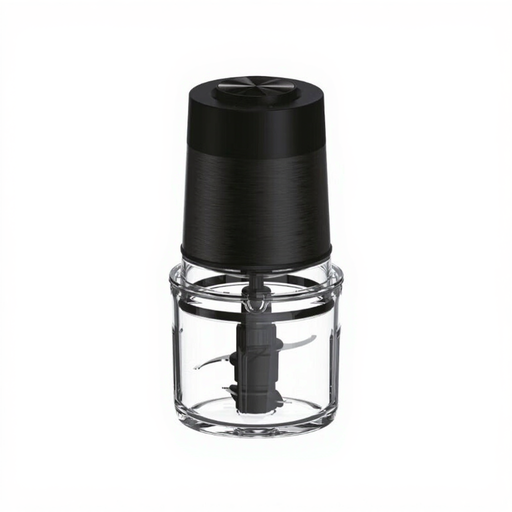
Why it suits this type of user: The 0,5-litre glass container and two speed settings with a pulse function are ideal for smaller portions and occasional kitchen tasks.
The product details clearly state the container capacity, two speed settings and removable, dishwasher-safe blades.
550 watts, a 0,5-litre glass container and four stainless steel blades.

Why it suits this type of user: If you regularly make minced meat, sausages or kibbeh, this appliance comes with several grinding plates and specialist attachments.
The three grinding plates, two sausage stuffers and kibbeh attachment are all listed, making it easier to plan how you’ll use the appliance.
2000 watts according to the product details, three grinding plates, a reverse function and an aluminium housing.
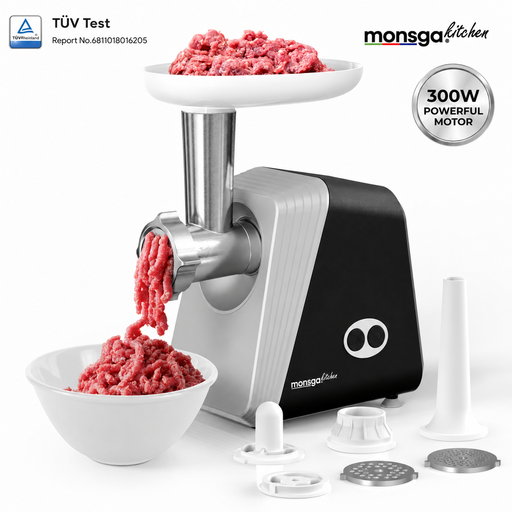
Why it suits this type of user: This model combines meat processing with sausage, kibbeh and biscuit attachments, making it a good fit for households that like to try different recipes.
The package contents include three grinding plates, a sausage stuffer and a kibbeh attachment; the reverse function can help if ingredients get stuck.
300 watts rated power, up to 1200 watts maximum power and integrated cable storage, according to the product description.
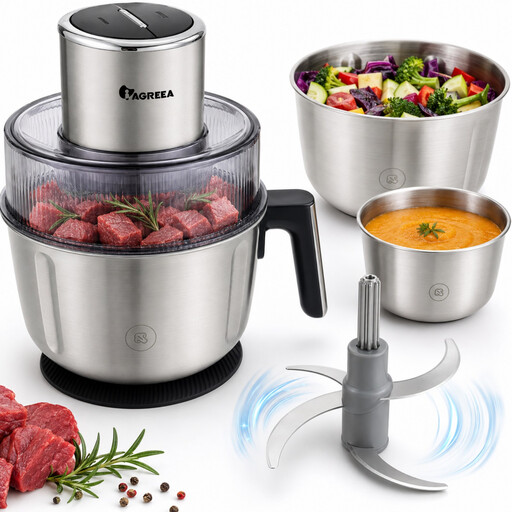
Why it suits this type of user: Three stackable stainless steel bowls handle everything from vegetables and meat to purées and cooked ingredients.
Its capacity is specified across three bowls of 1,8, 2,2 and 2,5 litres, rather than being marketed vaguely as having a ‘large capacity’.
350 watts, two pulse settings, a triple-curved stainless steel blade and space-saving bowls.
We’ve put together a complete, regularly updated list of products that meet these strict selection criteria and fully comply with the safety regulations in force in the EU.
A meat grinder processes ingredients using a mincing screw, blade and perforated plate, producing a consistent grind. An electric food chopper usually works with rotating blades in a container and is better suited to chopping, mixing or puréeing. A multifunction chopper can handle several tasks, but it won’t necessarily replace a meat grinder for making sausages or producing a coarse grind.
It depends on the model. Some appliances are designed for short pulses, while others specify a maximum operating time. Always follow the instructions in the user manual. Taking breaks between cycles helps prevent the motor from getting unnecessarily hot. If the appliance becomes blocked, switch it off and unplug it.
Running costs depend on the appliance’s power rating and how long you use it for. As a simple guide, multiply the power in kilowatts by the operating time in hours and your electricity tariff. A meat grinder usually runs for only a few minutes per preparation, so its actual energy use mainly depends on how often and how long you use it.