
Lieferung heute & morgen

Qualitätsgarantie

Willkommens-Angebote freischalten: KOSTENLOSE Lieferung | Bis zu 80 % RABATT | Kostenlose 30-Tage-JoyPlus-Testphase
App herunterladen
The decision to process your own food means more control over freshness and ingredients. An electric meat grinder is a key tool for anyone who values high-quality ground meat, homemade sausages, or traditional dishes. But the market is crowded, and many appliances don't live up to their promises. This guide will help you navigate the common pitfalls and find a model that truly fits your needs.
Before you make a decision, you should be aware of the most common marketing traps and design flaws that often lead to disappointment.
To avoid a bad purchase, focus on these three objective criteria. They determine the performance, durability, and versatility of your appliance.
A solid nominal power of 300 to 500 watts is generally sufficient for a standard home meat grinder to reliably process common types of meat. More important than a high wattage is a meat grinder with a reverse function. This feature is indispensable, as it allows you to easily clear blockages caused by sinew or meat scraps at the touch of a button, without having to completely dismantle the unit.
The components that come into direct contact with food should be made of hygienic and durable materials.
A multifunctional meat grinder significantly expands your culinary possibilities. Check the scope of delivery for the following accessories:
Instead of recommending a single one-size-fits-all device, we have matched models based on typical user profiles.
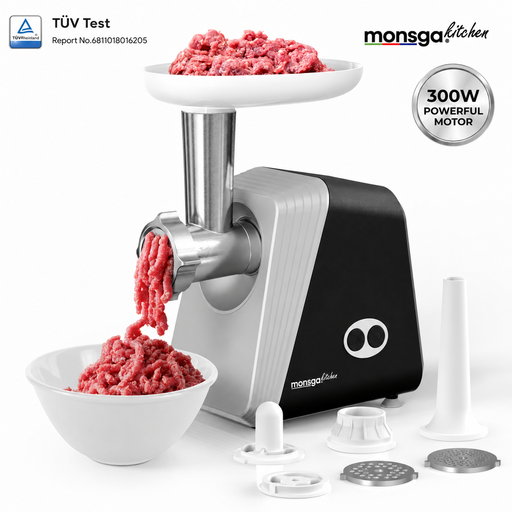
Why this model is a good fit: This model is aimed at beginners and families looking for a versatile appliance for regular use. It's suitable for preparing fresh ground meat for burgers and bolognese, as well as for first attempts at making homemade sausage.
The appliance comes with a complete accessory set, including 3 grinding plates, a sausage stuffer, and a Kibbeh attachment. There are no hidden follow-up costs for basic functions.
The integrated reverse function makes handling much easier. The copper core motor with 300W of nominal power provides stable performance for home use.
Why this profile needs more: Anyone who regularly processes large quantities of meat for sausage making needs a device with a higher throughput and a motor that won't overheat during extended use.
Specifically look for models with a robust metal gearbox and a high nominal power rating (500 watts and up). These are better designed for continuous load than basic entry-level models.
A higher throughput (kg per minute) and a solid construction save time and frustration. Additional, larger sausage stuffing tubes can also be a decisive advantage.
Why this profile needs more: Hunters processing game meat or families who produce in bulk place the highest demands on durability. The appliance must be able to handle sinewy meat and large quantities without overheating.
Ignore basic household models. Look for semi-professional units with explicit overheating protection, a heavy weight for a stable base, and a construction that relies entirely on metal components.
A high processing speed and the ability to reliably handle even demanding tasks are crucial here. Durability and reliability justify the higher investment.
We have compiled a complete, up-to-date list of products that fully meet these strict selection criteria and German safety regulations.
Proper cleaning is crucial for hygiene and longevity. Disassemble the unit after each use. The metal parts like the auger, blade, and grinding plates should generally not be put in the dishwasher, as the material (often cast aluminum or cast iron) can tarnish or rust. Wash these parts by hand with warm water and dish soap. Dry all components thoroughly immediately to prevent rust. The motor housing should only be wiped with a damp cloth.
Don't be fooled by maximum locked motor power ratings over 2000 watts. For home use, a nominal power between 300 and 500 watts is perfectly adequate for processing pork and beef for ground meat or sausages. Stable, continuous power is more important than a brief, unrealistic peak power.
Yes, many multifunctional meat grinders are also suitable for other foods. With a cookie press attachment, you can shape shortcrust pastry for cookies. Firmer vegetables like carrots or celery can also be minced, for example, for soup bases. However, a household appliance will reach its limits with very fibrous vegetables or very sticky doughs. Check the manufacturer's specifications for this.