
Lieferung heute & morgen

Qualitätsgarantie

Willkommens-Angebote freischalten: KOSTENLOSE Lieferung | Bis zu 80 % RABATT | Kostenlose 30-Tage-JoyPlus-Testphase
App herunterladen
An electric meat grinder can make preparing minced meat, burgers, meatballs and sausages much easier. However, models vary considerably in motor power, accessories, operating time and cleaning requirements. Focusing solely on a high wattage often means overlooking important details.
Typical buying mistakes include:
With an electric meat grinder, you should distinguish between rated power and maximum motor output. The Adler AD 4803, for example, is specified with 800 watts rated power and up to 2,000 watts maximum power. The Adler Mesko MS 4809 lists 350 watts rated power and up to 1,500 watts maximum power.
More important than the peak figure are:
According to the product information, a compact electric chopper such as the Bear QSJ-D03W5 is designed for a maximum of 40 seconds of continuous operation, followed by at least two minutes of rest. This may be sufficient for small portions; for larger quantities, a traditional meat grinder with a hopper and a more continuous workflow is more practical.
A meat grinder with different grinding plates allows you to adjust the consistency more precisely. Smaller holes are suitable for finer mince, for example, while larger holes are better for coarser preparations. Check whether the grinding plates are included and what diameters they have.
For a home sausage-making machine, you will also need:
The Adler Mesko MS 4809 is described as including grinding plates with 3, 5 and 7 millimetre holes, a sausage stuffer and a pusher. Other models may also include three plates, but they could be intended for different applications. The product description should therefore be read carefully before buying.
Capacity is important for families and larger households. The IAGREEA chopper comes with three stackable stainless-steel bowls measuring 2.5, 2.2 and 1.8 litres. This saves storage space and keeps different preparation tasks separate.
The Bear chopper has a 2-litre glass bowl. Its transparent material allows you to monitor the contents directly while chopping. The bowl of the Philips HR1393/00 holds 0.7 litres, making this model more suitable for smaller quantities.
You should also look for:
The motor unit of an electric kitchen appliance must never be immersed in water. Blades and grinding plates should be handled carefully because of their sharp edges.
The following appliances meet different requirements. The categorisation is based on the stated technical specifications and the accessories supplied with each model.
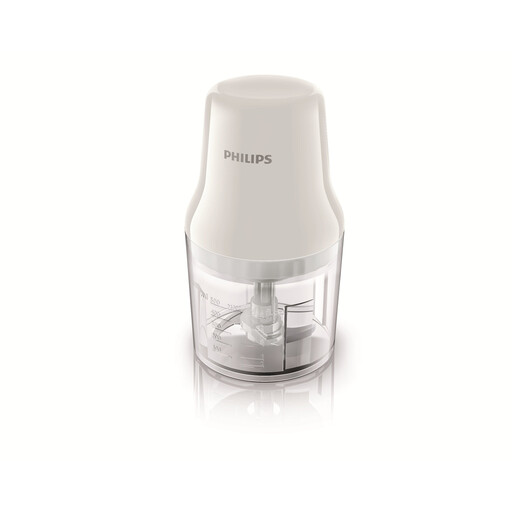
Why this product suits this profile: The compact 450-watt chopper with a 0.7-litre bowl is suitable for small quantities of vegetables, herbs, nuts or chopped meat. The one-button operation is easy to understand and the appliance takes up very little worktop space.
The product data clearly specifies the bowl capacity, motor power and dishwasher-safe removable parts. This makes it easier to assess realistically whether it is suitable for small portions.
450-watt motor, compact design and dishwasher-safe removable parts. No traditional sausage stuffer or interchangeable grinding plates.
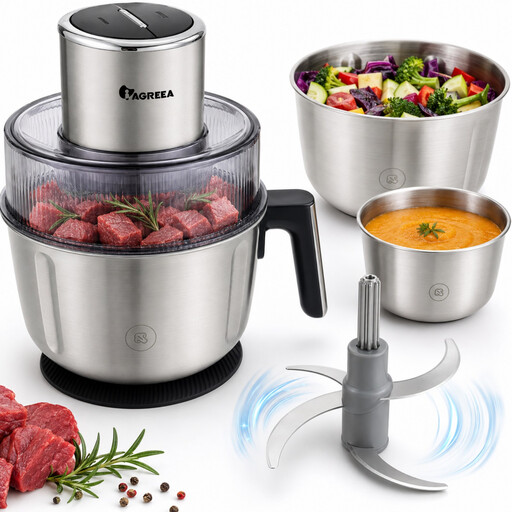
Why this product suits this profile: Three stackable stainless-steel bowls measuring 2.5, 2.2 and 1.8 litres accommodate different portion sizes and preparation tasks. Two speed settings support the processing of both soft and firm ingredients.
The separate bowl sizes mean you do not need to use an oversized bowl for every small or medium quantity. The specified pulse duration is up to 30 seconds per cycle.
304 stainless-steel bowls, three capacities and a triple-curved stainless-steel blade. No sausage stuffer is specified for sausage making.
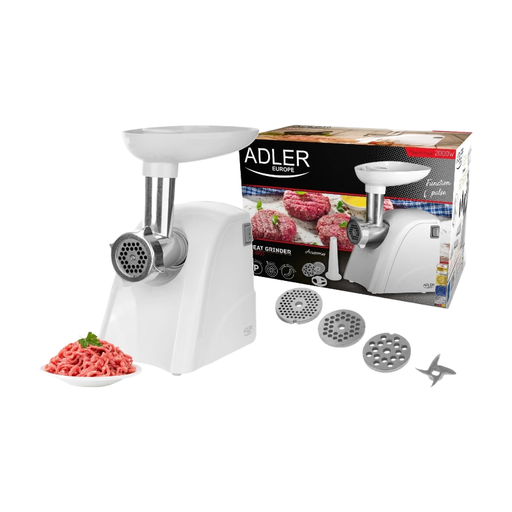
Why this product suits this profile: The appliance is described as including three grinding plates, a sausage-stuffing attachment and a pusher. This makes it suitable for households that want to prepare minced meat and homemade sausages with one appliance.
Rated power and maximum power are listed separately. The supplied pusher supports the intended operation without requiring you to put your hands into the filling opening.
800 watts rated power, up to 2,000 watts maximum power, three grinding plates and a sausage stuffer. The accessories must be cleaned thoroughly after every use.
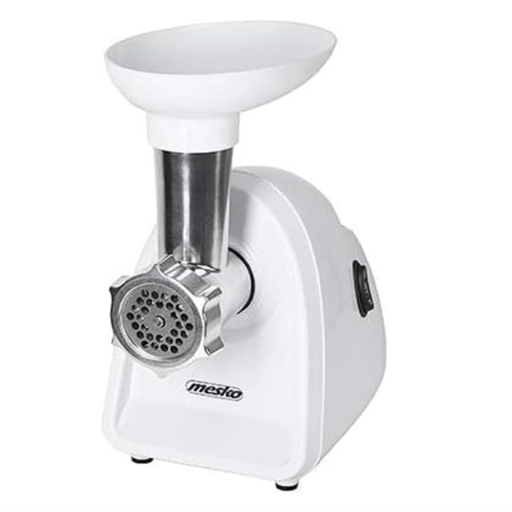
Why this product suits this profile: Its stated processing capacity of up to 1 kilogram per minute and three grinding plates make it appealing to households that regularly prepare larger quantities of minced meat or sausage filling.
According to the product description, the reverse function can help clear a blockage in the mechanism. Rated power and maximum power are also listed separately.
3, 5 and 7 millimetre grinding plates, sausage stuffer, pusher, plus forward and reverse operation. According to the specifications, bones, sinews and frozen meat are not suitable.
A traditional meat grinder for the home kitchen makes sense if minced meat and sausages are your main focus. A multifunctional meat grinder with additional attachments may be worth considering if you also plan to prepare kibbeh, biscuits or other dishes. For vegetables, herbs, purée or small portions of baby food, an electric chopper is often more space-efficient.
A stand mixer with a meat-grinding attachment combines kneading, mixing and grinding, but requires more worktop space and accessory storage. If you already prepare dough regularly, this combination may be worth considering. For occasional chopping of vegetables, a smaller appliance is often sufficient.
Before placing your order, you should therefore check:
We have put together a complete, regularly updated list of products that fully meet these strict selection criteria and the safety regulations applicable in the EU.
Wattage alone is not enough for a reliable assessment. Compare rated power, maximum power and permitted operating time. For small portions, a 300- to 450-watt chopper may be sufficient. When regularly processing larger quantities, the accessories, motor runtime and reverse function are just as important.
Its service life depends on how it is used, cleaned, stored and loaded. Only process the foods the appliance is designed for, remove bones and frozen pieces, and follow the breaks specified in the instructions. Blades and grinding plates should be stored dry and checked for damage.
Running costs are determined by the power rating and operating time. An appliance rated at 800 watts theoretically uses 0.133 kilowatt-hours when operated for ten minutes. In practice, the motor often runs only in short intervals. To calculate your own costs, multiply the consumption in kilowatt-hours by your electricity supplier’s tariff.