
Lieferung heute & morgen

Qualitätsgarantie

Willkommens-Angebote freischalten: KOSTENLOSE Lieferung | Bis zu 80 % RABATT | Kostenlose 30-Tage-JoyPlus-Testphase
App herunterladen
An electric meat grinder can make preparing minced meat, sausage fillings or kibbeh at home far more predictable. However, not every appliance marketed as an “electric meat grinder” or multifunctional kitchen helper is suitable for the same tasks. A compact electric food chopper often processes ingredients using rotating blades in a bowl. A traditional meat grinder, on the other hand, feeds food through an auger and a perforated disc.
If you overlook these differences, you could end up buying an appliance that is suitable for vegetables and onions but reaches its limits when handling larger quantities of meat or making sausages.
Marketing information often highlights the motor’s maximum power. For everyday use, the rated power is more meaningful, especially when combined with information about the permitted operating time. An appliance with a high peak output is not automatically designed to run for hours.
You should therefore check the following:
A container with a capacity of 2 or 3 litres does not necessarily hold the same quantity of meat that can actually be processed. With a food chopper, enough space must remain for the ingredients to reach the blades evenly. Overfilling can lead to inconsistent results and put greater strain on the motor.
For small portions, onions, herbs or meal preparation, a home meat grinder with a smaller container is often sufficient. Families and users who want to prepare larger quantities should instead pay attention to the recommended working quantity and operating intervals.
“Multifunctional” does not mean the same thing for every model. Check whether the parts you want are actually included:
It is particularly important to distinguish between a meat grinder with sausage filler and an electric chopper. A chopper can mince meat, but it does not automatically replace a sausage machine with an auger and filling attachment.
For occasional small quantities, an electric mincer with around 300 to 550 watts may be sufficient, provided you follow the manufacturer’s instructions on running time. For regular meat processing and sausage making, motor power, metal construction and a suitable feed hopper are more important than a single wattage figure.
With an electric food chopper, you should also check whether meat is listed as a suitable ingredient at all. Some models are primarily designed for soft ingredients, vegetables, herbs or nuts.
A meat grinder with 3 perforated discs typically offers fine, medium and coarse processing. The hole diameters may vary depending on the model. Examples from the product specifications include 3, 4.5 and 8 millimetres for the Kenwood MG700, and 3, 5 and 7 millimetres for the ADLER Mesko MS 4809.
The right choice depends on the recipe:
All parts that come into contact with raw meat must be thoroughly cleaned and completely dried after every use. Removable stainless-steel parts are practical for everyday use. With choppers, dishwasher-safe bowls and blades can reduce the cleaning effort.
Important: Never immerse the motor unit in water. Cutting components, perforated discs and blades are sharp and should be handled with care. With glass containers, also follow the instructions regarding temperature changes and microwave suitability.

Why this product suits this profile: Two glass bowls with capacities of 0.6 and 2 litres make both small and larger preparations possible. The appliance is suitable for chopping, puréeing and mincing for everyday household use.
The product specifications list the two bowl sizes, two speed settings and removable stainless-steel blades. However, it remains a chopper rather than a traditional meat grinder with perforated discs.
300 watts, two glass bowls and dishwasher-safe bowls according to the product description.

Why this product suits this profile: For regular meat processing, homemade sausages and different minced-meat textures, this model offers a clearly defined range of accessories.
The product description distinguishes between three perforated discs measuring 3, 4.5 and 8 millimetres, as well as two sausage-filling attachments. This makes the functionality easier to assess than relying on purely promotional claims.
2000 watts according to the product specifications, aluminium housing, reverse function, three perforated discs and a kibbeh attachment.
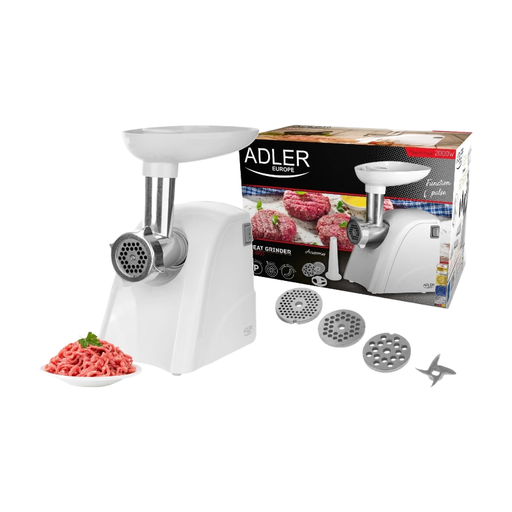
Why this product suits this profile: This model is designed for households that want to prepare minced meat and homemade sausages using a traditional meat grinder.
The specifications list 800 watts of rated power and 2000 watts of maximum power separately. They also include three perforated discs, a sausage filler and a pusher.
Three perforated discs, sausage-filling attachment, pusher and a housing designed for easy cleaning.
We have put together a complete, regularly updated list of products that fully meet these strict selection criteria and the safety regulations applicable in the EU.
For consistent results, cut meat into small, suitable pieces and chill it thoroughly before adding it. Tendons, bones, hard cartilage and frozen pieces should only be put into the appliance if the manufacturer expressly permits this. Use only the supplied pusher and never put your hands into the feed chute.
After use:
Choppers are also subject to their respective operating intervals. For example, the Bear QSJ-D03W5 is stated to have a maximum running time of 40 seconds, followed by a break. Information of this kind is more important for the motor’s service life than an isolated power rating.
A traditional meat grinder works with an auger, blade and perforated disc. It is designed for minced meat and often for sausage filling too. A food chopper uses rotating blades in a bowl and is more suitable for smaller quantities, vegetables, herbs or coarsely chopped meat.
There is no one-size-fits-all wattage. Compact appliances may be sufficient for occasional household quantities. For frequent use, rated power, permitted running time, overheating protection, materials and accessories should all be assessed together. Maximum wattage alone says little about continuous power.
That depends on how you plan to use it. If you only mince meat occasionally, you may not need a separate sausage filler. For regular sausage making, a suitable filling attachment, reverse function, several perforated discs and a design that can be easily dismantled are all practical features.