
Lieferung heute & morgen

Qualitätsgarantie

Willkommens-Angebote freischalten: KOSTENLOSE Lieferung | Bis zu 80 % RABATT | Kostenlose 30-Tage-JoyPlus-Testphase
App herunterladen
An electric motorbike for children can provide hours of varied outdoor fun in the garden, on a private driveway or on suitable paths. But there are significant differences between a slow ride-on motorbike with stabilisers and a more powerful electric dirt bike for children, including speed, seat height, weight and how it is operated.
Many poor buying decisions have little to do with the motor itself and more to do with unsuitable dimensions or unrealistic expectations about how the bike will be used. Parents and grandparents should pay particular attention to these three points:
An electric motorbike for children should be suited to your child’s riding ability and surroundings. For beginners aged around three to eight, a 12V children’s motorbike with a speed of around 5.5 to 6 km/h may be a good choice. These models are designed for slow riding and often come with stabilisers.
An electric dirt bike for children with a 250W or 350W motor, on the other hand, is intended for children who can already steer and brake confidently. Multiple speed settings allow you to increase the pace gradually. With more powerful models, parents should initially keep the bike on its lowest setting and supervise their child as they learn to use it on private, open ground.
It’s important to remember that the motor’s power rating in watts doesn’t determine how the bike will ride on its own. Gearing, tyre size, vehicle weight, controller and speed limiter all affect how it performs.
Your child’s feet don’t necessarily need to rest completely flat on the ground when they’re on a ride-on motorbike, but they must be able to control it safely. That’s why seat height and the distance between the seat, handlebars and footrests are key details to check.
Buyers should also look at the following:
Before buying, compare the manufacturer’s specifications for each model with your child’s actual height. An age recommendation such as ‘suitable for ages 3 to 6’ doesn’t guarantee that a particular model will be right for your child.
When choosing a battery-powered electric motorbike for children, consider both the voltage and capacity. A 36V battery with a capacity of 5Ah is equivalent to around 180Wh. This is a technical measure of capacity, not a guaranteed riding time. A heavier rider or frequent use of the highest speed setting will reduce how long the battery lasts.
Things to check:
Lithium batteries should be kept dry, protected from high temperatures and charged according to the manufacturer’s instructions. Keep chargers out of children’s reach. Before every ride, check the brakes, tyres, handlebars, fastenings and battery charge.
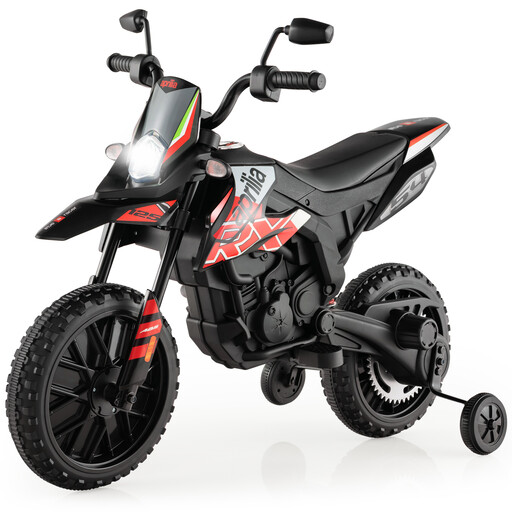
Why this product suits this type of rider: This model is listed as suitable for children aged around 3 to 8, reaches 5.5 to 6 km/h and has two removable stabilisers. That makes it a good choice for first rides on flat, private ground.
The low top speed reduces the risk of a beginner starting out on a bike that’s too fast. The stabilisers help make up for a lack of balance in the early stages.
12V battery, two motors, stabilisers and a stated playtime of 1 to 2 hours per charge.
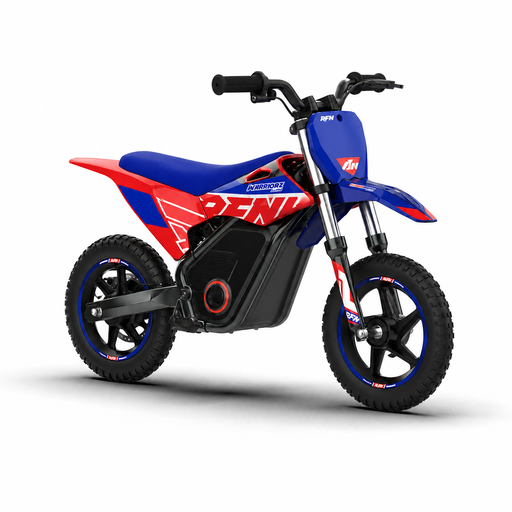
Why this product suits this type of rider: This 250W model has three speed settings of 8, 12 and 25 km/h, along with front suspension and a rear shock absorber. It’s a good fit for families looking to progress gradually from beginner to more advanced riding.
The three speed settings mean your only options aren’t standing still or going full speed. An emergency stop switch is listed as a safety feature.
36V 5.2Ah lithium battery, stated range of 18 km, rear disc brake and front and rear suspension.
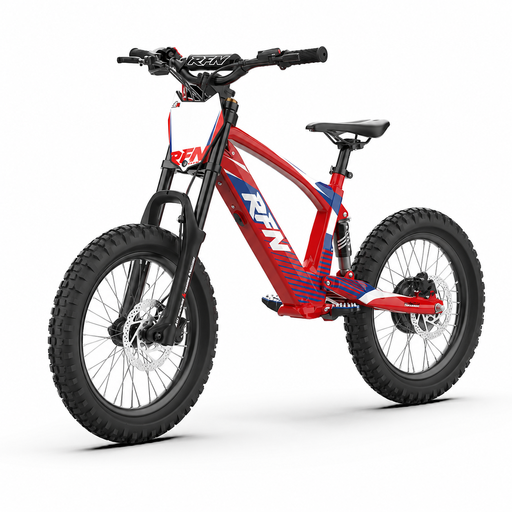
Why this product suits this type of rider: This 36V 500W model has 18-inch tyres, three speed settings and hydraulic brakes. It’s designed for experienced child riders, under close supervision and on suitable private ground.
The speed settings of 15, 22 and 30 km/h make it possible to match the pace to your child’s riding ability and the terrain. Check your child’s height, weight and ability to use the brakes before buying.
500W rated power, 180Wh battery, hydraulic front and rear brakes, mountain bike tyres and stated IP66/IP65 protection ratings for individual components.
We’ve put together a complete, regularly updated list of products that meet these strict selection criteria and the safety regulations in force in the EU.
It depends on the seat height, weight, speed and your child’s riding ability. Slow 12V models with stabilisers are often marketed for children from around three years old. More powerful off-road motorbikes for children with 250W or more should only be ridden by children who can steer and brake confidently. An adult should supervise every ride.
Battery life varies depending on the battery, speed setting, rider’s weight, surface and temperature. The 12V models mentioned are listed as offering 1 to 2 hours of playtime. Some 36V models are stated to have a range of 18 km or a run time of up to 80 minutes. These figures are based on specific conditions and are not a guaranteed riding time.
Electric motorbikes for children are generally intended for suitable private areas, such as gardens, driveways or designated leisure grounds. They can’t simply be used on public roads, pavements or cycle paths. Before your child rides, check local rules, the product labelling and the manufacturer’s safety information. Whatever the model, a helmet, sturdy footwear, suitable protective clothing and direct adult supervision are essential.