
Lieferung heute & morgen

Qualitätsgarantie

Willkommens-Angebote freischalten: KOSTENLOSE Lieferung | Bis zu 80 % RABATT | Kostenlose 30-Tage-JoyPlus-Testphase
App herunterladen
An electric motorcycle can be a practical alternative to a petrol motorcycle for commuters, city dwellers and riders travelling short to medium distances. Before buying, however, you should look beyond the motor power and range shown on the specification sheet. The vehicle category, documents, licence, battery design and your actual use in Germany are all crucial considerations.
A figure such as “up to 80 km” or “up to 115 km range” usually describes a test or comparison value. Rider weight, speed, inclines, outside temperature, tyre pressure and headwinds all affect the distance you can actually cover. If you travel 35 km each way every day, you should therefore avoid basing your calculations on the manufacturer’s maximum stated range.
For a realistic comparison:
A 3000W electric motorcycle is not automatically suitable for every rider or every road. Its legal classification is determined not only by the wattage, but also by factors including top speed, type approval and vehicle category.
An L1e electric scooter with a top speed of 45 km/h is treated differently from an L3e electric motorcycle capable of up to 80 km/h. An electric motorcycle with a top speed of 80 km/h will generally require the appropriate motorcycle licence category, registration and motor insurance. Before buying, you should therefore check the details in the COC and confirm that your driving licence covers the vehicle.
An electric motorcycle with a COC is not automatically ready to ride on public roads. The EU Certificate of Conformity supports the registration process, but it does not replace the required formalities.
Check the following after delivery:
Original documents should be stored safely. If anything is unclear, contact the registration office, insurer or seller for advice.
For urban traffic at 45 km/h, an L1e-B model may be sufficient. Depending on the vehicle and its national classification, licence category AM may be relevant, for example. For an electric motorcycle approved for road use in category L3e, such as one with a top speed of 80 km/h, A1, A2 or A will normally be required. The specific entitlement depends on your age, driving licence and the vehicle’s specifications.
A category B car licence does not automatically cover every electric motorcycle. The applicable legal requirements and the category documented in the COC are decisive.
A removable lithium battery makes charging at home, in the office or in a cellar easier. Beforehand, you should consider its weight, dimensions and suitable safe-storage options. With permanently installed batteries, a suitable power supply must be available at the parking location.
Look out for:
Hydraulic disc brakes on both the front and rear wheels are a sensible feature for heavier or faster vehicles. Full LED lighting, indicators, rear-view mirrors and a stable chassis are also important for everyday road use.
With a 2-seater electric motorcycle, the permitted total load must be suitable for your intended use. It is not just the seat area that matters, but also the load limit stated in the COC or vehicle documents.

Why this product suits the profile: Designed for urban traffic, this L1e model has a stated top speed of up to 45 km/h and features a removable 72-V/30-Ah lithium battery.
The product description states that an EU COC, VIN and invoice are included. The range of up to 90 km is expressly linked to defined conditions.
45 km/h, 2 seats, front and rear disc brakes, plus charging via the removable battery.

Why this product suits the profile: According to the product specifications, this L3e electric motorcycle combines 3000 W of power, a top speed of up to 80 km/h, a range of up to 115 km and two approved seats.
The product description lists the COC, VIN and the required vehicle documents. The range is stated as “up to”, so it should not be treated as a guarantee for everyday riding.
Hydraulic disc brakes, front and rear suspension, LED lighting, a removable lithium battery and a digital display.
Why this product suits the profile: This L3e model is an appealing option for longer commutes. It is specified with a 72-V/50-Ah battery, two seats and a range of up to 150 km at 40 km/h.
The test conditions for the stated range are specified. Before riding, you must clarify registration, the number plate, insurance and the appropriate driving licence.
3000-W motor, removable battery, disc brakes, two seats and an optional top box.
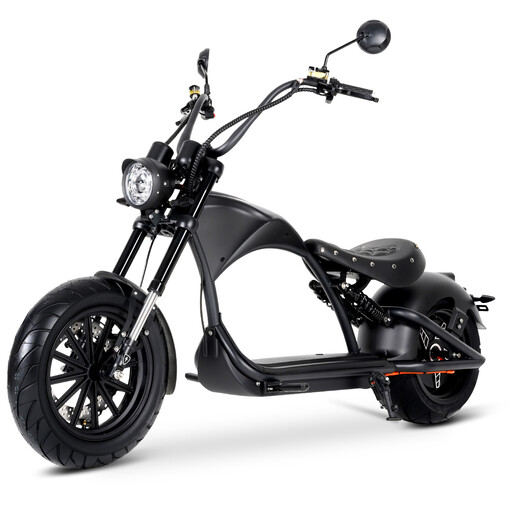
Why this product suits the profile: With 2000 W of power, a top speed of up to 45 km/h and a range of up to 80 km, the M1P is designed for everyday urban journeys.
The specifications include the battery, a charging time of 4 to 6 hours and COC documents. The range still depends on the conditions of use.
Hydraulic disc brakes, removable 60-V/30-Ah battery, 14-inch front wheel and a stated load capacity of up to 200 kg.
An electric motorcycle does not require engine oil and has fewer traditional drivetrain components than a combustion engine. Nevertheless, wear and additional costs still apply:
Information from providers about running costs, such as a specific amount per 100 km, should be treated as a guideline and not as a binding cost forecast.
We have put together a complete, regularly updated list of products that fully meet these strict selection criteria and the safety regulations applicable in the EU.
Energy costs depend on battery capacity, charging losses, your electricity tariff, speed and riding conditions. You should also factor in insurance, maintenance, tyres and any registration costs. A removable battery can simplify the charging setup, but it does not automatically change the overall cost.
Battery life depends on factors including charging cycles, temperature, state of charge, use and storage. Before buying, check the manufacturer’s warranty terms and battery cover. The battery should be charged in a dry, protected location and in accordance with the instructions in the user manual.
This depends on the vehicle category. An L1e model with a top speed of up to 45 km/h may fall under category AM. An L3e electric motorcycle with a top speed of 80 km/h will generally require an appropriate motorcycle licence, such as A1, A2 or A. Registration, a number plate, third-party insurance and a helmet may also be compulsory. The COC, German regulations and your individual driving entitlement are decisive.