
Lieferung heute & morgen

Qualitätsgarantie

Willkommens-Angebote freischalten: KOSTENLOSE Lieferung | Bis zu 80 % RABATT | Kostenlose 30-Tage-JoyPlus-Testphase
App herunterladen
An electric multi-cooker can combine an electric saucepan, mini rice cooker, electric hot pot, slow cooker and soup maker in one appliance. This saves space and is ideal for ramen, noodles, rice, soups, stews and steamed dishes. However, models vary considerably in capacity, heating power, controls and safety features.
As a Joybuy Product Recommendation Officer, I focus on reliable product data rather than marketing claims when making my selections. Before buying a multifunctional cooker, make sure you avoid these three common purchasing misconceptions.
A pot with a capacity of 1.6 l is not designed for large family portions. Liquids also generally should not be filled right to the brim. 1.6 l is practical for one person or small meals; depending on the recipe, couples may manage with 1.6 to 2.6 l. For several people, 5 l or 6 l is more suitable.
Higher power can speed up heating, but it says nothing about temperature control or even cooking. A small portable cooker with 600 W is designed for ramen, eggs or one portion of soup. A 5-l multi-cooker with 1,500 W is more suitable for hot pot, stews and several portions.
What matters is whether the power can be adjusted to suit the recipe. Variable control or several heat settings are more useful for gentle simmering and rapid boiling than a single maximum wattage figure.
A non-stick cooker makes cleaning easier, but it requires suitable kitchen utensils. Metal spoons and forks can damage the surface. Silicone or wooden utensils are more suitable. The electrical base, cable and controls must not be immersed in water. Also check whether the inner pot, lid and steaming insert can be removed.
The external dimensions are just as important as the volume. A 5-l appliance can measure around 37 × 31 × 24 cm, while a mini rice cooker requires considerably less worktop space. Measure your worktop, cupboard compartment and the clearance below wall units before buying.
Consider which functions you actually need. A 4-in-1 model, for example, can be used as a slow cooker, braiser and hot pot, as well as for boiling. A soup maker with pre-set programmes, on the other hand, is designed for specific cooking processes.
Useful features include:
A noodle cooker or portable cooker for student accommodation usually does not need an extensive selection of programmes. For regular family meals, more precise settings and a larger capacity can offer greater practical value.
For UK households, the stated 220–240 V and 50–60 Hz specifications should be compatible with the local power supply. Hot surfaces and steam are produced during operation. Place the appliance on a stable, heat-resistant surface and keep ventilation openings clear.
Boil-dry protection reduces the risk when there is too little liquid, but it does not replace supervision. Disconnect the multi-cooker from the mains before moving or cleaning it, and allow it to cool down completely.

Why this product suits this profile: This compact 1.6-l model is designed for ramen, noodles, eggs and small portions of soup. With 600 W and a portable design, it fits easily into student accommodation, office kitchens or small flats.
The clearly stated capacity helps prevent it from being misjudged as suitable for large meals. Automatic shut-off and boil-dry protection are listed as safety features.
1.6 l capacity, 600 W power, one-button operation and non-stick coating.
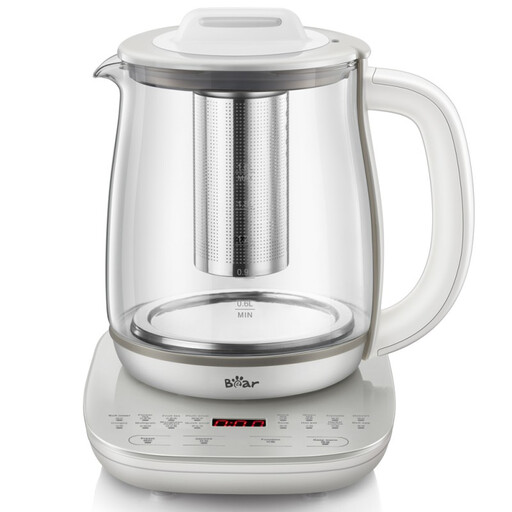
Why this product suits this profile: The glass vessel with stainless-steel components and 16 pre-set programmes is aimed at users who regularly prepare tea, soups, porridge or hot drinks using defined cooking processes.
The selection of programmes is clearly specified rather than described using only a general multifunction label. A wide opening makes filling and cleaning easier.
1.8 l capacity, 1,000–1,200 W, 16 programmes, borosilicate glass and 304 stainless steel inside.

Why this product suits this profile: This 5-l appliance is designed for family portions, hot pot, braised dishes and shared cooking. Variable power control allows you to switch between gentle cooking and rapid boiling.
The larger capacity reduces the risk of choosing a small appliance for several people. Boil-dry protection, a glass lid and a detachable cable are explicitly specified.
5 l capacity, 1,500 W, 4-in-1 function, variable power control and non-stick coating.
We have put together a complete, regularly updated list of products that fully meet these strict selection criteria and the safety regulations applicable in the EU.
Running costs depend on power, usage time and the electricity tariff. The simple calculation is:
Power in kW × operating time in hours × electricity price per kWh = cost
An appliance rated at 600 W uses 0.6 kWh during one hour of operation. A 1,500-W model theoretically requires 1.5 kWh during one hour, provided it runs continuously at full power. When simmering, the heating element may switch off intermittently or operate at a lower power level, depending on the model. Actual costs may therefore be lower than the rated power suggests.
It is not possible to give a reliable service-life estimate without standardised testing conditions. It depends, among other things, on the coating, heating cycles, cleaning and storage. To help extend the product’s service life:
Yes, provided the manufacturer expressly states that it is suitable for cooking rice. Not every model regulates the temperature automatically like a traditional rice cooker. Therefore, check the instruction manual, minimum fill level and keep-warm function.
For one person, 1.6 to 1.8 l is often sufficient. For two people, 1.8 to 2.6 l is practical. Families and users who regularly prepare hot pot or larger stews should consider appliances with a capacity of 5 l or more.
The cost depends on power, operating time and the electricity price. A 600-W model uses 0.6 kWh at full load for one hour, while a 1,500-W model uses 1.5 kWh. In practice, the heat setting, thermostat and actual cooking time all affect consumption.