Which type is right for you?

For cookery tutors teaching dough techniques

If your group will be rolling out sheets of dough, comparing thicknesses and then cutting ribbon pasta, a motorised roller keeps feeding the dough through the machine as a separate step. Imperia and Marcato describe the rollers and settings available on their respective machines.

For tutors running a cookery class alongside other preparation

If you want to spend less time handling dough while making the sauce and preparing other ingredients, a fully automatic machine can take care of mixing and kneading. Springlane and Philips describe machines and features for this purpose. Plan batch sizes according to the relevant manufacturers’ guidance.

For tutors who already own a stand mixer

If you already have a suitable stand mixer, first check that the model and attachment hub are compatible with the attachments you need. KitchenAid and Kenwood each specify requirements for their pasta attachments.

What should you look for when buying?

Fully automatic machine with a tagliatelle attachment

A good fit if: You want the machine to handle mixing and kneading, and need an attachment specifically identified as being for tagliatelle.

The trade-off: A compatible shaping attachment isn’t necessarily included with the base machine. A fully automatic machine also won’t teach participants how to roll out the dough.

Motorised dough roller

A good fit if: You want participants to feed dough sheets through the machine and learn about different thicknesses. Imperia says the Electric iPasta Classic has six thickness settings and a tagliatelle cutter.

The trade-off: Preparing the dough and feeding the sheets through the machine remain hands-on tasks. Marcato’s stated cutting shapes don’t specifically include tagliatelle.

Attachment for an existing stand mixer

A good fit if: You already own a compatible stand mixer and rolling out and cutting dough sheets are part of the class.

The trade-off: The model and roller attachment need to be compatible. KitchenAid lists fettuccine and spaghetti cutters, while Kenwood specifies a 6.5 mm fettuccine cut.

What you’re looking for What to check before buying Who it matters most to
Tagliatelle shape Check the shaping attachment and what’s included with the exact model; don’t assume accessories come as standard. If tagliatelle is a must-have for the class, I want to be sure the attachment and cut are right. Around 33% of consumers put a confirmed tagliatelle shape first.
Dough techniques Decide in advance whether the group will knead and roll the dough themselves or simply oversee the pressing process. If rolling out the dough and adjusting its thickness are learning objectives, the machine needs to allow for these steps. Around 27% of consumers prioritise dough techniques.
Batch sizes and class schedule Match the quantity per batch and number of batches to the machine and class recipe. Don’t confuse the manufacturer’s stated preparation time with the length of the whole class. If several groups will be cooking in turn, I want to be able to plan the changeovers between stations. Around 20% of consumers look first at batch size and workflow.
Cleaning Read the care instructions separately for the housing, cover, rollers and attachments. If there’s little time to tidy up after several batches, I want to know how each part can be cleaned. Around 7% of consumers put ease of cleaning first.
Existing stand mixer Check the model, attachment hub and required roller attachments together. If I already own a stand mixer, I’d rather use compatible attachments than plan for another base machine. Around 13% of consumers prioritise the equipment they already own.

What to watch out for when buying for a tagliatelle class

  • Assuming all ribbon pasta is tagliatelle

    Manufacturers use different names for their cutting attachments. Philips lists a compatible tagliatelle shaping attachment as an accessory, but compatibility doesn’t tell you whether it comes in a particular pack.

    Before buying, check the exact cut and what’s included with the model you’ve chosen.

    You may need to buy a compatible attachment separately, so check whether it comes with the base machine.

  • Buying a cutting attachment without the right machine or roller

    The Kenwood KAX981ME needs a lasagne roller attachment to roll out the dough first. The KitchenAid attachment requires a KitchenAid stand mixer.

    Check that your machine model and attachment hub are compatible, and that you have everything you need for the full process.

  • Mistaking the manufacturer’s stated times for the length of the whole class

    Philips’s stated preparation time is for 250 g of pasta. It doesn’t include portioning, additional batches or clearing up, so it shouldn’t be taken as the total time for a class.

    Plan the batches and schedule around the number of participants and the recipe you’ll be using.

Key brands at a glance

Springlane

The Nina is a fully automatic machine for which Springlane lists a tagliatelle attachment.

  • The manufacturer lists seven attachments and 200–600 g of flour per batch.
  • The stated preparation speed doesn’t indicate the total time needed for a cookery class; an independent review describes the scales as slow to respond.

Imperia

The Electric iPasta Classic is a motorised roller machine for making dough sheets and cutting pasta shapes.

  • According to the manufacturer, it has six thickness settings and a Duplex cutter described as suitable for tagliatelle and fettuccine.
  • Preparing the dough remains a separate step; the manufacturer’s information doesn’t state how much pasta it can make per hour for a class.

Marcato

The Atlasmotor+ combines a dough roller with a motor supplied with the machine.

  • Marcato lists ten thickness settings and says you can work freely with both hands.
  • The product description includes fettuccine and tagliolini, among other shapes, but doesn’t specifically mention tagliatelle.

Philips

The HR2665/93 is a fully automatic machine; the CP1442/01 tagliatelle shaping attachment is listed as a compatible accessory.

  • Philips describes automatic mixing and shaping.
  • The attachment’s compatibility doesn’t confirm that it’s included in a particular pack. The stated preparation time is for 250 g of pasta.

KitchenAid

The 3-in-1 attachment 5KSM3MPA uses a compatible KitchenAid stand mixer to roll and cut pasta.

  • The manufacturer lists eight thickness settings, along with fettuccine and spaghetti cutters.
  • You’ll need a compatible KitchenAid stand mixer, and a cut specifically described as tagliatelle hasn’t been confirmed.

Kenwood

The KAX981ME is a cutting attachment for compatible Kenwood stand mixers.

  • Kenwood specifies a 6.5 mm fettuccine cut.
  • According to the manufacturer, you’ll need a lasagne roller attachment to roll out the dough first. Different names on the product page don’t confirm a different cutting width.

Rommelsbacher

The Pastarella PM 220 is a fully automatic machine with built-in scales and controlled water dispensing.

  • The manufacturer states that it can make up to 800 g of fresh pasta per batch and includes seven shaping attachments.
  • The product description doesn’t identify any attachment specifically as being for tagliatelle.

Joybuy products for this topic

The Joybuy products below include attachments for compatible stand mixers and electric pasta machines. If tagliatelle is a must-have for your class, check the cut and what’s included with each model carefully.
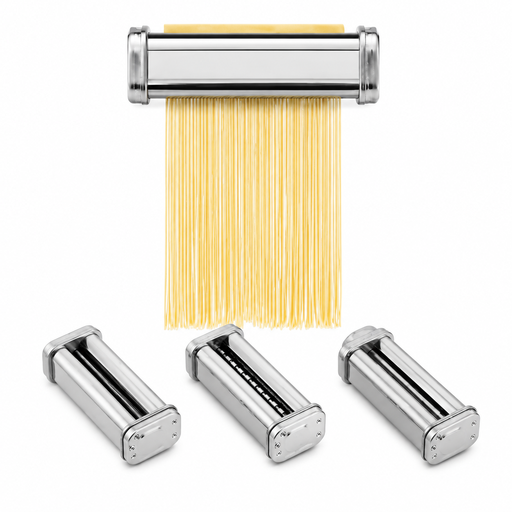
Three-piece pasta attachment set for KitchenAid stand mixers

Three-piece pasta attachment set for KitchenAid stand mixers

For a class with an existing KitchenAid stand mixer, where you want to use dough rollers and cutting attachments.

The set is described as including three rollers and cutters for fettuccine, lasagne and angel hair or spaghetti. A KitchenAid stand mixer is required; this set isn’t confirmed as having a tagliatelle attachment.

View at Joybuy

FOHERE electric pasta machine with seven thickness settings

FOHERE electric pasta machine with seven thickness settings

For a class where participants will roll out sheets of dough and choose between different thicknesses.

The description lists seven settings from 0.5 to 3 mm and two cutting attachments. The parts should be cleaned with a dry cloth and brush, and must not be immersed in water; a tagliatelle attachment isn’t specifically confirmed.

View at Joybuy

Automatic electric pasta maker with nine shaping attachments

Automatic electric pasta maker with nine shaping attachments

For a class where the machine will mix and shape the pasta instead of participants rolling out the dough by hand.

The machine is described as having nine attachments and a mixing and pressing process; fettuccine is listed as one of the pasta shapes. Check first whether any of the attachments is specifically intended for tagliatelle.

View at Joybuy

Automatic electric pasta maker, 180 W

Automatic electric pasta maker, 180 W

For a class where pasta will be pressed in smaller batches.

The description gives a maximum dough quantity of 200 g per batch. The main unit should be wiped clean rather than rinsed; check the care instructions against your planned class schedule.

View at Joybuy

Frequently asked questions

Is a fettuccine cutter automatically a tagliatelle cutter too?

No. If your class specifically requires tagliatelle, check the cut of the exact attachment. Manufacturers use different names for different machines, and Kenwood’s descriptions aren’t entirely consistent.

Do I have to prepare the dough myself when using a motorised roller?

Yes. With a motorised roller, preparing the dough and feeding the sheets through the machine remain separate tasks. According to the manufacturer, a fully automatic machine such as the Springlane Nina also takes care of kneading.

Can I put the whole pasta machine in the dishwasher?

No. The fact that individual removable parts are dishwasher-safe doesn’t mean the whole machine is. For the HR2665/93, Philips excludes the front cover and accessories from its dishwasher-safe claim. Check the care instructions for your exact model.

What happens if a product develops a fault after purchase in Germany?

Statutory consumer rights are generally exercised against the seller and are separate from a voluntary guarantee. If a product is faulty, you should first ask the seller to remedy the problem. The Verbraucherzentrale explains the difference.

Which EU rules apply to electric pasta machines and parts that come into contact with food?

Electrical equipment must comply with the relevant EU product rules. CE marking is required when the applicable harmonised rules require it, but it isn’t an independent quality mark. Materials and articles intended to come into contact with food must meet the applicable requirements of Regulation (EC) No 1935/2004. Your Europe and the European Commission explain these rules.