What should you look for when buying?
If you’re making spaghetti in batches, assess batch size, cleaning, safe storage, the workflow you want and compatibility with equipment you already own separately.
| What matters |
What to check before buying |
Who will find this most important? |
| Amount per batch |
Check whether the figure refers to the flour capacity or the weight of the finished pasta, and whether a spaghetti attachment is included with the specific model. |
If I’m preparing several meals, I want to know how much finished pasta I’ll actually get per batch. That’s why around 28% of consumers put usable batch size first. |
| Cleaning between batches |
Read the care instructions for the auger, shaping discs, kneading hook, container and lid individually. |
If I make pasta often, I want to factor in the work involved in cleaning the parts that come into contact with the dough. Around 22% of consumers prioritise cleaning after use. |
| Safe storage |
Plan how you’ll store individual portions and make sure you have enough fridge or freezer space. The German Federal Institute for Risk Assessment explains that chilling slows or stops the growth of most bacteria. |
If I want to eat fresh pasta later, I plan how to store it safely at the same time. Around 22% of consumers put safe food storage first. |
| Making your own dough |
Distinguish between a fully automatic machine that processes ingredients and extrudes pasta, and a roller that rolls out and cuts dough you’ve already prepared. |
If I want to make the dough myself and have more control over how it’s worked, I’ll look for a motorised roller rather than as much automation as possible. Around 17% of consumers prioritise having control over making the dough. |
| Compatibility and accessories |
Check the connection on your specific stand mixer and whether the spaghetti cutter is included with the set you’re considering. |
If I already own a stand mixer, I want to make sure the attachment and connection are compatible before buying. Around 11% of consumers put compatibility with their existing equipment first. |
Joybuy products
This selection includes electric appliances for making spaghetti and a motorised roller attachment. The attachment requires a compatible stand mixer.
 No image available
FOHERE electric pasta maker with seven thickness settings
For anyone who wants to choose the dough thickness and cut spaghetti.
The product description lists seven thickness settings and two cutting attachments, including one for spaghetti. Wipe the surfaces dry and clean the blades with a brush; do not immerse the appliance in water.
View at Joybuy
 No image available
Electric home pasta maker with nine shapes
For anyone looking for an electric appliance that can make spaghetti and several other pasta shapes at home.
The product title lists nine shapes; the description says the machine prepares the dough before extruding it.
View at Joybuy
 No image available
Automatic electric pasta maker, 180 W, with nine shapes
For anyone who wants to make different noodle and pasta shapes using an electric appliance.
The product title lists 180 W and nine interchangeable shaping discs; the description says the dough is prepared electrically.
View at Joybuy
 No image available
BEAR pasta maker YMJ-K40Z7
For anyone who wants to make spaghetti and other pasta shapes in smaller batches of dough.
The product description gives a maximum of 200 g of dough per batch and lists five shaping discs. Wipe the main unit clean; do not rinse it with water.
View at Joybuy
 No image available
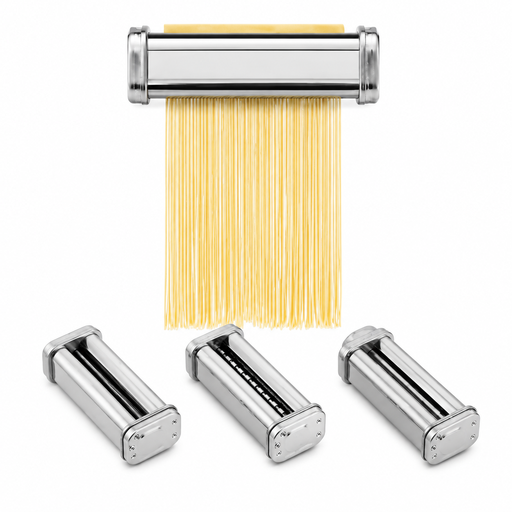
Three-piece pasta attachment for compatible KitchenAid stand mixers
For anyone who wants to roll and cut spaghetti using a compatible KitchenAid stand mixer.
The product description lists three rollers or attachments, including one for spaghetti. This attachment isn’t a standalone machine and requires a compatible stand mixer.
View at Joybuy
Frequently asked questions
Can I compare a flour capacity of 600 g with 800 g of finished pasta?
No. Springlane gives Nina a flour capacity of 200–600 g, while Rommelsbacher says the PM 220 makes up to 800 g of finished pasta per batch. Only compare figures that refer to the same measurement; these figures alone don’t allow a direct comparison of output.
Can all parts of a pasta maker go in the dishwasher?
No, it depends on the model and the individual part. According to Rommelsbacher, several PM 220 accessories, including the auger and shaping discs, need to be cleaned by hand; Philips’ instructions list exceptions for the HR2665/93. Always follow the care instructions for the specific version.
How should I store fresh spaghetti if I want to eat it later?
Plan to refrigerate or freeze it safely rather than assuming it will keep at room temperature. The German Federal Institute for Risk Assessment explains that chilling slows or stops the growth of most bacteria; this doesn’t establish a universal shelf life for every homemade recipe.
What should I check about CE marking and food contact?
EU rules on food-contact materials also cover food-processing equipment. Whether CE marking is required depends on whether the harmonised EU rules that apply to the specific appliance explicitly require it; the EU’s information on CE marking explains this limitation.
Does a manufacturer’s guarantee replace your statutory rights?
No. According to consumer information from the European Union, when you buy from a business seller within the EU, you have a statutory guarantee of at least two years from the date you receive the goods. A voluntary manufacturer’s guarantee is separate.


