What to look for when buying
For a weekend class, your choice will mainly depend on whether participants will be practising dough techniques or you’d prefer to prepare several batches with less hands-on work.
| Priority |
What to check before buying |
Who it matters most to |
| Teaching practical techniques |
Check whether the roller and spaghetti cutter are included with the specific machine or set. |
If participants are going to roll and cut the dough themselves, I want to teach them these techniques during the class. Around 33% of consumers put learning dough techniques first. |
| Planning batches |
Compare quantities using the same measurement; don’t compare flour weight directly with the weight of finished pasta. |
For several groups, the quantity per batch needs to suit the recipe and timetable. Around 27% of consumers say batch planning is their top priority. |
| Reducing hands-on work |
Check which steps are automated on the exact model and whether a spaghetti attachment is included. |
If I need to teach at the same time, I want to spend less time mixing and shaping the dough myself. Around 20% of consumers prioritise automation. |
| Planning for cleaning |
Follow the cleaning instructions for each removable part; don’t assume that dishwasher suitability applies to the main unit. |
Between groups, I want to clean attachments quickly and plan changes carefully. Around 20% of consumers share this priority. |
Key brands and product ranges
The main difference between the product ranges below is whether the class focuses on dough techniques or automated preparation.
Springlane
Nina is a standalone pasta maker with a kneading function and, according to Springlane, an included spaghetti attachment.
- Springlane gives a flour capacity of 200–600 g; this refers to flour, not finished pasta.
- Springlane says the removable parts are dishwasher-safe.
- An automatic machine takes care of hands-on dough preparation, so it won’t replace practising with a roller.
Rommelsbacher
The PM 220 Pastarella is a standalone automatic machine with scales and controlled water dispensing.
- Rommelsbacher states that it makes up to 800 g of finished pasta per batch. The manual lists three spaghetti dies.
- The manufacturer’s recommendation of at least 200 g of flour for a smooth mixture applies to this model and is not a general minimum quantity.
- The dies must be cleaned according to the instructions.
Marcato
According to Marcato, Atlasmotor+ combines a dough roller with an included motor and spaghetti accessories.
- The roller is a good fit for a class where participants feed prepared dough through the machine and cut it themselves.
- Preparing and kneading the dough are still separate steps. Check compatibility when pairing individual motors with older rollers.
KitchenAid
The 5KSM3MPA is a rolling and cutting attachment for a compatible KitchenAid stand mixer, not a standalone pasta maker.
- KitchenAid lists eight roller thickness settings and integrated cutters for spaghetti and fettuccine.
- You’ll need a compatible stand mixer to use the attachment, and you’ll have to prepare the dough separately.
Philips
The 7000 Series HR2665/93 is a standalone pasta maker with mixing, weighing and extrusion functions.
- Philips states that it makes up to eight portions from 800 g of pasta, and takes under ten minutes to prepare 250 g of pasta.
- Philips notes that the number of shaping discs varies by model. Check the items included with the HR2665/93 to see whether it comes with a spaghetti attachment.
Joybuy products for your class
This selection includes automatic pasta makers, a motorised roller and an attachment for working with prepared dough.
 No image available
FOHERE electric pasta roller with 7 thickness settings
For a class where participants will roll and cut the dough themselves; the product description says the roller is powered by a 60 W motor.
It has seven thickness settings from 0.5 to 3 mm, plus two cutting attachments for noodles measuring 1.5 and 6.6 mm wide.
View at Joybuy
 No image available
Electric pasta maker with 9 shaping discs
For a class where you’d like the machine to take care of more of the preparation; the product description lists automatic mixing and shaping.
Nine shaping discs are listed as included. Check whether one of them is the spaghetti attachment you need before buying.
View at Joybuy
 No image available
Electric pasta maker with 9 shaping discs, 180 W
For a class where you want to automate more of the dough preparation; the product description lists mixing and kneading.
It is rated at 180 W and comes with nine interchangeable shaping discs. Check the specific package contents for a spaghetti disc.
View at Joybuy
 No image available
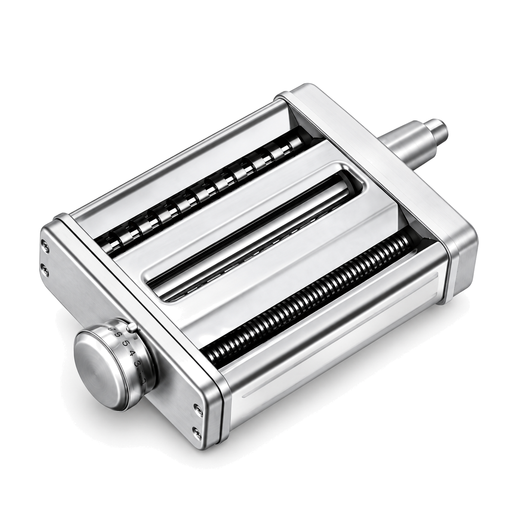
FOHERE 3-in-1 pasta attachment for KitchenAid stand mixers
For working with prepared dough, if you have a compatible KitchenAid stand mixer.
The product description lists a dough roller with eight thickness settings, plus spaghetti and fettuccine cutters.
View at Joybuy
 No image available
BEAR YMJ-K40Z7 electric pasta maker
For planning smaller batches, the product description states a capacity of up to 200 g of dough per batch.
Five shaping attachments and spaghetti options are listed. According to the product information, the main unit must not be rinsed; clean it with a soft cloth instead.
For charging, the product information specifies a 5 V adapter rated at 1 or 2 A and warns against chargers with very high voltage or current.
View at Joybuy
Frequently asked questions
What should be ready before the first batch of spaghetti for a class?
For a roller, prepare the dough and check that the exact set includes a spaghetti cutter. For an automatic machine, choose the recipe, suitable die and batch size by following the instructions; the Rommelsbacher PM 220 manual lists three spaghetti dies.
Can all parts of a pasta maker go in the dishwasher?
No, it depends on the model and the individual part. Springlane says Nina’s removable parts are dishwasher-safe; Philips excludes the front cover from its equivalent claim for the HR2665/93. For the PM 220 dies, Rommelsbacher recommends cleaning them with water, washing-up liquid and a cleaning tool. Unplug the main unit before cleaning it.
Who should I contact if there’s a fault?
According to Your Europe, if you buy as a consumer from a business seller, you have at least two years of legal guarantee rights against the seller, starting from the date you receive the goods. This is separate from any voluntary manufacturer’s guarantee. Whether a machine bought for a commercially run class is covered by consumer law depends on the specific purchase.
What requirements matter when buying an electric pasta maker in Germany?
Electrical equipment covered by relevant harmonised EU legislation must carry the required CE marking before it can be placed on the market. The European Union’s Your Europe website explains that the marking represents the manufacturer’s declaration and is not an independent quality mark. EU requirements for food contact materials also apply to parts that come into contact with dough or pasta during normal use, as summarised by EUR-Lex.


