If you want to control the thickness of your ravioli sheets yourself during a class, a motorised pasta roller is a good place to start. It rolls out prepared dough, but won’t mix, fill or seal it for you. If you already own a compatible KitchenAid stand mixer, a motorised roller attachment may be all you need. An automatic pasta maker is a better fit if automatic mixing matters more to you than rolling the dough out in stages. For presses, check that the right shaping attachment is compatible and included.
Which type is right for you?
For anyone filling their own ravioli
If you want to roll out the sheets and control their thickness yourself during a class, a motorised roller is designed for that step. Marcato, Imperia and Ariete describe their respective models as rollers with multiple thickness settings.
For classes with several batches of dough
If you’re planning several batches, consider whether rolling the dough repeatedly or mixing it will take up more time. Ariete says the Pastamatic 1593 can run continuously for up to an hour, while Springlane and Philips describe automatic preparation steps for their pasta makers.
For KitchenAid stand mixer owners
If you already own a compatible KitchenAid stand mixer, the 5KSMPSA roller attachment could be an alternative to buying another stand-alone appliance. KitchenAid lists eight thickness settings for the attachment.
What should you look for when buying?
Stand-alone motorised roller
A good fit if: you want to roll out prepared dough during a class and adjust the thickness of the sheets.
Bear in mind: mixing, filling and sealing are separate steps, and features and cleaning requirements vary by model.
Roller attachment for a stand mixer
A good fit if: you already own a compatible KitchenAid and want to use it to roll out pasta sheets.
Bear in mind: the attachment can’t be used on its own without a compatible stand mixer.
Pasta press with a shaping attachment
A good fit if: automatic mixing and pressing out sheets matter more to you than a roller with adjustable thickness settings.
Bear in mind: check that the attachment for your exact model variant is actually included.
| What to consider |
What to look for |
Who should pay particular attention |
| Control over the pasta sheets |
Check whether the machine has a roller with adjustable thickness settings or a shaping attachment that’s explicitly compatible. The number of settings tells you how many adjustments are available, not how good the results will be. |
If I’m making my own ravioli, I want to roll the sheets to suit each step. Around 36% of consumers say this is their main concern. |
| Batches and workload |
Plan how many batches you’ll need based on the recipe and number of participants. Compare quantities only when they use the same reference measure, and check the operating instructions for the exact model. |
If several people need dough one after another, I want to know whether rolling it out or preparing it will set the pace. Around 29% of consumers say batches and time are their main concerns. |
| Drive and compatibility |
Check the attachment’s full model number against the manufacturer’s compatibility information and the stand mixer you already own. |
If I want to keep using my existing stand mixer, the attachment must be compatible with it and not be mistaken for a stand-alone appliance. Around 21% of consumers say this is their main concern. |
| Cleaning after the class |
Read the instructions for the roller body and each removable part separately. Approval for individual parts doesn’t automatically apply to the whole appliance. |
If there’s little time for cleaning up after cooking together, I want to know in advance how the appliance can be cleaned. Around 14% of consumers say cleaning is their main concern. |
Common assumptions to avoid
-
Assuming a lasagne sheet is the same as a roller with adjustable settings
A press with a shaping attachment and a roller with thickness settings do different jobs. An attachment shown in a product listing isn’t necessarily included with every variant.
First decide whether you want to roll out dough or mix it and press it into sheets. Then check the full model code and exactly what’s included.
Depending on the model, you may need to buy a compatible shaping attachment separately. Check before you buy.
-
Assuming a roller attachment is a stand-alone appliance
The KitchenAid 5KSMPSA is powered by a compatible stand mixer and can’t be used as a stand-alone appliance.
Before deciding, check that you already have a compatible stand mixer and that the attachment works with it.
-
Assuming a general dishwasher claim applies to the roller
KitchenAid says not to clean the 5KSMPSA pasta roller in the dishwasher. Always follow the specific manufacturer’s instructions for this part.
Clean the roller according to the manufacturer’s instructions, and don’t assume that guidance for removable parts applies to the whole appliance.
Key brands at a glance
Marcato
The Atlasmotor+ is a stand-alone motorised roller for prepared dough.
- Marcato lists a motor, a lasagne function and ten thickness settings. According to the manufacturer, it can be used on a flat surface without a table clamp.
- The machine doesn’t mix or fill the dough. Marcato says Atlas products must not be cleaned under running water or in a dishwasher.
Imperia
The Electric iPasta Classic is a stand-alone motorised roller.
- Imperia lists six thickness settings, a PastaFacile motor, a worktop clamp and a Duplex cutter.
- These features don’t indicate that it prepares dough automatically or fills ravioli.
Ariete
The Pastamatic 1593/00 combines an electric roller with a hand crank.
- Ariete lists nine thickness settings, two motor speeds with a pulse function and up to one hour of continuous operation.
- These details apply to model 1593/00. Filling and shaping the ravioli are still separate steps.
KitchenAid
The 5KSMPSA is a roller attachment for KitchenAid stand mixers.
- KitchenAid lists eight thickness settings for the attachment.
- It isn’t a stand-alone motorised appliance, and KitchenAid says not to clean the pasta roller in the dishwasher.
Springlane
According to the manufacturer, Nina is an automatic pasta maker supplied with a lasagne insert in its seven-piece set.
- Springlane lists 200–600 g of flour per batch and says the removable parts are dishwasher-safe.
- This information about removable parts doesn’t mean the whole appliance is dishwasher-safe. Nor does it confirm that the machine has a roller with adjustable thickness settings.
Philips
The 7000 Series Pastamaker HR2665/93 is a press option with automatic preparation steps.
- Philips lists automatic mixing and weighing; the portion estimate is based on 800 g of pasta. A lasagne/wonton shaping attachment with a 0,8 mm setting is listed for the 7000 Series.
- The accessory list for attachment CP1451/01 refers to HR2660/00 and doesn’t confirm that it’s included with HR2665/93. Nor does it confirm that the machine has an adjustable roller.
Related products from Joybuy
The following Joybuy products include electric pasta makers and attachments for existing KitchenAid stand mixers. For each model, check that it suits the job you have in mind and what’s actually included.
 No image available
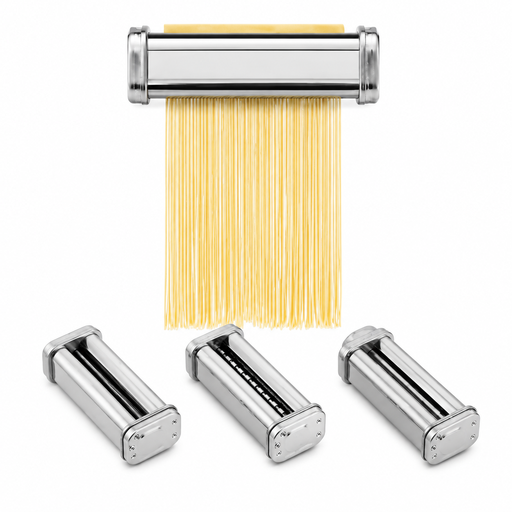
3-piece pasta attachment set for KitchenAid stand mixers
An option if you already own a compatible KitchenAid stand mixer and want an attachment rather than a stand-alone appliance.
Listed as a 3-piece set; requires a compatible KitchenAid stand mixer.
View at Joybuy
 No image available
FOHERE electric pasta maker with 7 thickness settings
A stand-alone electric pasta maker for anyone looking for adjustable dough thickness.
The product name lists seven thickness settings. According to the product information, wipe the housing with a dry cloth and don’t immerse it in water.
View at Joybuy
 No image available
Electric pasta maker with 9 shaping discs
An option if you want an electric machine with shaping discs for extruding dough, rather than a roller with adjustable thickness settings.
The product name lists nine shaping discs. The product description says it prepares dough automatically and can be used to make dumpling wrappers.
View at Joybuy
 No image available
180 W electric pasta maker with 9 shaping discs
Another press option if you’re looking for an electric machine with interchangeable shaping discs rather than a roller.
The product name lists 180 W and nine interchangeable shaping discs. The product description includes dumpling wrappers as one possible shape.
View at Joybuy
 No image available
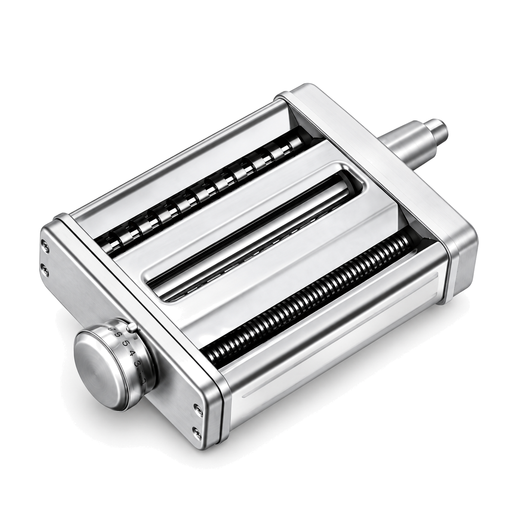
FOHERE 3-in-1 pasta attachment for KitchenAid stand mixers
An option if you already own a compatible KitchenAid stand mixer and want a roller attachment for making pasta sheets.
The product name lists a lasagne roller and fettuccine and spaghetti cutters. Requires a KitchenAid stand mixer.
View at Joybuy
Frequently asked questions
Does an electric pasta roller make ready-to-eat ravioli?
No. The rollers described here make pasta sheets; filling and sealing them are separate steps. Also check whether any separately sold ravioli attachment is actually compatible with your model and included with it.
Which type should I choose if I want to roll out my own ravioli sheets?
A motorised roller is designed for rolling out prepared dough at an adjustable thickness. A stand mixer attachment is an option if you already own a compatible mixer; a press is a better fit if automatic mixing and extruding sheets matter more to you.
How should I clean a pasta roller after a cooking class?
Follow the instructions for the specific model and part. Marcato says Atlas products must not be washed under running water or in a dishwasher; KitchenAid says not to clean the 5KSMPSA pasta roller in a dishwasher.
Does a weekend cooking class need to be registered as a food business?
Not simply because it’s called a “cooking class”. According to the Federal Portal, food businesses that produce, process or distribute food must register with the local food safety authority. Whether this applies to a particular class depends on how it is actually organised.
What product requirements should I check for an electric pasta maker?
Check which EU rules that apply to the specific appliance require CE marking, and whether the parts that come into contact with dough must meet the requirements of Regulation (EC) No 1935/2004 on materials intended to come into contact with food. CE marking is not a certificate issued by a central EU body, nor does it by itself prove that a product has been independently tested.


