
Lieferung heute & morgen

Qualitätsgarantie

Willkommens-Angebote freischalten: KOSTENLOSE Lieferung | Bis zu 80 % RABATT | Kostenlose 30-Tage-JoyPlus-Testphase
App herunterladen
An electric ride-on car for children combines independent movement with play. Models with batteries, music or illuminated wheels may look similar at first glance, but they can differ significantly in terms of drive system, controls, age suitability and maintenance. If you focus only on eye-catching colours or a long list of features, it is easy to overlook important details.
A battery-powered children’s vehicle can offer different running times depending on the model. The voltage is not the only important factor: the battery type, charging instructions, charging time and availability of replacement parts also matter. A 12V system is a technical specification, but it does not by itself indicate the running time or speed.
The Neuleb model mentioned uses a rechargeable 12V battery. According to the product description, the charger must not be connected before switching the vehicle on. After activation, the battery should be charged at least once a week. The indicator light is red while charging and turns green when charging is complete.
A ride-on car with illuminated wheels does not necessarily light up when it is pushed or rolling slowly. According to the manufacturer’s information, the Neuleb model’s lighting is activated by magnetic self-generation. At low speeds or while coasting, the lights may remain off. This is an intended feature of the design, not automatically a fault.
If the vehicle will mainly be used in the living room, check whether the wheels can reach sufficient speed on the available flooring. Carpets, door thresholds and uneven surfaces may further restrict how it can be used.
A tip-proof ride-on toy should have a broad, stable construction and straightforward controls. However, the term “Anti-Rollover” in a product description does not replace checking the actual conditions in which the vehicle will be used. Even a vehicle with design features intended to prevent tipping should only be used on level surfaces and under supervision.
Before buying, compare the age recommendation, maximum load, dimensions, recommended surfaces and safety instructions. The child should be able to access and steer the vehicle safely and independently.
An electric Wiggle Car is often steered using a side-to-side or rocking movement. The Neuleb Electric Wiggle Car has a stated maximum speed of 3.2 mph, or approximately 5.1 km/h. This is considerably slower than many motorised vehicles for older children, but the child still needs enough space to brake and avoid obstacles.
Look for:
The stated load capacity of 160 lb is approximately 72.6 kg. This figure describes the product specification and should not be taken as a recommendation to use the vehicle beyond its intended age range.
A ride-on car from 3 years is not automatically suitable for every three-year-old. Height, coordination and understanding of the controls are also important. The child should know how to steer, stop and avoid obstacles.
Products for younger children are not interchangeable with an electric ride-on. The Chicco Happy Hippy Walker, for example, is intended for children aged 9 to 24 months and serves as a baby walker and activity centre. It is not an electric ride-on car and is therefore not suitable for use by children aged 3 and over.
A children’s vehicle with Bluetooth music can connect to a compatible smartphone or audio device. According to the Neuleb model’s product description, Bluetooth pairing is supported by an audible signal. The USB port is intended for playing music from a USB stick and is not for charging.
Before buying, consider whether music is really needed all the time. The volume, controls and duration of use should be suitable for the surroundings, particularly in living rooms or blocks of flats.
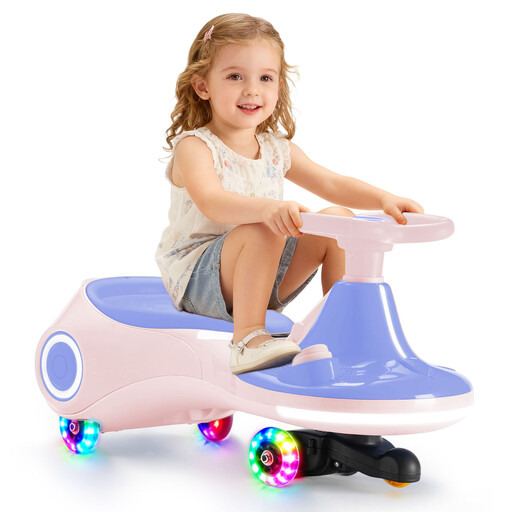
Why this product suits this profile: The combination of a 12V battery, pedal and rocking function offers several ways to operate the vehicle, making it a versatile entry-level model for families.
The product description specifies the battery, charging indicator and practical advice for resolving starting problems. This can help prevent basic operating errors during assembly and charging.
12V battery, 3-in-1 concept with pedal and stated top speed of 3.2 mph.
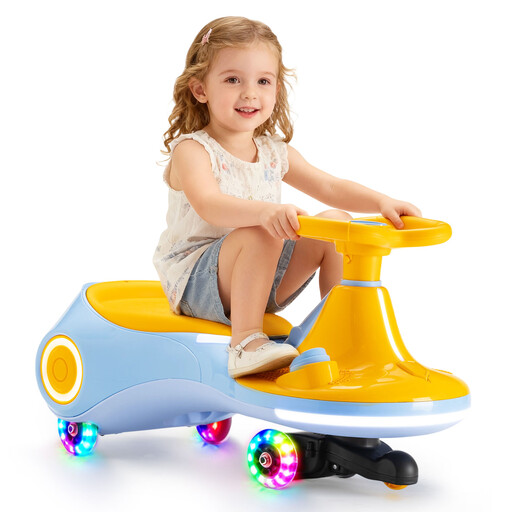
Why this product suits this profile: This option is appealing to buyers who want to consider features such as music, lighting and assembly in addition to the basic function.
The description clearly distinguishes the USB function from charging and explains that the illuminated wheels only become active once sufficient speed has been reached.
Bluetooth support, music control at the touch of a button and magnetically generated lighting on the wheels.
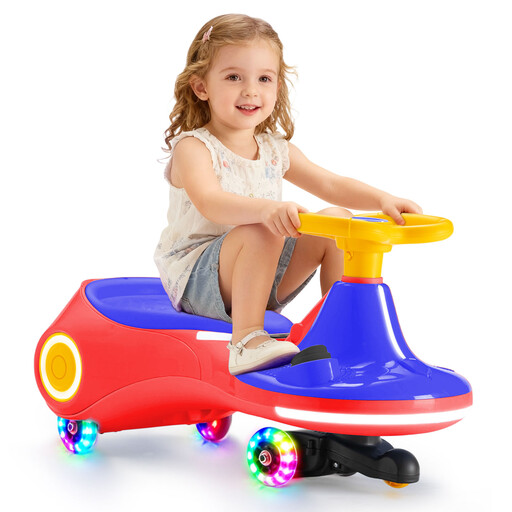
Why this product suits this profile: The 3-in-1 design is suitable for families looking for a vehicle that supports different types of play and regular use on level surfaces.
The instructions on fitting the steering wheel, the V-shaped seal and checking the plug connections provide practical checkpoints for repeated use.
3-in-1 concept, rechargeable battery and stated Anti-Rollover construction according to the product description.
For products bearing the CE mark, buyers should also check the information about the manufacturer, importer, age recommendation and relevant safety standards such as EN 71 or EN IEC 62115. A CE mark alone does not replace checking the product information.
We have put together a complete, regularly updated list of products that fully meet these strict selection criteria and the safety regulations applicable in the EU.
It is not possible to give a reliable fixed running time without information about battery capacity, charging time, surface and load. Cold temperatures, inclines, frequent starts and heavier loads can reduce the running time. Regular charging in accordance with the manufacturer’s instructions and dry storage help support the intended use.
This depends on the dimensions, flooring and available space. In principle, a 12V ride-on car can be used indoors on smooth, level surfaces. However, you should first consider furniture, door thresholds and delicate flooring. The wheel lighting may not activate during slow indoor use.
The ongoing electricity costs depend on the battery capacity, charging frequency and electricity tariff. With a small 12V battery, the charging costs alone are generally lower than those of larger electric vehicles. Additional costs may arise if the battery, charger or wheels need replacing. That is why information about replacement parts and correct battery care are important buying criteria.