
Lieferung heute & morgen

Qualitätsgarantie

Willkommens-Angebote freischalten: KOSTENLOSE Lieferung | Bis zu 80 % RABATT | Kostenlose 30-Tage-JoyPlus-Testphase
App herunterladen
An electric ride-on vehicle for children can provide varied entertainment in the garden, courtyard or suitable private areas. However, product images and advertising claims do not always show whether a model is suitable for the child’s age, body weight and intended location. Three common misconceptions particularly often lead to an unsuitable purchase:
The manufacturer’s age recommendation is only a starting point. Also check the maximum load capacity, seat width and dimensions. A two-seater children’s ride-on vehicle is practical for siblings, but requires sufficient space for turning and storage. When two children are riding, their combined weight should remain below the stated load limit.
An electric ride-on vehicle for children aged 3 and over should offer a low, controllable speed and simple operation. For older children between 5 and 12, electric scooters with several speed settings may also be suitable, depending on the model. Height and motor skills are just as important as chronological age.
A 12V electric car for children is often suitable for paved paths, indoor areas and level garden surfaces. Two motors can improve power transmission to the wheels, but the surface, incline and total weight remain decisive factors. The stated speed of the two-seaters featured here is 3 to 8 km/h.
A 24V model may be designed for a different type of use. The RICTOR C8, for example, is specified with a 120W motor, a 24V battery and three speed settings of 5, 10 and 15 km/h. A lower setting should be selected for younger children. App control is only useful if parents can understand how to operate it and consistently use the speed limiter.
Look for specific, verifiable features in a children’s ride-on vehicle with a safety belt:
With a children’s ride-on vehicle with remote control, the radio connection should be checked before first use. The remote control is not a substitute for supervision. The vehicle should only be used on suitable private land and in accordance with the manufacturer’s instructions; public roads and pavements are generally not the intended place of use.
Battery life and charging time depend on load, temperature, speed and surface. The stated figures should therefore be understood as manufacturer specifications. Before buying, you should also check whether replacement batteries, a charger and remote-control batteries are available.
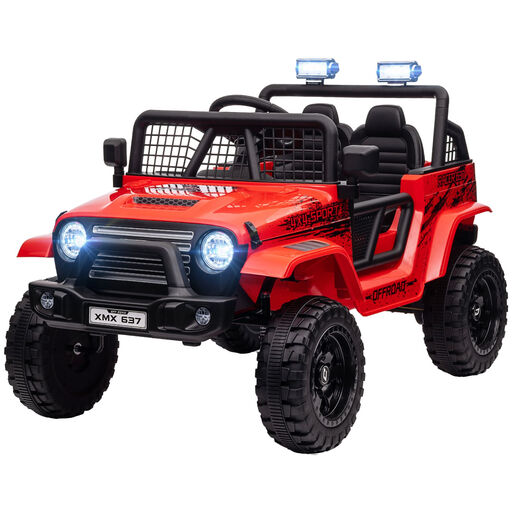
Why this product suits this profile: According to its product name, this 12V children’s Jeep is intended for children aged 3 to 7 and combines two drive motors with remote control, lights, music and a safety belt.
The stated age range and 12V drive system make it easier to narrow down your options. The remote control allows parents to take control instead of relying solely on the child to operate the vehicle.
12V dual drive, remote control, lights, music and safety belt according to the product description.
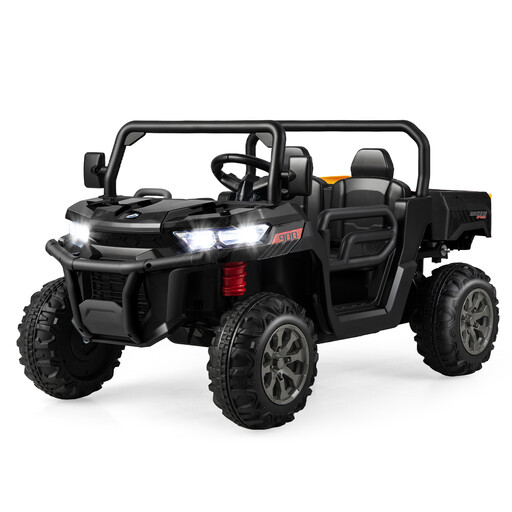
Why this product suits this profile: This two-seater is designed for two smaller children and specifies a load capacity of 50 kg, two motors, suspension and a 2.4 GHz remote control with three speed settings.
Rather than making a general claim about off-road capability, the product description specifies four large wheels, suspension, material details and precise dimensions of 119 × 68 × 65 cm.
Two seats, stated load capacity of 50 kg, 12V-7Ah battery, safety belt, soft start and suspension according to the product data.

Why this product suits this profile: According to the product description, this scooter is intended for children aged 5 to 12 and offers app control, a foldable design, storage space and a five-wheel design to help prevent tipping.
The stated speed options of 5, 10 and 15 km/h, together with parental app control, make it easier to understand how the vehicle can be used than a single maximum speed would.
120W motor, 24V-4.5Ah battery, foldable frame, puncture-proof solid rubber tyres and a stated range of 15 to 20 km per charge.
An electric Jeep for children is a suitable choice if the child is meant to steer and drive forwards, backwards and with a pedal. Models with two motors and suspension can be used on level grass, asphalt or concrete, provided the manufacturer lists these surfaces as suitable.
An electric children’s tipper truck offers additional play functions: according to the product description, the tipping bed can be raised automatically, while a shovel and opening tailgate add to the play experience. However, these components also increase the vehicle’s length and space requirements.
A children’s ride-on vehicle with all-wheel drive should not be bought based on the term alone. Check whether all wheels are genuinely powered, what motor output is specified and whether the tyres are suitable for the intended surface.
We have put together a complete, regularly updated list of products that fully meet these strict selection criteria and the safety regulations applicable in the EU.
Actual driving time depends on battery capacity, weight, speed, temperature and surface. Specifications such as 12V-7Ah or 24V-4.5Ah describe the electrical equipment, but do not guarantee a specific operating time. Charge the battery according to the instructions and store it in a dry place at a suitable temperature.
A remote control can allow parents to influence the speed and direction or stop the vehicle. It does not replace supervision or checks of the child’s age, load capacity and surroundings. For children aged 3 and over, particularly low speed settings and a soft start should be considered.
The electricity cost per charge is usually manageable and can be roughly calculated using the battery voltage, capacity and local electricity price. You may also need to factor in wear-and-tear parts, replacement batteries, remote-control batteries and, where necessary, a new charger. Before ordering, it is therefore worth checking the contents of the package, availability of replacement parts and charging time.