
Lieferung heute & morgen

Qualitätsgarantie

Willkommens-Angebote freischalten: KOSTENLOSE Lieferung | Bis zu 80 % RABATT | Kostenlose 30-Tage-JoyPlus-Testphase
App herunterladen
An electric ride-on toy for children can provide hours of varied play in the garden, on paved paths or in suitable indoor spaces. However, there are clear differences between electric ride-on cars, electric ride-on toys and ride-on toys with remote control. It’s not just colour and features that matter: you should also consider the recommended age, speed, battery system, space requirements and supervision.
A 12 V ride-on car generally has a different motor and battery configuration from a 6 V model. However, that doesn’t automatically mean it will run for longer, be better made or suit every type of surface. You should also check:
A 6 V bumper car may be suitable for short rides on flat ground. A 12 V electric ride-on toy for children may be a better choice if you plan to use it on grass, tarmac or slightly uneven surfaces too.
The description ride-on toy with remote control doesn’t tell you much about what the remote can do. Check whether it only controls direction or also offers speed settings and a stop button. Other useful features include:
A remote control is no substitute for supervision. Children should only ride on clear, obstacle-free surfaces, and always follow the manufacturer’s guidance.
An electric ride-on car for children often needs more storage space than you might expect. Before buying, measure doorways, hallways and the space where you plan to store it. If you’re buying a ride-on toy for outdoor use, also check that the surface is suitable. Water, heavy soiling and prolonged outdoor storage can put a strain on the electronics and battery.
Charging time and battery care are part of using rechargeable models. For example, the Neuleb Wiggle Car is stated to require regular charging. According to the product information, the charging indicator changes from red while charging to green when charging is complete. Remove the charger before switching on the vehicle.
The description ‘electric ride-on toy for children aged 3+’ is a starting point, but it shouldn’t be your only guide. Check that your child can comfortably reach the pedals, handlebars or steering wheel. Seat width and ease of getting in and out matter too. There are compact bumper cars as well as larger two-seater vehicles for children aged around 3 to 8.
Check the age recommendation against the maximum weight capacity. A model for two children, for example, may have a higher weight limit, but it will also need more space and require close supervision.
A lower speed is usually easier for younger children to control. The bumper cars listed have a stated top speed of 2.5 km/h. According to the product information, the Neuleb Wiggle Car has three speed settings, ranging from 0 to 5 km/h.
A vehicle with several operating modes can keep children interested for longer: in manual mode, the child drives independently; in electric mode, the motor provides assistance. With a ride-on toy that has a remote control, parents can supervise the ride and step in if needed.
The voltage tells you the electrical system’s voltage, not directly how far the vehicle can travel. For a realistic idea, check the following details:
According to the product details, the two-seater electric ride-on in our selection has two motors, a 12 V battery and a stated speed of 3 to 8 km/h. Actual running time depends on factors including weight, temperature, surface and driving style.
For a ride-on toy with a safety belt, the belt length and seating position should suit your child. Suspension, wide tyres and a low centre of gravity can all affect handling on suitable surfaces. Don’t take claims such as ‘tip-proof’ or ‘especially safe’ at face value. What matters is the specific design, the manufacturer’s information and using the vehicle as intended.
In Germany and the EU, buyers should also look for clear product labelling, instructions in German and details of the responsible manufacturer or importer. CE marking is an important formal indication, but it doesn’t replace checking the product details and instructions.
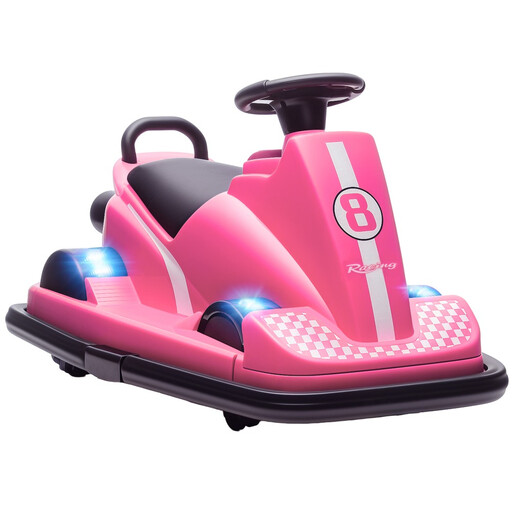
Why this product suits this profile: This compact electric bumper car for children is designed for short rides at low speed. On a suitable surface, it can be a straightforward first ride-on toy.
Its stated speed of 2.5 km/h makes it easier to plan for than a much faster ride-on vehicle.
6 V system, 360-degree rotation, plus music and horn functions, according to the product name.
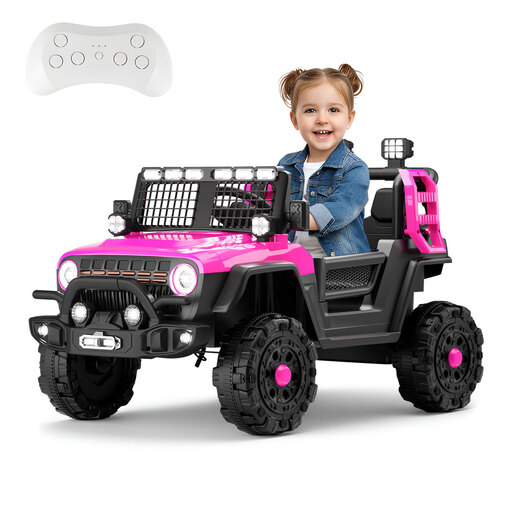
Why this product suits this profile: This electric ride-on car for children combines two driving modes with a remote control, safety belt and several comfort features. It’s a good option for families who want to compare the details carefully.
The product information lists soft start, a safety belt, lockable doors and a parental remote control, rather than focusing solely on decorative features.
12 V motor, two operating modes, Bluetooth music playback and spring shock absorbers, according to the product description.
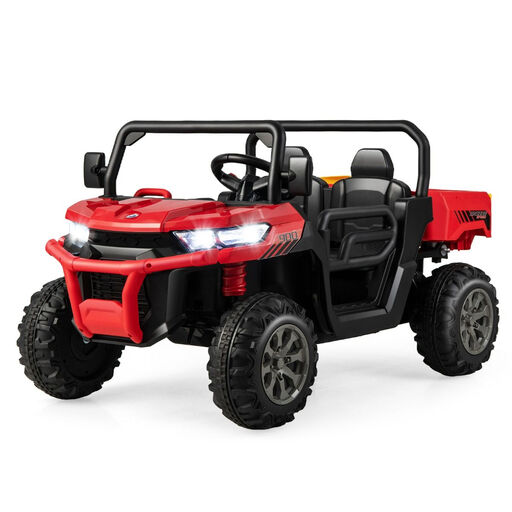
Why this product suits this profile: This two-seater electric ride-on is aimed at families looking for a vehicle for shared rides or extra features such as a loading area and shovel.
The product details clearly state the weight capacity, speed range, charging time and battery capacity. This makes it easier to check that the vehicle suits your space and needs before you buy.
Two seats, 50 kg weight capacity, 2.4 GHz remote control, soft start and suspension, according to the product description.
We’ve put together a complete, regularly updated list of products that meet these strict selection criteria and fully comply with the safety regulations in force in the EU.
Running time depends on battery capacity, the child’s weight, the surface, the outdoor temperature and driving style. A single figure is therefore unlikely to be reliable. After use, charge the battery according to the manufacturer’s instructions. If the vehicle won’t be used for a while, regular top-up charges can help, provided the instructions recommend them.
The electricity costs for small batteries are usually modest. To estimate them accurately, you’ll need the battery capacity, how often it’s charged and your electricity tariff. You may also need to buy batteries for the remote control, and later on, possible replacement parts such as tyres or a battery.
It depends on the design, tyre material, turning circle and available space. Models with soft wheels and a low top speed may be suitable for certain indoor areas. Before use, consider delicate flooring, furniture, stairs and narrow doorways. Always follow the manufacturer’s instructions.