
Lieferung heute & morgen

Qualitätsgarantie

Willkommens-Angebote freischalten: KOSTENLOSE Lieferung | Bis zu 80 % RABATT | Kostenlose 30-Tage-JoyPlus-Testphase
App herunterladen
An electric scooter for children aged 6 and over can be a good option for supervised riding on private paths, in courtyards or on suitable recreational grounds. However, your choice should not be based solely on speed or range. The age recommendation, braking system, battery, tyres and the legal requirements for use in Germany are all important considerations.
The wording “from 6 years” is initially a manufacturer’s recommendation for the intended use. It does not automatically mean that a child is allowed to use the scooter on public roads. In Germany, e-scooters are subject to requirements including the Small Electric Vehicles Regulation. Use in public areas is generally restricted to people aged 14 and over.
An electric scooter for children should therefore primarily be planned for private property and suitable enclosed areas. Parents should also check whether use is permitted on the particular site.
Figures such as 15 km/h or 16 km range are technical guide values. The actual result depends on factors including body weight, surface, gradient, temperature, riding style and battery condition. An electric scooter for children with a top speed of 15 km/h is not automatically suitable for every child. A lower speed may already be more appropriate for younger or inexperienced riders.
The range of a children’s scooter with a 16 km range can also be considerably lower when starting and stopping frequently or riding uphill. When making your choice, it is therefore more important to check whether the battery provides enough reserve for the planned short journey.
An e-scooter with solid tyres does not require tyre-pressure checks and is less susceptible to traditional punctures. However, solid tyres usually provide less natural cushioning than air-filled tyres. Uneven paths, cobbles and wet conditions can affect handling.
Children should use the scooter on level, dry and unobstructed surfaces. Solid tyres are practical, but they do not replace an appropriate speed, protective clothing or supervision.
An e-scooter for children with 250 W can be designed for short leisure rides on level ground. However, the wattage alone says little about the overall riding experience. The permitted rider weight, acceleration characteristics, maximum speed and suitability for gradients are also relevant.
For children aged between 6 and 12, the controls should be easy to understand. An uncomplicated throttle, an easily accessible brake and a stable standing platform are more important in everyday use than the highest possible power rating.
A children’s scooter with a brake should have clearly defined, easily accessible brake controls. The model featured here is listed as having a dual-braking system. Two braking methods or braking options may provide additional control choices; parents should explain how to use them correctly before the first ride.
The following are also important:
The CE marking should be clearly visible. However, it is not an independent quality seal. You should also check the product documentation, warning notices, EU representative details and instruction manual.
The Ladped LP65 is described as having a 25.2 V battery with 4.4 Ah, a stated range of 16 km and a maximum motor output of 250 W. To maximise the battery’s service life, it is important to charge it regularly in accordance with the manufacturer’s instructions, store it in a dry place and protect it from extreme heat and frost.
A scooter should never be charged unattended or in damp areas. The charger should be unplugged from the mains after charging. Before every use, parents should check the charge level, visible damage, brake function and tyres.
The available product data includes one suitable model in this category. We have therefore assessed the same product for three different usage scenarios, rather than artificially comparing it with products from unrelated categories.
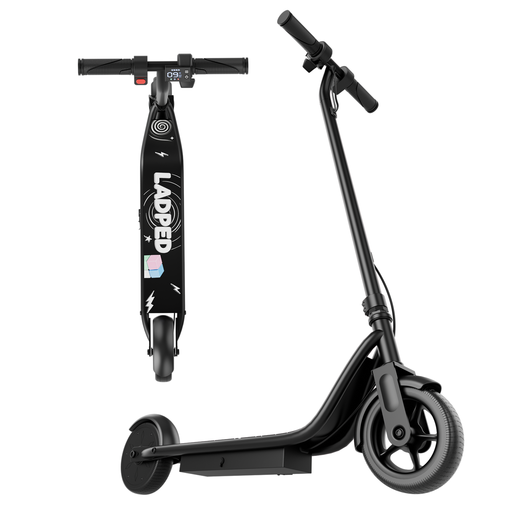
Why this product suits this profile: With 250 W, a speed of up to 15 km/h and a range of 16 km, it is suitable for short leisure rides on level private grounds, without the need to move up to a larger adult model.
The product data specifies the speed, battery and dual-braking system. This makes it easier for parents to check whether the specification suits the intended use.
250 W maximum output, 6.5-inch solid tyres and a dual-braking system, according to the product information.
Why this product suits this profile: If you want to compare technical specifications before buying, this model provides specific figures for the battery, tyres, power, speed and braking system.
The solid tyres eliminate the need to check and top up the air pressure. At the same time, buyers should bear in mind that they may provide less cushioning over uneven surfaces.
25.2 V and 4.4 Ah battery, 6.5-inch solid tyres and two specified braking options.
Why this product suits this profile: For regular short rides on suitable private grounds, the stated range is practical, provided that charging breaks are planned.
The stated range is not treated as a guaranteed everyday distance. The surface, rider’s weight and riding style can all affect the actual distance.
Stated range of 16 km, maximum speed of 15 km/h and a dual-braking system.
We have put together a complete, regularly updated list of products that fully meet these strict selection criteria and the safety regulations applicable in the EU.
In Germany, small electric vehicles may generally only be ridden in public areas by people aged 14 and over. A model labelled “from 6 years” by the manufacturer is therefore not automatically approved for roads, cycle paths or public spaces. Younger children may only use suitable private or enclosed areas.
Its service life depends on charging cycles, storage, temperature, use and care. A stated range of 16 km does not represent a guaranteed distance under all conditions. The battery should be charged according to the manufacturer’s instructions and should not be left completely discharged for extended periods or exposed to extreme heat or frost.
The electricity cost per charge is usually modest for a small battery. The main ongoing costs are more likely to be wear parts, potential repairs, the charger and battery replacement. Before buying, you should therefore check the availability of spare parts, warranty terms and returns policy.