Crafters dealing with dirty grout
If you mainly clean narrow grout lines and joins around the tiled area by the hob, a detail attachment that’s easy to control is important.


For narrow grout lines, corners and short stretches of tile, a handy brush with a suitable detail attachment is an obvious choice. A larger brush head may be more practical for mostly open areas. What matters is which attachment is actually included, whether it’s suitable for the surface and what the instructions say about moisture for that particular device. You may be able to remove fresh residue with a cloth and a suitable cleaner: the German Environment Agency notes that fresh dirt is easier to remove.
If you mainly clean narrow grout lines and joins around the tiled area by the hob, a detail attachment that’s easy to control is important.
If you mainly need to clean open stretches of tile after regular crafting sessions, compare the brush head size with the space around your hob.
If your tiles or nearby materials are delicate, first check whether the attachment and cleaner are suitable for the surface in question.
Choose based on whether you mainly clean open stretches of tile, narrow grout lines or delicate areas. If the residue is fresh and easy to reach, wiping it away promptly may be an alternative to buying a device.
A good fit if: you want to target short stretches of tile, grout lines and tight joins.
Trade-off: a small head takes more passes to clean open areas.
A good fit if: you mainly need to clean accessible tiled areas and the brush head fits between the hob, edges and joins.
Trade-off: a larger head is less precise for narrow grout lines.
A good fit if: you’re usually dealing with just a small amount of fresh residue that can be removed with a suitable cloth. The German Environment Agency recommends removing dirt as soon as possible.
Trade-off: this requires manual effort and may be less convenient for hard-to-reach grout lines.
| What matters | What to look for when buying | Who is this most relevant to? |
|---|---|---|
| Open tiled areas | Measure the accessible area and compare it with the size and shape of the brush head. | If I regularly clean larger, open areas, I care about how easy the head is to manoeuvre there. Consumers who prioritise surface cleaning are estimated to account for around 31%. |
| Grout lines and corners | Check the shape, compatibility and included accessories for a suitable detail attachment. | If I need to reach narrow grout lines and joins, a suitable detail attachment matters more than a large head. Consumers with this priority are estimated to account for around 31%. |
| Protecting surfaces | Check the guidance for your tile material, attachment and cleaner; test it on an inconspicuous area first. | If I want to clean delicate tiles or nearby materials, I want to choose an attachment and cleaner that are suitable for them. Consumers who prioritise surface protection are estimated to account for around 23%. |
| Ease of use and accessories | Compare the grip and what’s included; check the protection and charging information for the specific component mentioned. | If I need to control the brush around the hob and plan for any missing accessories, the exact contents of the package matter to me. Consumers with this priority are estimated to account for around 15%. |
A 15-cm head and a narrow attachment are designed for different areas. Check whether the head fits between the hob, edges and joins, and whether a suitable grout attachment is included.
If there’s no suitable detail attachment, you may need to clean grout lines by hand or buy an extra accessory.
Einhell states that the PICOBELLA 18/90, in the version specified, comes without a battery and charger. So compare the contents of the specific offer with the accessories you already own.
You may need to buy a compatible battery and charger separately.
Protection ratings apply to the specific model or component stated. Ryobi explicitly applies its IPX7 rating to the battery compartment, not the entire device.
Follow the instructions for the device, battery and charging, and keep moisture away from the hob wherever its care instructions require this.
The attachment and cleaner need to suit both the surface and the residue. General information about brushes doesn’t prove they can remove every type of craft paint or adhesive.
First identify the residue and material, follow the care instructions and, wherever possible, start with a gentler method.
An unsuitable attachment or cleaner could damage a delicate surface.
Bosch describes the UniversalBrush as a compact cordless hand-held brush for tiles, grout and kitchen cleaning.
The ERB 3815 A is a cordless brush with attachments for cleaning around the hob and grout lines.
The PICOBELLA 18/90 is a cordless surface brush for indoor and outdoor use, including in kitchens and bathrooms.
The R18CPS-0 is a ONE+ cordless brush with a rotating head for accessible areas.
The selection below includes electric cleaning brushes with attachments for tiles, grout or kitchen surfaces.
 No image available
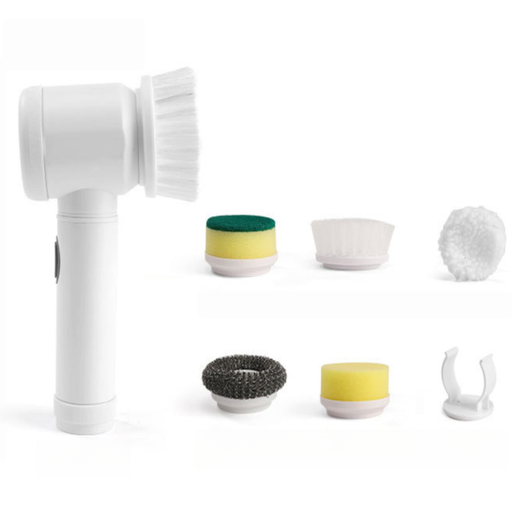
For kitchen surfaces and hard-to-reach corners. The product information lists ten interchangeable heads, including soft brushes and sponges.
 No image available
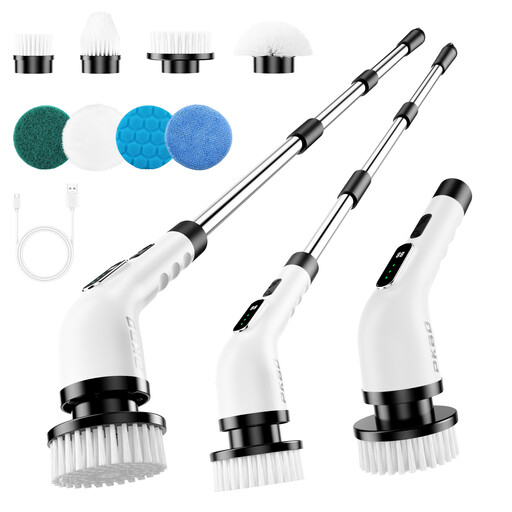
Designed for tiles, grout and kitchen surfaces. The product information lists eight attachments, three speeds, a 2,500-mAh battery and a telescopic handle.
 No image available
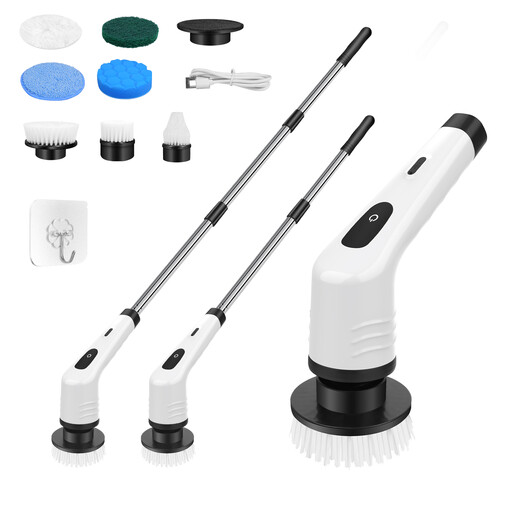
The product information lists tiles, grout and hobs as suitable uses, as well as seven interchangeable heads and an LED charging indicator.
 No image available
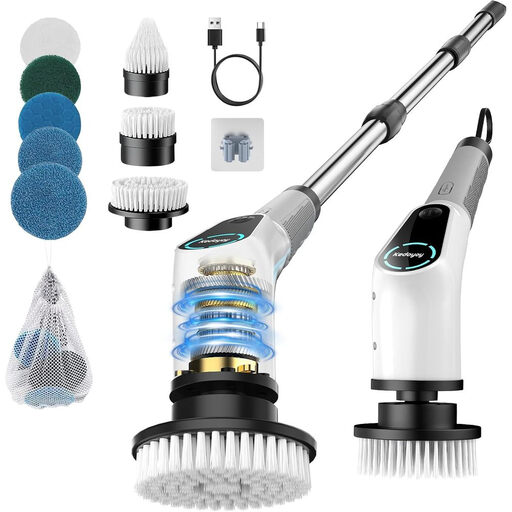
Designed for tiles and kitchen surfaces. The product information lists eight interchangeable heads, two speeds, an adjustable handle measuring 30–137 cm and USB-C charging. Despite the IPX7 rating, the product description says the device must not be submerged.
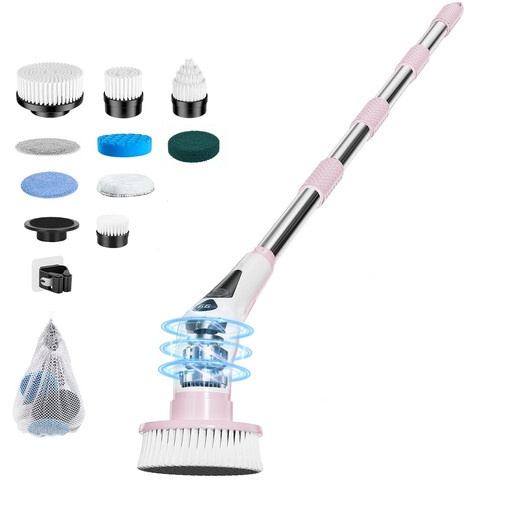 No image available
Designed for tiles, grout and edges. The product information lists a corner attachment, nine interchangeable heads and an adjustable handle measuring 30–130 cm.
No. You can’t assume a device is suitable for this based on its general product information. Identify the residue and surface, follow the care instructions, then choose an attachment and suitable cleaning product. Remove fresh dirt as soon as possible: the German Environment Agency notes that fresh dirt is easier to remove.
Follow the instructions for the specific device. Bosch lists IPX5 for the UniversalBrush and Einhell lists IPX4 for the PICOBELLA 18/90; Ryobi explicitly applies its IPX7 rating to the battery compartment. Clatronic’s instructions say that the ERB 3815 A must be charged using a suitable power adapter with a USB-A port; the charging cable is a separate component.
Check whether the battery, charger and any replacement attachments you need are included in the specific offer. Einhell explicitly states that the PICOBELLA 18/90 bare tool comes without a battery and charger. In Germany, the statutory guarantee against the seller is distinct from a voluntary manufacturer’s guarantee, as explained by the consumer advice centre.
No. According to Germany’s Federal Ministry for the Environment, old electrical appliances must be handed in at an authorised collection point, to a manufacturer or to a retailer. Additional conditions apply when returning an item to a retailer without buying a new one, including the size of the appliance and whether the retailer is obliged to accept it. Removable used batteries must be handed in separately.