What to look for when buying
First, measure the available space, including room for the pasta to come out or for guiding the dough. Then consider which steps you’d like the machine to handle, and how much cleaning and extra equipment you’re happy to take on.
| What to consider |
What to check |
Who it matters most to |
| Appliance footprint and working space |
Allow for the width, depth and height, as well as the clear space in front of the outlet or for guiding the dough. Philips gives the HR2345/19’s dimensions as 13.5 × 35 cm; Springlane lists the Nina’s footprint as 18 × 27.5 cm and its height as 37 cm. |
If my worktop space is limited, I’d measure the depth and room for the pasta to come out, rather than looking at the width alone. Around 33% of consumers would put footprint first. |
| Spaghetti die |
Check the model code against what’s included. Springlane lists seven dies for the Nina, including one for spaghetti; Marcato says spaghetti accessories are included with the Atlasmotor+. |
If I specifically want to make spaghetti, I’d want to know that the right die is actually included with that model. Around 27% of consumers would make a confirmed spaghetti shape their top priority. |
| Preparation steps and quantities |
Check whether the appliance mixes and kneads, or only rolls and cuts. Compare quantities on a like-for-like basis: Springlane lists 200–600 g of flour, while Rommelsbacher gives up to 800 g of fresh pasta per cycle. |
If I want to do as little of the dough preparation myself as possible, I’d check which steps the machine actually handles. Around 20% of consumers would put time saved first. |
| Cleaning and accessories |
Check which parts can be removed and are dishwasher-safe for the exact model. For the HR2665/93, Philips excludes the front cover and accessories from its dishwasher guidance. |
If I want to keep things simple after cooking, I’d want to know in advance which parts need cleaning and storing. Around 20% of consumers would put ease of cleaning first. |
Joybuy products for making spaghetti
This selection includes electric pasta makers, motorised dough rollers and spaghetti attachments for compatible stand mixers. Mains-powered appliances covered by the EU Low Voltage Directive must meet the relevant safety and conformity requirements. CE marking is a declaration made by the manufacturer, not an independent quality mark (EUR-Lex and Your Europe, European Union). Check the safety and voltage information for the specific version listed for the German market.
 No image available
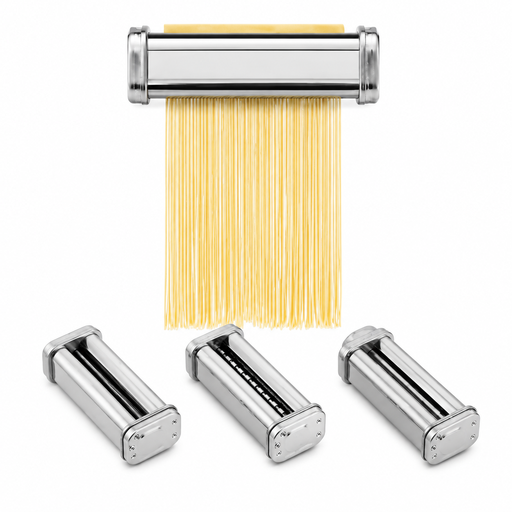
Three-piece pasta attachment set, compatible with KitchenAid
An option if you already own a compatible KitchenAid stand mixer and want to cut spaghetti using an attachment.
According to the product description, the set includes three stainless steel rollers for different pasta shapes, including spaghetti or angel hair. Check that it’s compatible with your exact model before buying.
View at Joybuy
 No image available
FOHERE electric pasta machine with 7 thickness settings
This electric roller machine could suit you if you want to roll dough and cut it into spaghetti using a powered appliance.
The product description lists seven thickness settings from 0.5 to 3 mm, two cutting attachments and dimensions of 20.8 × 14.2 × 21.3 cm. It says to wipe the surfaces dry and clean the cutting attachments with the brush provided; do not immerse the appliance in water.
View at Joybuy
 No image available
Electric pasta maker with 9 shaping dies
A possible choice if you want one electric appliance to prepare the dough and make pasta in a range of shapes, including spaghetti.
The product description lists nine shaping dies, as well as a mixing and reverse system. Before buying, check the safety and voltage information for the specific version listed.
View at Joybuy
 No image available
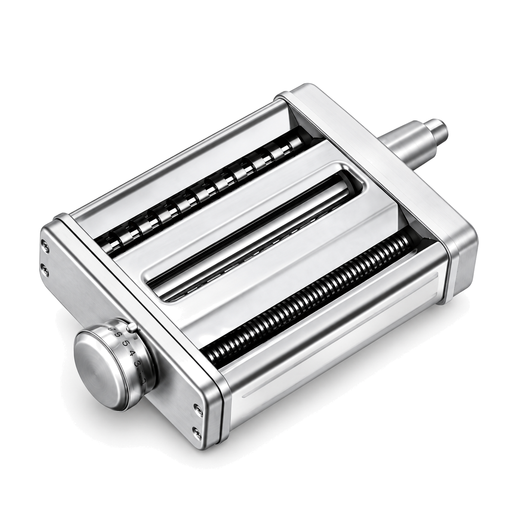
FOHERE 3-in-1 pasta attachment for KitchenAid
According to its product name, this attachment is designed for a KitchenAid stand mixer and combines a dough roller with a spaghetti cutter.
The product description lists eight thickness settings, as well as spaghetti and fettuccine cutters. Hand-washing is recommended; check that it’s compatible with your exact model before buying.
View at Joybuy
 No image available
BEAR electric pasta maker YMJ-K40Z7, 200 g of dough
Its compact size could be handy for smaller batches of dough, provided the stated dimensions suit your available space.
The product description gives a capacity of 200 g of dough, five shaping dies and dimensions of 300 × 218 × 56 mm. It says to wipe the main unit with a soft cloth only and not to rinse it under water.
View at Joybuy
Frequently asked questions
Is the stated appliance width enough to plan where it will go?
No. Measure the depth and height too, and allow for clear space in front of the outlet or to guide the sheet of dough. For the Nina, Springlane gives a width of 18 cm and a depth of 27.5 cm; these appliance dimensions don’t account for all the room you’ll need while working.
Can a motorised roller knead the dough for you?
The motor supplied with the Marcato Atlasmotor+ drives the roller; Marcato doesn’t describe it as a fully automatic machine that mixes and kneads. If you want the machine to handle those steps, look for an extruder that’s specifically stated to prepare the dough.
Can you put the whole appliance in the dishwasher?
You can’t assume so from a claim that “parts are dishwasher-safe”. Springlane’s statement about the Nina applies to removable parts; Philips specifically excludes the front cover and accessories for the HR2665/93. Follow the instructions for the exact model you own.
What else do I need for the Kenwood spaghetti attachment?
Kenwood lists a roller attachment for rolling out the dough first. Check the connection on your stand mixer too; Kenwood says an adapter is needed for older fittings.
Is CE marking an independent safety mark?
No. Electrical appliances covered by the EU Low Voltage Directive, including those with a rated voltage of 50 to 1,000 V AC, must meet the relevant safety and conformity requirements. CE marking is the manufacturer’s declaration of conformity, not a blanket independent assessment of each product (EUR-Lex and Your Europe, European Union).


