
Lieferung heute & morgen

Qualitätsgarantie

Willkommens-Angebote freischalten: KOSTENLOSE Lieferung | Bis zu 80 % RABATT | Kostenlose 30-Tage-JoyPlus-Testphase
App herunterladen
An electric towel radiator for the bathroom can warm towels, help them dry and provide an additional source of heat. At first glance, choosing one seems simple: compare the colour, shape and wattage, order a model and install it. In practice, however, a few typical purchasing decisions can lead to disappointment.
A specification such as 600 W sounds informative, but on its own it says little about whether the radiator is actually suitable. Room size, insulation, window area and intended use also play a role. A towel radiator is often designed as supplementary heating and does not automatically replace the bathroom’s entire heating system.
It is therefore important to check the approximate room size for which the manufacturer recommends the model. For the EMKE models featured here, 600 W is specified for approximately 7 or 8 m².
A Wi-Fi towel radiator with an app, voice control and weekly schedule can make operation easier. However, a Wi-Fi connection does not automatically reduce energy consumption. What matters is how long the appliance actually runs and whether timers or schedules are used consistently.
A bathroom radiator with a timer is therefore practical if heating is only required before a shower or at certain times of day. Also check whether the app is compatible with your smartphone and, where applicable, your voice assistant.
The external dimensions are not the only factors that matter. You should also consider:
A curved towel radiator often provides more space between the bars. This makes it easier to hang towels. Nevertheless, you must check whether the construction provides enough clearance at the intended installation location.
Heating output is specified in watts. A 600 W towel radiator consumes 0.6 kWh per hour of operation when running at full power. For a rough cost estimate, use:
Power in kW × operating hours × electricity price = electricity costs
At 600 W and two hours of operation, for example, consumption is 1.2 kWh. The actual cost depends on your individual electricity tariff. A thermostat, timer and weekly programme can help prevent unnecessary operating times.
A towel heater with a thermostat regulates the target temperature according to the selected setting. Pay attention to how the controls work and to the documented adjustment range. The EMKE model’s product information describes control from 7 to 30 °C in 1 °C increments; elsewhere, a range of 30 to 70 °C is given. As these details do not match, you should check the current product page or instructions before buying.
A thermostat does not prevent an appliance from using a lot of energy if it is poorly positioned or operated for long periods. It is a control feature, not a substitute for sensible operating planning.
For bathroom appliances, the IP44 protection rating is an important point to check. It indicates protection against solid foreign objects above a certain size and against splashing water from various directions. IP44 does not mean that the appliance can be immersed in water or installed anywhere in a wet area without restriction.
Before installation, observe the following:
The material and surface treatment affect everyday usability. The EMKE models are specified as being made from low-carbon steel with a powder-coated finish and seamless 360° welding. The SONNI model is described as being made from SPCC steel in white. These details describe the construction, but do not provide a blanket guarantee of a specific service life.
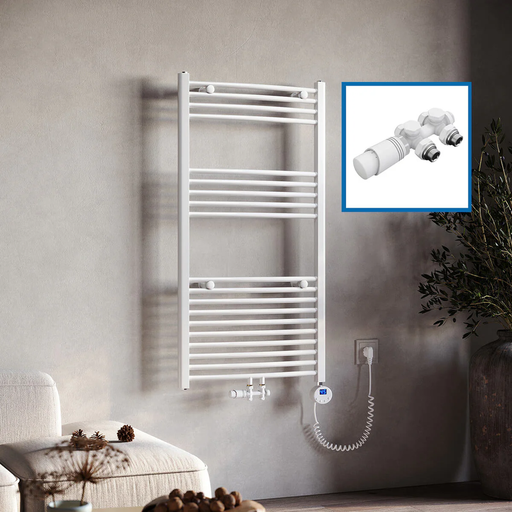
Why this product suits the profile: The white finish and central connection may appeal to renovators looking to combine a classic electric bathroom radiator with existing or planned bathroom plumbing. Before buying, check the “with/without Multiblock” details against your existing connection.
The product description specifies the material, colour and connection option. As different dimensions are listed, check the measurements and connection type again before placing your order.
SPCC steel, white finish and central connection design; suitable for users who prefer a conventional look.
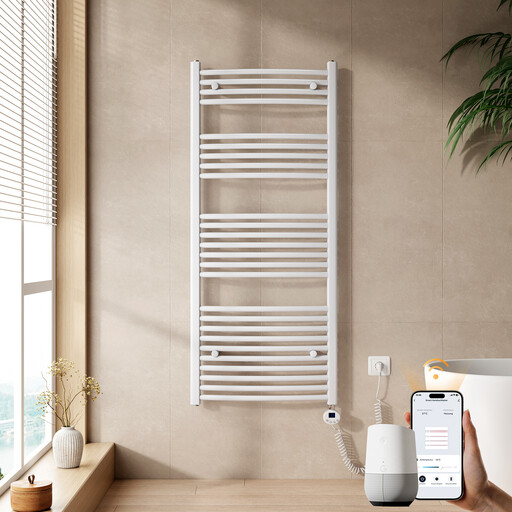
Why this product suits the profile: This model combines a curved towel radiator with Wi-Fi control, a thermostat, weekly schedules and a timer. The dimensions of 1400 × 600 mm and the stated suitability for approximately 8 m² make it a good fit for medium-sized bathrooms, provided sufficient wall space is available.
The timer and weekly schedules help prevent unnecessary operating times. IP44, overheating protection and a factory-fitted heating element are also specified. However, the wall clearances of 98–113 mm must still be taken into account.
600 W, Wi-Fi app, voice control, 1–24-hour timer, weekly schedule, child lock and 1.4 m coiled cable according to the product description.
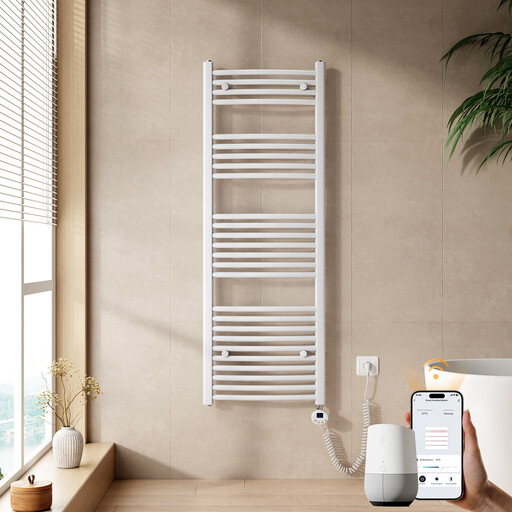
Why this product suits the profile: The narrower width of 500 mm may be a better solution for smaller bathrooms or for installation next to a washbasin. According to the supplier, the 600 W model is suitable for rooms of up to approximately 7 m².
The narrower design reduces the risk of exceeding the available wall width. Before installation, check the 94–109 mm wall clearance, cable position and actual heating area.
1400 × 500 mm, 600 W, Wi-Fi control, thermostat, timer, weekly schedules, frost protection and IP44 according to the product information.
We have put together a complete, regularly updated list of products that fully meet these strict selection criteria and the safety regulations applicable in the EU.
Before placing your order, draw a scale plan of the wall. Mark the radiator, brackets, socket and the area where towels will hang. Leaving sufficient clearance improves air circulation and prevents textiles from resting directly on the controls for long periods.
A model with a plug is generally easier to install, provided the structural conditions are suitable. “Plug and play” does not mean that safety requirements no longer apply. If you are unsure about the electrical installation, a qualified professional is the right person to contact.
This depends on the rated output and operating time. A 600 W appliance uses 0.6 kWh when operated for one hour. A timer, thermostat and weekly programme can limit the operating time. To calculate the cost, multiply the consumption by the price per kilowatt-hour specified in your contract.
This depends on the room size, insulation and heating output. The models mentioned are described as an additional heat source and as being suitable for warming and drying towels. Whether the output is sufficient to heat the entire room must be assessed based on the heating load and the local conditions.
IP44 provides protection against splashing water, but it is not a licence to install the appliance in any position. The relevant bathroom protection zones, the manufacturer’s instructions and applicable installation regulations are decisive. Before buying, therefore, do not just search for “IP44”; also check the installation clearances and connection type.