
Lieferung heute & morgen

Qualitätsgarantie

Willkommens-Angebote freischalten: KOSTENLOSE Lieferung | Bis zu 80 % RABATT | Kostenlose 30-Tage-JoyPlus-Testphase
App herunterladen
An electric tyre inflator for car tyres can come in handy if a tyre is slowly losing pressure, before a long journey or when you’re out and about. But not every compact device is equally suitable for a car tyre. If you focus only on claims such as “150 PSI”, “High Power” or “cordless”, you could overlook important limitations.
A 150 PSI tyre inflator or one rated at 160 PSI will usually reach that figure only under certain conditions. For car tyres, however, maximum pressure isn’t the only thing that matters. Airflow, hose connection, run time and cooling breaks are just as important. A high PSI rating, then, tells you little about how quickly a flat tyre can be inflated.
A mini compressor may fit in your glove compartment or a bike bag, but it can take longer to inflate larger tyres. Check whether the manufacturer gives specific information about tyre size, inflation time or the number of uses per charge. A short power cable can also be inconvenient when using the device with a car.
A battery-powered tyre inflator needs to be charged regularly. Run time can vary in cold temperatures, after prolonged storage or when inflating several tyres. A battery-powered model is handy for occasional top-ups; for longer jobs, a 12V compressor without a built-in battery may be the more predictable option.
You’ll find the recommended tyre pressure on the sticker inside the door frame, on the fuel flap or in your vehicle’s handbook. The figure given by the vehicle manufacturer is the one that matters, not the pump’s maximum pressure.
Look out for:
For corded models, compatibility with your vehicle’s 12V socket is important. Follow the manufacturer’s instructions on whether the vehicle should be running during use, to avoid putting unnecessary strain on the starter battery. A cable that’s long enough makes it easier to reach all four tyres.
For battery-powered devices, consider:
A battery-powered tyre inflator offers greater flexibility, while a 12V model doesn’t need charging before each use.
If you’re looking for an inflator for cars, motorbikes and bicycles, check that it comes with suitable valve adapters. Inflating balls, air beds or other inflatables requires additional nozzles. An LED light can be useful in the dark, but it’s no substitute for adequate high-visibility clothing or taking proper precautions in traffic.

Why this product suits this type of user: Its corded design suits anyone looking for a simple way to inflate car, motorbike and bicycle tyres without having to manage a battery.
Powering it from your vehicle means its availability doesn’t depend on having a charged battery.
According to the product information, it has a portable design and can be used with cars, motorbikes and bicycles.

Why this product suits this type of user: A good choice if you prefer digital controls, a choice of pressure units and a higher-capacity battery in a portable compressor.
Preset modes and automatic shut-off help reduce the risk of exceeding your target pressure while inflating.
According to the product information, it offers a maximum pressure of 160 PSI, an airflow rate of 35 l/min, a 7,500 mAh battery and a display showing PSI, kPa and BAR.
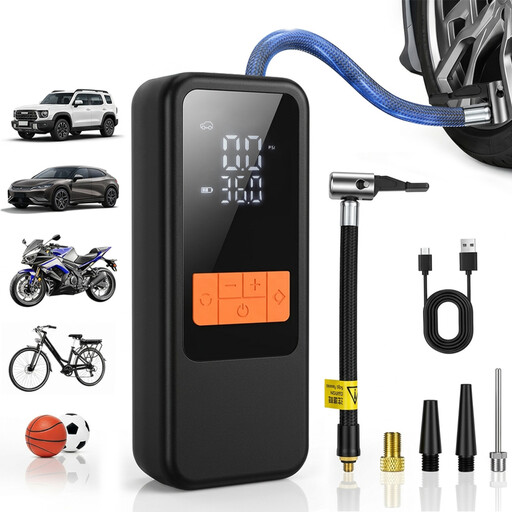
Why this product suits this type of user: Suited to anyone looking for a cordless inflator for cars, motorbikes, bicycles and balls, with several preset modes.
The stated run time, charging time and inflation time give you a clearer idea of performance than a maximum pressure rating alone.
According to the product information, it has a 4,000 mAh battery, a maximum pressure of 150 PSI, an airflow rate of 26 l/min, five modes and an LED light with steady and SOS settings.
We’ve put together a complete, regularly updated list of products that meet these strict selection criteria and the safety regulations in force in the EU.
Where possible, check tyre pressure when the tyres are cold, as heat can affect the reading. Connect the hose securely to the valve and select the correct unit. If you’re using a 12V compressor, run the engine as instructed in the product guide. Store battery-powered models somewhere dry and out of direct sunlight, and avoid leaving them for long periods in extreme temperatures.
Also check the manufacturer’s recommended duty cycle. Take breaks during longer inflation jobs to let the motor and casing cool down. An electric inflator is designed for pressure adjustments and emergencies on the go; it isn’t a substitute for repairing a damaged tyre or carrying out a permanent repair.
The recommended tyre pressure given by your vehicle manufacturer is what matters. Many cars need around 29 to 51 PSI, depending on the vehicle, load and tyre size. The inflator’s maximum PSI should be higher than the pressure you need, but that figure alone doesn’t tell you how quickly it will inflate a tyre.
It depends on the battery capacity, airflow, tyre size and the temperature of the device. Some models give specific inflation times or the number of tyres they can inflate on a charge. If a tyre has lost all its pressure, follow the manufacturer’s guidance on run time and cooling breaks.
A 12V compressor is a good choice if you have a constant power source in your vehicle and don’t want to charge a battery. A cordless inflator gives you more freedom of movement and is handy away from your vehicle, too. So when choosing between them, think about where and how often you’ll use it, and how portable you need it to be, rather than focusing on the design alone.