
Lieferung heute & morgen

Qualitätsgarantie

Willkommens-Angebote freischalten: KOSTENLOSE Lieferung | Bis zu 80 % RABATT | Kostenlose 30-Tage-JoyPlus-Testphase
App herunterladen
An electric tyre inflator for car tyres can come in handy when tyre pressure drops, before a long journey or while you’re out and about. However, battery-powered inflators, 12V compressors and compact bicycle pumps vary considerably in power, run time and intended use.
Many poor purchases aren’t down to the maximum pressure quoted. More often, it’s an unsuitable power supply, a lack of cooling breaks or an inadequate airflow rate. The following criteria will help you assess marketing claims objectively and choose a device that suits your needs.
A 150 PSI tyre inflator can theoretically reach a high final pressure. In practice, it’s just as important to know how much air the device delivers per minute and how long its motor can run under load. A high maximum pressure alone tells you little about how quickly, for example, a car tyre can be inflated from 1.8 to 2.5 bar.
A compact mini compressor is often enough for bicycle tyres or balls. For car tyres, you should also check the motor power, airflow rate and permitted operating time.
A cordless tyre inflator can be used without a 12V socket. However, its battery needs to be recharged regularly. The available capacity may be limited when inflating several car tyres or tyres that are very flat.
A 12V tyre compressor draws power directly from the vehicle socket. This is useful for longer jobs, but you’ll need a cable that’s long enough and a secure connection. With corded models, the vehicle’s engine should be running in line with the instruction manual to avoid putting unnecessary strain on the starter battery.
An automatic shut-off tyre inflator stops once it reaches the preset target pressure. This helps prevent overinflation, but it doesn’t replace checking the recommended tyre pressure. Always follow the vehicle manufacturer’s guidance, usually found on the door frame, fuel cap or in the owner’s manual.
Where possible, check and adjust tyre pressure when the tyres are cold. An inflator with an LCD display is handy, but readings can vary depending on the device and connection. For regular checks, we recommend using a separate, suitable pressure gauge.
There are two types to consider for emergencies in the car:
For battery-powered models, check the stated run time as well as the capacity in mAh. A high mAh figure alone doesn’t allow for a direct comparison if the voltage and motor power differ.
A digital inflator should display several units, such as PSI, BAR and kPa. For drivers in Germany, bar is particularly straightforward. A target pressure of 2.5 bar is roughly equivalent to 36 PSI. It’s important that you can set the pressure precisely and read the display easily while inflating.
Car, motorbike and bicycle tyres require different valve connections. Models supplied with adapters for the following are useful:
For corded CARSUN models, a cooling break of around five to ten minutes is recommended after longer periods of use. Follow the manufacturer’s guidance: a mini compressor isn’t necessarily designed for continuous operation.
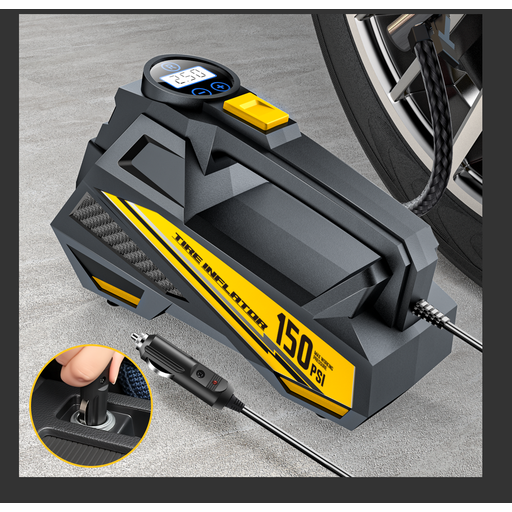
Why it suits this user: This corded model uses a 12V socket and is designed for cars, motorbikes, bicycles and balls. It’s a good choice if you’d rather not plan around battery charging.
Its power supply is clearly specified as 12V DC. The digital display, automatic shut-off and multiple pressure units make it easier to set the right pressure.
150 PSI maximum pressure, LCD display, LED light and multiple nozzles; the vehicle socket provides a continuous power supply.

Why it suits this user: According to the product information, this compact device weighs around 459 g, has a 2500-mAh battery and offers five inflation modes for different uses.
The stated pressure accuracy of ±0,05 bar and digital target-pressure setting make it easier to use than relying on a rough estimate.
USB-C input, 19-cylinder design, five modes and automatic shut-off once the target pressure is reached.
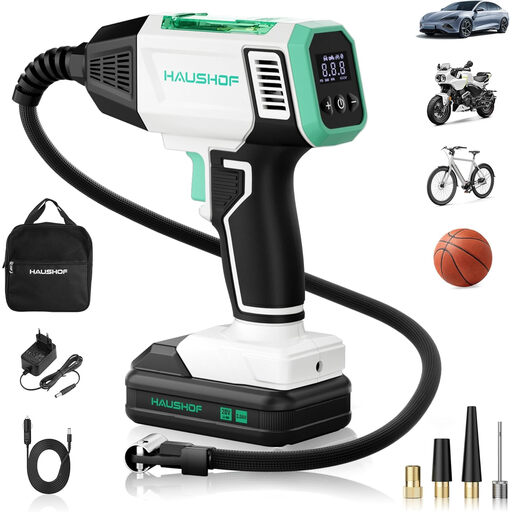
Why it suits this user: The combination of a 2000-mAh battery and a 4 m 12V cable offers both portable use and a continuous power supply for longer jobs.
You’re not reliant solely on the battery charge. Automatic shut-off and four preset modes help reduce user errors.
150 PSI, stated airflow rate of 22 l/min, LCD display, LED light, and battery and cable operation.

Why it suits this user: According to the product information, this model is designed exclusively for bicycles and works with Presta and Schrader valves. Its specialist design makes it a relevant choice for road bikes, mountain bikes and e-bikes.
Its clearly stated purpose avoids creating the false expectation that it can also inflate car tyres. You can switch valves directly on the integrated hose.
5000-mAh battery, 150 PSI maximum pressure, automatic shut-off and a stated run time of up to 25 minutes.
We’ve put together a comprehensive, regularly updated list of products that meet these strict selection criteria and the safety regulations in force in the EU.
For standard car tyres, choose a device whose operating range covers the pressure recommended by the vehicle manufacturer. Many portable models offer 150 PSI or more, but maximum pressure isn’t the only thing to consider. Airflow rate, connection type and operating time are just as important in practice.
It depends on the motor power, battery capacity and tyre size. Small battery-powered inflators are often designed for pressure adjustments and compact vehicles. Inflating a completely flat tyre can take considerably longer. A 12V compressor or a 2-in-1 model may be more suitable for several tyres in a row. Make sure you only use the inflator for the stated operating time.
Its lifespan depends on the battery, motor, storage conditions and how often it’s used. High temperatures, moisture and continuous use without a cooling break can increase the strain on the device. Store it in a dry place, recharge battery-powered models regularly and follow the manufacturer’s guidance to help ensure proper use.