
Lieferung heute & morgen

Qualitätsgarantie

Willkommens-Angebote freischalten: KOSTENLOSE Lieferung | Bis zu 80 % RABATT | Kostenlose 30-Tage-JoyPlus-Testphase
App herunterladen
An electric tyre inflator can come in handy in your boot, garage or as part of your regular tyre-pressure checks. However, models vary considerably in their power supply, battery capacity, ease of use and duty cycle. A high PSI rating alone tells you little about whether a model is right for your vehicle.
Car drivers, SUV owners, electric vehicle drivers, and motorbike and bicycle owners should check some common advertising claims and technical limitations before buying.
Figures such as 150 PSI or more mainly describe the theoretical maximum pressure. The pressure recommended by the vehicle manufacturer is considerably lower for many car tyres. That’s why airflow, inflation time, measurement accuracy and duty cycle matter too.
A 150 PSI car compressor is not automatically suitable for large SUV tyres or for inflating several completely flat tyres in a row. Check the usage specifications and allow the device to cool down during longer inflation sessions.
A cordless air pump offers flexibility, but it needs to be charged. In low temperatures, after long periods in storage or when inflating several tyres, the available battery power may decrease. Models with a 12-volt connection, on the other hand, don’t need a charged battery, but rely on a socket in the vehicle and a cable that’s long enough.
A tyre inflator with automatic shut-off will normally stop at the set pressure. Even so, you should check the pressure after inflating, particularly if the hose connection isn’t fully sealed or the device uses a different pressure unit. The vehicle’s recommended pressure, shown on the door pillar, fuel filler flap or in the owner’s manual, is what matters — not the pump’s maximum output.
A battery-powered air pump is suitable for bicycles, motorbikes, balls and small top-ups to car tyres. Look out for:
A 12V tyre inflator runs from the cigarette lighter or accessory socket. This is handy for longer sessions, provided the engine is running in accordance with the manufacturer’s instructions. This helps avoid putting unnecessary strain on the vehicle battery. Also check that the cable reaches all the tyres and that the plug fits securely.
A tyre inflator with a digital display should show the units commonly used in Germany: BAR and PSI. Some models also offer KPA or KG/CM². A clear, backlit display can be useful in the dark.
It’s important to distinguish between resolution and actual measurement accuracy. A display with several decimal places isn’t automatically more precise. For vehicle maintenance, what matters is being able to set the desired pressure consistently and secure the connector so it’s airtight.
Higher airflow can reduce inflation time, while a longer hose or power cable makes the device easier to handle. With a mini air compressor, you should also consider how much heat it generates. Some devices need a cooling break of 5 to 10 minutes after around 10 to 15 minutes of continuous use.
Bicycle tyres, balls and air beds require suitable adapters. A pump for motorbike and bicycle tyres should therefore include several nozzles or a suitable Presta valve adapter. Heavy commercial vehicle tyres have different requirements from car, SUV, motorbike or bicycle tyres.
The selection below groups models by typical use. Details are based on the respective product descriptions.

Why this product suits this user profile: This compact 12-volt device runs directly from your vehicle and is designed for car, motorbike and bicycle tyres, as well as other inflatables.
It doesn’t need to be charged before use. However, check the cable reach and recommended cooling break before buying.
12V DC power supply, portable design and plug-and-play operation, according to the product description.

Why this product suits this user profile: For anyone looking for a cordless option with a digital display, preset pressure and an additional light for the vehicle.
The digital display lets you set the pressure in PSI, BAR and KPA. However, the battery should be charged before longer journeys.
7.2-volt battery with 2,500 mAh capacity, digital pressure display, automatic shut-off and LED/SOS light, according to the product specifications.

Why this product suits this user profile: A compact battery-powered air pump for anyone looking to inflate car, SUV, motorbike and bicycle tyres, as well as balls, with one device.
Five modes and automatic shut-off help reduce setting errors. If you need to inflate several completely flat tyres, battery capacity is still the key thing to check.
2,500 mAh battery, USB-C input, five inflation modes and stated pressure accuracy of ±0,05 BAR.
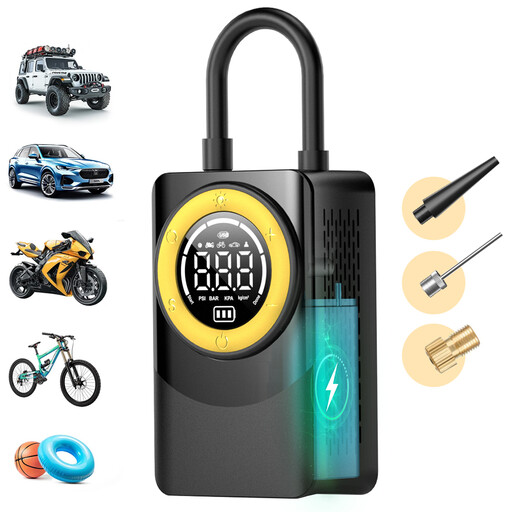
Why this product suits this user profile: Its cordless design is intended for drivers who want to top up their tyres without a fixed power cable, including electric vehicle drivers in suitable situations.
The digital display and automatic shut-off help you top up in a controlled way. Make sure the built-in battery is fully charged before use.
Cordless design, built-in battery, digital display and automatic shut-off, according to the product description.
We’ve put together a complete, regularly updated list of products that meet these strict selection criteria and fully comply with the safety regulations in force in the EU.
For cars, an adjustment range that covers the pressure specified by the vehicle manufacturer is often enough. The maximum rating of 150 PSI is therefore less important than a suitable pressure display, an airtight connection and controlled shut-off.
A battery-powered air pump is handy for quick top-ups and flexible use. For longer sessions or several tyres, a 12V tyre inflator has the advantage of drawing power directly from the vehicle. Cable reach, duty cycle and charge level should all factor into your decision.
Its operating time depends on the battery, motor, heat generated and how often it’s used. There’s no one-size-fits-all figure for its lifespan. Following the stated duty cycle, letting the device cool down and storing it in a dry place will help reduce the usual wear and tear.