
Lieferung heute & morgen

Qualitätsgarantie

Willkommens-Angebote freischalten: KOSTENLOSE Lieferung | Bis zu 80 % RABATT | Kostenlose 30-Tage-JoyPlus-Testphase
App herunterladen
An electric tyre inflator can save you time on the road, help with regular pressure checks and prove a useful addition to your breakdown kit. However, cordless inflators, 12 V inflators and small portable compressors vary considerably in their power supply, run time and intended use.
If you focus only on a high PSI rating or an especially compact design, you can easily overlook important details. Here are three common misconceptions:
A cordless tyre inflator is suitable for bicycles, motorbikes, balls and small top-ups to car tyres, without needing a mains socket or your vehicle’s 12-volt socket. Before buying, check:
A 12 V tyre inflator may be a better choice for longer jobs. It runs from a cigarette lighter or 12 V socket, so there’s no need to charge it in advance. With many corded models, the vehicle’s engine should be running to avoid putting unnecessary strain on the starter battery. If you own an electric car, also check whether the 12 V socket is active and what maximum power it can supply.
A 150 PSI air compressor rating may look impressive at first glance. However, the recommended pressure for typical car tyres is usually much lower. What matters is whether the inflator can reach your required pressure in a reasonable time and how long it can run continuously.
Look out for:
A high maximum pressure is particularly relevant for balls or certain bicycle tyres. For a car, the inflator should mainly provide sufficient airflow. Manufacturers’ figures also often refer to specific tyre sizes and starting pressures, so the actual time may vary.
A tyre inflator with a digital display should show the current pressure clearly and ideally support several units. Preset modes for cars, motorbikes, bicycles and balls are useful, as is a custom mode.
An automatic shut-off stops inflation when the preset target pressure is reached. This means you don’t have to keep a close eye on the tyre throughout the process. Even so, you should check the pressure afterwards with a separate, suitable portable tyre pressure gauge, especially before longer journeys.
Ideally, the package should include adapters for bicycle valves, balls and, where applicable, air beds. An LED emergency light with a steady or SOS mode can be useful in the dark, but it’s no substitute for a high-visibility vest, warning triangle or the required precautions at a breakdown scene.
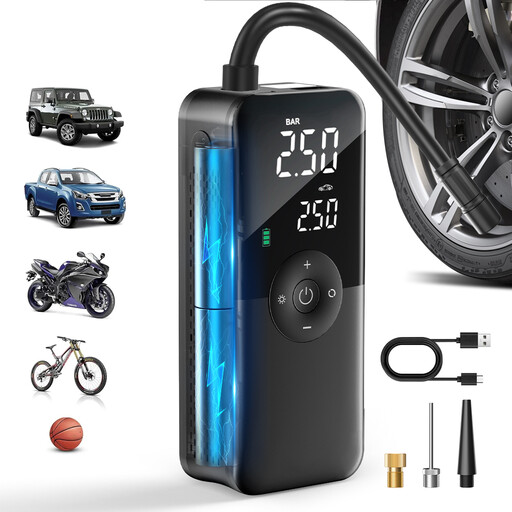
Why it suits this profile: Its cordless design is made for occasional top-ups to car, motorbike and bicycle tyres, as well as inflating balls.
With no power cable, you don’t need to rely on a 12 V socket; just make sure the battery is charged before longer jobs.
A handy cordless design and, according to the product information, fast charging.

Why it suits this profile: This model combines cordless operation, five inflation modes and a stated pressure accuracy of ±0.05 Bar.
You can select the pressure unit and target value, rather than relying solely on a headline PSI maximum.
2500-mAh battery, USB-C input and automatic shut-off, according to the product description.
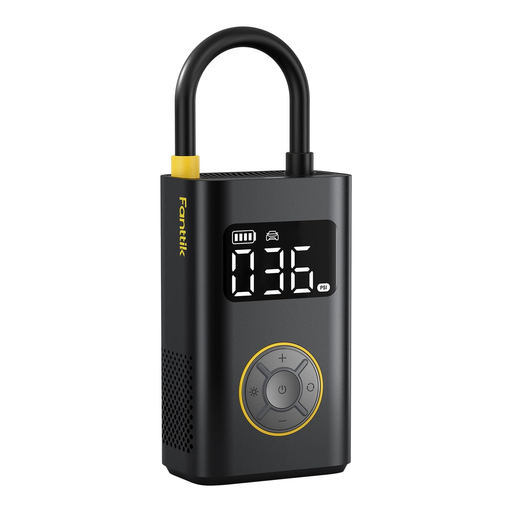
Why it suits this profile: Four preset modes and a manual mode are available for car, motorbike and bicycle tyres, as well as balls.
Its stated run time of up to 23 minutes and automatic shut-off make its operating limits clearer.
Digital display, integrated hose and a stated maximum pressure of 150 PSI.
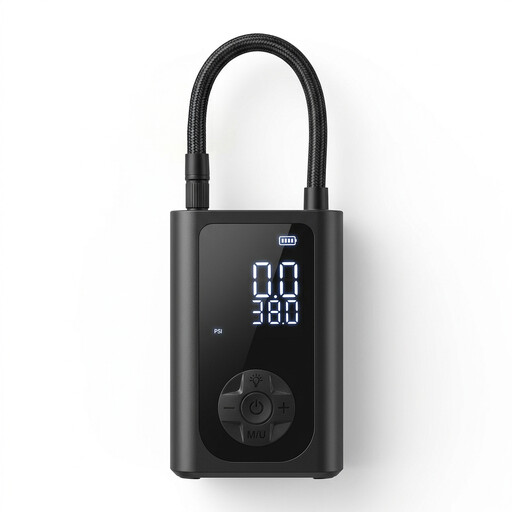
Why it suits this profile: This compact cordless tyre inflator is designed to fit in a vehicle storage compartment or rucksack, and has an integrated light.
The product specifications state an airflow of 26 l/min, a run time of 25 minutes and automatic pressure control across five modes.
4000-mAh battery, USB-C connection, 150 PSI maximum pressure and steady or SOS LED mode.
We’ve put together a complete, regularly updated list of products that meet these strict selection criteria and fully comply with the safety regulations in force in the EU.
If you can see damage to a tyre, notice an unusual loss of pressure or find a damaged valve, don’t rely on an electric tyre inflator as a permanent fix. In these cases, have the tyre checked by a professional.
For cars, a model that reliably reaches the pressure range recommended by the vehicle manufacturer is usually sufficient. A 150 PSI rating isn’t a target pressure you need to reach; it’s generally the maximum pressure stated in the technical specifications. Always follow the pressure recommended for your vehicle, in Bar or PSI.
This depends on the battery capacity, tyre size, starting pressure, ambient temperature and operating time. Small top-ups use much less energy than inflating a completely flat car tyre. After use, charge the battery and store it in a dry place in accordance with the manufacturer’s instructions.
A cordless tyre inflator is flexible and doesn’t depend on your vehicle’s power socket. A 12 V tyre inflator, on the other hand, provides a continuous power supply as long as a suitable socket is available. A cordless model is often a good choice for everyday use with a bicycle or motorbike; a corded model may be more practical for inflating several car tyres.