
Lieferung heute & morgen

Qualitätsgarantie

Willkommens-Angebote freischalten: KOSTENLOSE Lieferung | Bis zu 80 % RABATT | Kostenlose 30-Tage-JoyPlus-Testphase
App herunterladen
An electric tyre inflator for car tyres can come in handy if your tyre pressure drops, when you’re travelling or while camping. Many models are cordless, fit in the glove compartment and can also be used to inflate bicycle and motorbike tyres. However, battery-powered compressors vary considerably in battery capacity, airflow, ease of use and limitations.
If you focus only on a “150 PSI” rating or an especially compact design, you could end up buying a device that isn’t suitable for your vehicle. The points below will help you make sense of marketing claims and choose a portable tyre inflator that suits your needs.
A 150 PSI tyre inflator can theoretically display a high pressure reading. However, this tells you little about how quickly it will inflate a car tyre. In Germany, car tyres usually require considerably lower pressures. Other important factors include the airflow rate, motor power and stated inflation time.
Claims such as “in one minute” often refer to a particular tyre size and a small pressure top-up. Fully inflating a flat tyre takes much longer, and compact battery-powered models may need to cool down during the process.
Automatic shut-off stops inflation when the set pressure is reached. This reduces the risk of overinflation, but only if you’ve set the correct pressure. Always follow the tyre pressure recommended by your vehicle manufacturer. You can usually find it on the door frame, inside the fuel filler flap or in the owner’s manual.
The display should also let you switch between PSI, BAR and kPa. This helps you avoid accidentally entering a target pressure in the wrong unit.
A cordless tyre inflator gives you flexibility because it doesn’t need a cigarette lighter socket or mains power. However, battery life depends on battery capacity, tyre size, starting pressure and the outside temperature. Make sure the battery-powered compressor is fully charged before a longer journey. Models with an additional 12-volt cable can be useful if you need to inflate several tyres in a row.
Check that the adjustable pressure range is suitable for your vehicle. A high maximum pressure isn’t automatically necessary for a standard car. In everyday use, an easy-to-read digital tyre pressure display and straightforward pressure settings are more important than the highest possible PSI rating.
Bicycle and motorbike tyres, as well as balls, often require different pressures. Multiple modes can make it easier to set the right pressure, but don’t rely on preset values without checking them first.
Airflow is often given in L/min. This gives you an indication of potential speed, but it isn’t the only figure to compare. Check the conditions behind the manufacturer’s claim: tyre size, starting pressure and target pressure all affect the result.
A mini air compressor is often enough for occasional top-ups. If you regularly inflate several car, motorbike or bicycle tyres, look for a model with sufficient battery capacity and a stated continuous operating time.
A device that can be charged via USB-C can be charged in your car, using a mains adaptor or with a power bank, as long as the charging power and cable are compatible. Check whether a USB-C cable is actually included.
Useful accessories include:
You should also consider the weight before buying. A particularly small device is easy to store, but may take longer to inflate larger tyres.
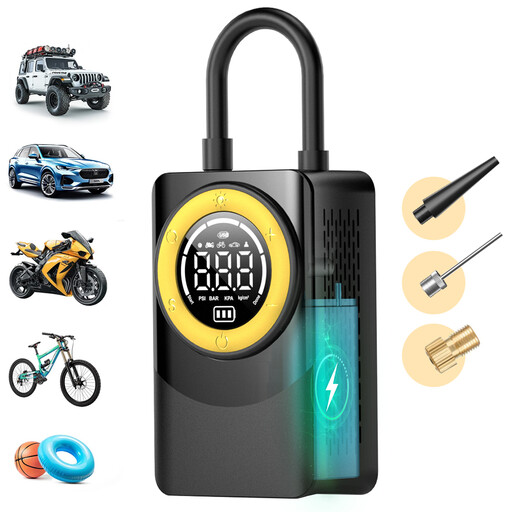
Why this product suits this profile: Its cordless design and built-in battery make it a good choice for drivers who want to keep a compact inflator in their vehicle for occasional pressure top-ups.
The digital display helps you set the pressure accurately, rather than relying solely on an imprecise estimate.
Cordless operation, built-in battery and digital display, according to the product description.

Why this product suits this profile: Its stated pressure accuracy of ±0,05 BAR and five inflation modes will appeal to anyone who wants to inflate different vehicles and items with a set pressure.
The specific accuracy figure makes it easier to assess the product than claims that focus only on maximum pressure. According to the description, this device isn’t intended for heavy lorry tyres.
2500-mAh battery, USB-C input, five modes and automatic shut-off, according to the product details.

Why this product suits this profile: This model is designed for people who want to inflate car, bicycle and motorbike tyres, as well as balls, using different pressure units.
The product description gives specific inflation times and lists three pressure units. This makes it easier to compare the expected performance with your needs.
Up to 150 PSI, 2500-mAh battery, digital display and LED emergency light, according to the manufacturer.
We’ve put together a complete, regularly updated list of products that meet these strict selection criteria and the safety regulations applicable in the EU.
A battery-powered compressor is intended for pressure top-ups and emergencies. If you notice visible damage, an unusual loss of pressure or a damaged valve, don’t continue inflating the tyre. Have it checked by a professional instead. Lorry, trailer and other high-volume tyres have different requirements.
Its lifespan depends on the battery, motor, heat build-up, charging cycles and how often it’s used. It isn’t possible to give reliable timeframes without consistent testing conditions. Store the device in a dry place and recharge the battery regularly, following the manufacturer’s instructions.
A single inflation usually uses very little electricity. Cordless models mainly incur charging losses; the actual cost depends on battery capacity, your electricity tariff and how often you use the device. For occasional top-ups, running costs are normally lower than the purchase price of the device.
Many models can, provided they come with the right adapters and have a suitable pressure range. Use the relevant mode or attachment and check the permitted pressure for the item you’re inflating. Not every device is suitable for large air beds or heavy vehicle tyres.