
Lieferung heute & morgen

Qualitätsgarantie

Willkommens-Angebote freischalten: KOSTENLOSE Lieferung | Bis zu 80 % RABATT | Kostenlose 30-Tage-JoyPlus-Testphase
App herunterladen
An electric tyre inflator for your car can come in handy if your tyres are gradually losing pressure, before a long journey or while you’re on the road. However, portable models vary considerably in their power supply, airflow, controls and operating time. A high PSI rating alone won’t tell you whether a model is right for your everyday needs.
Our selection explains the key product specifications for different types of user. This makes it easier to decide whether a portable tyre compressor, a battery-powered tyre inflator or a corded 12V tyre inflator is right for your vehicle and how you plan to use it.
Figures such as 150 PSI air compressor or 160 PSI can look impressive, but they aren’t automatically important for car tyres. The tyre pressure recommended by the vehicle manufacturer is usually much lower. Airflow, a clear pressure display and a suitable operating time matter more.
Maximum pressure primarily describes the technical limit. It doesn’t tell you how quickly a flat car tyre can be inflated or how many tyres you can inflate one after another.
A cordless air pump gives you flexibility, but it needs to be charged. On longer journeys or when you have several vehicles, a flat battery can be a drawback. Check the battery capacity, charging time, stated run time and whether you can power the device from your vehicle while using it.
A 12V tyre inflator gets its power directly from your vehicle’s socket. It doesn’t need charging beforehand, but should only be used with a suitable 12V power source.
Many digital tyre inflators stop when they reach the preset pressure. This reduces the risk of going over your target, but you should still check the vehicle manufacturer’s recommended pressure. You’ll usually find it on the B-pillar, inside the fuel flap or in the owner’s manual.
Where possible, measure and adjust the pressure when the tyres are cold. After inflating, check that the valve connector is fitted securely.
For use in the garage, boot or on the road, a battery-powered tyre inflator gives you more freedom of movement. Models with a USB-C port can be charged using a suitable power adapter or power bank. Actual run time depends on factors including the starting pressure, tyre size and ambient temperature.
A corded portable tyre compressor is a good choice if you keep the pump in your car and want it ready to use without having to plan when to charge it. For 12V models, follow the product instructions on whether the engine should be running, to avoid putting unnecessary strain on the vehicle battery.
A tyre inflator with a pressure gauge should display the commonly used units bar and PSI. Preset programmes for cars, motorbikes, bicycles and balls are useful. Manual pressure selection is important if the pressure recommended by your vehicle manufacturer doesn’t match one of the standard programmes.
Check the manufacturer’s specific accuracy rating. A figure such as ±0.05 bar isn’t the same as a calibrated workshop reading. A separate pressure gauge can be a useful addition for regular checks.
Airflow is often given in L/min or CFM. Higher airflow can speed up inflating car tyres, but you should also consider the motor’s power and heat build-up. Check the guidance on taking breaks between inflation sessions, too.
For a tyre inflator for motorbikes and bicycles, suitable valve adapters are an important accessory. A ball needle and a tapered nozzle let you inflate balls, airbeds and other inflatables, too. Also check the hose and cable lengths, weight and packed dimensions.

Why it suits this type of user: This corded model connects directly to your car’s power supply, so there’s no need to charge it beforehand. According to the product information, it has programmes for cars, motorbikes, bicycles and balls, plus a custom setting from 3 to 150 PSI.
Direct power avoids the problem of a flat battery. Pressure selection in 0.5 PSI increments makes it easier to match different requirements.
12V operation, five preset modes and built-in LED lighting with three light modes, according to the product description.

Why it suits this type of user: This battery-powered model is designed for people looking for a portable solution for cars, SUVs, bicycles and balls. According to the product information, it has a maximum operating pressure of 160 PSI, an airflow of 1.25 CFM and weighs 1.47 kg.
Battery power gives you freedom of movement without a 12V cable. However, check the charge before setting off, as the device’s readiness depends on the battery capacity.
Lithium-ion battery, 132 watts of maximum power and several adapters, according to the product specifications.
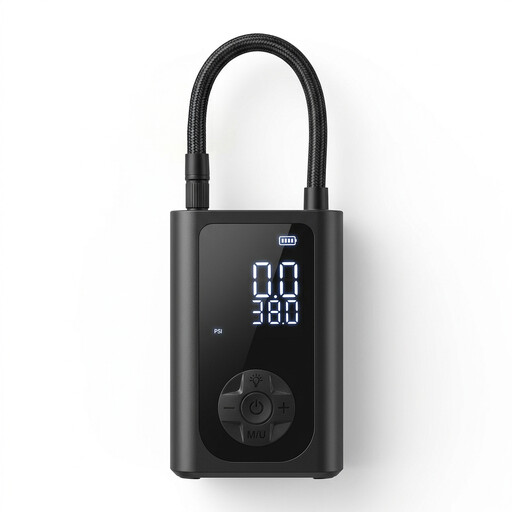
Why it suits this type of user: This compact battery-powered model is a good option if you need a digital tyre inflator with several preset modes for different uses. According to the product information, it supports cars, motorbikes, bicycles and balls, as well as a custom mode.
Information on charging time, run time and airflow helps you plan realistically. If you’re inflating several tyres, allow for the recommended breaks and check the battery charge.
4,000 mAh battery, 26 L/min airflow, 150 PSI maximum pressure and USB-C port, according to the product description.
We’ve put together a complete, regularly updated list of products that meet these strict selection criteria and fully comply with the safety regulations in force in the EU.
First, check the recommended pressure for your vehicle and, if possible, measure the tyre when it’s cold. Then connect the hose securely to the valve, select the correct unit and target pressure, and start inflating. Check the pressure again after the pump switches off automatically.
It depends on the battery capacity, tyre size, starting pressure and temperature. Figures such as ‘25 minutes’ run time should therefore be treated as a guide. For emergencies, keep your battery-powered tyre inflator charged and take its charging cable with you.
A 12V tyre inflator doesn’t require separate battery charging while you’re using it. It draws power from your vehicle. Power consumption, how long you use it for and the vehicle battery all affect the cost. Use the device as directed in the manual, and avoid running it for unnecessarily long periods with the engine switched off.