
Lieferung heute & morgen

Qualitätsgarantie

Willkommens-Angebote freischalten: KOSTENLOSE Lieferung | Bis zu 80 % RABATT | Kostenlose 30-Tage-JoyPlus-Testphase
App herunterladen
A good vegetable chopper promises to be a significant time-saver in the kitchen. Uniform cubes, fine julienne strips, or perfect spirals in seconds—that's the goal. But the market is flooded with devices of widely varying quality. Many buyers soon discover that their new kitchen gadget causes more frustration than joy. Before you make a decision, it's crucial to understand the typical weaknesses that can render a promising appliance useless.
This guide focuses on the objective criteria that truly matter, helping you distinguish marketing hype from genuine functionality.
Disappointment with kitchen appliances often stems from the same fundamental problems. Pay close attention to these three points to avoid a bad purchase:
To avoid the pitfalls mentioned above, you should focus on a few crucial technical parameters. These determine the durability, safety, and practical utility of your vegetable chopper.
The heart of any cutting device is its blades. There are no compromises here: blades made of stainless steel (often labelled as Inox or Stainless Steel) are the standard for durability and hygiene. Pay attention to the cutting shapes the included inserts provide. Common variants include:
A set with interchangeable blades offers more flexibility, but each blade must fit securely and stably in the housing.
The choice between a manual and an electric device depends on your cooking habits and the quantities you need to process.
The housing must withstand the forces generated during cutting. A non-slip base, often achieved with rubber feet, is a must for safe operation. There are two common options for the materials of the collection containers:
Instead of making a blanket recommendation, we have selected products tailored to specific user profiles that purposefully avoid the pitfalls mentioned above.
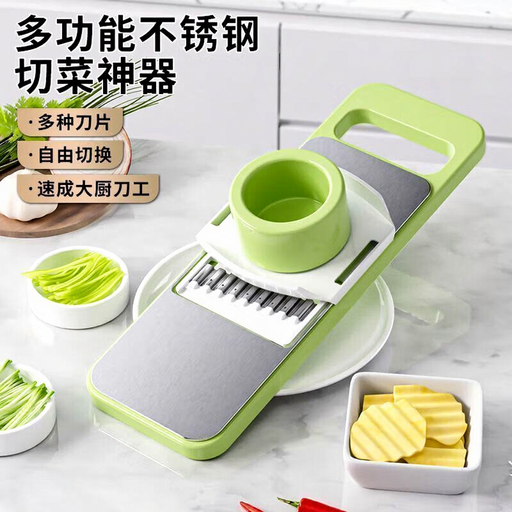
Why this model is a good fit: Ideal for novice cooks or occasional users looking for a simple, safe solution for basic cutting tasks like slicing cucumbers or potatoes. The focus is on straightforward handling without too many separate parts.
The included hand guard directly addresses the safety pitfall of mandolines, minimising the risk of injury. Its simple design avoids hard-to-clean corners.
Three stainless steel blades for different types of cuts. Compact design for easy storage.
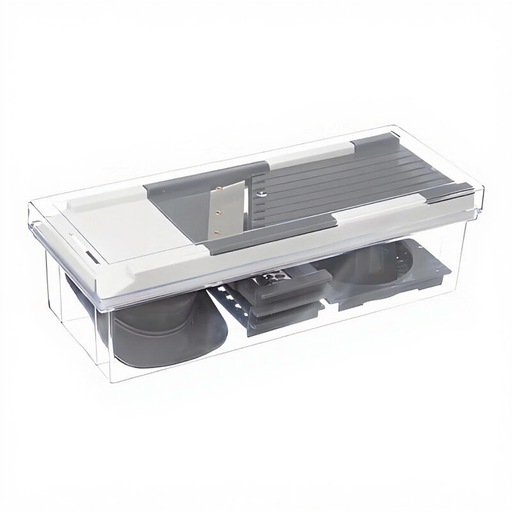
Why this model is a good fit: For creative cooks who want to do more than just slice. This 11-piece set covers slicing, grating, julienning, and spiralising, making it a central workstation for vegetable prep.
The polypropylene/polystyrene housing is designed for versatile use. All parts can be stored inside the collection container, which promotes tidiness and reduces cleaning chaos.
A comprehensive 11-piece set for maximum versatility, including a spiraliser. Compact dimensions (L. 30 x W. 11.6 x H. 8.7 cm) for easy storage.

Why this model is a good fit: For anyone who regularly prepares larger quantities, wants to save time, and also processes tougher ingredients like nuts or meat. The 300-watt motor and two speed settings offer power and control.
The sturdy glass bowls are durable, dishwasher-safe, and resist odours, bypassing the cleaning trap. A non-slip base and a safety lock address security concerns.
Two separate glass bowls (2 L + 0.6 L) with their own blade sets allow for the separate processing of ingredients without flavour transfer (e.g., onions and fruit).
We have compiled a complete, up-to-date list of products that fully meet these strict selection criteria and safety regulations.
Disassemble the appliance as much as possible immediately after use. Rinse all parts that came into contact with food under running water to remove coarse residue. Many parts, especially containers and some blade inserts, are dishwasher-safe—check the manufacturer's instructions for this. For the blades themselves, cleaning by hand with a brush is often gentler and safer. Let all parts dry completely before reassembling the device.
Yes, many modern electric choppers are also designed for small quantities. Models like the Bear chopper featured here offer a smaller, additional bowl (0.6 L) that is ideal for processing garlic, herbs, or a single onion. This prevents small amounts from just being flung to the sides of a large container.
A mandoline (or vegetable slicer) is primarily specialised in cutting food into uniform slices. The slice thickness is often adjustable. A multi-chopper is a more comprehensive system that usually has various interchangeable inserts to cut cubes, sticks (like a French fry cutter), or spirals in addition to slices. It is typically designed as a closed system with a collection container.