
Lieferung heute & morgen

Qualitätsgarantie

Willkommens-Angebote freischalten: KOSTENLOSE Lieferung | Bis zu 80 % RABATT | Kostenlose 30-Tage-JoyPlus-Testphase
App herunterladen
Electric vehicles for children combine physical activity, imaginative play and technical features. The choice ranges from a small electric car for children to a children’s electric quad bike or electric motorbike. Electric diggers, children’s electric tractors and electric karts are also part of the range. To make sure the vehicle suits your child’s age, size and intended use, don’t focus solely on its design and extra features.
A high top speed may look appealing in a product photo, but it’s often not suitable for younger children. What matters is having several clearly defined speed settings, controlled acceleration and an easily accessible brake. If you’re buying a battery-powered ride-on for a child, also check whether you can limit its use or stop it using a remote control.
Actual running time depends on factors such as the rider’s weight, the surface, temperature, gradients and riding style. So a claim such as ‘up to’ doesn’t guarantee that you’ll achieve the stated figure. Check the battery voltage and capacity, charging time and whether a replacement battery is available. A powerful motor can reduce running time if the battery is small.
Music, LED lights, a trailer, a tipping tray or app control can all add to the fun. But they tell you little about whether the seat height, footrest, handlebars and vehicle width are right for your child. An electric vehicle for children aged 3 and over should only be used if your child’s age and size are suitable and they’re within the manufacturer’s stated weight limit.
Low speeds and easy-to-use controls are important for toddlers. When comparing models, look out for:
A ride-on with remote control is particularly useful if your child isn’t yet confident steering or is just starting out under your direct supervision. However, a remote control is no substitute for supervision.
Always consider the battery specifications alongside the motor power and vehicle weight. A 12 V model with a moderate top speed is typically designed quite differently from a 36 V electric motorbike for children with off-road tyres. Check:
An electric quad bike or electric ride-on for outdoor use should also have tyres that are suitable for the surface. Smooth plastic wheels are suitable for flat surfaces, while treaded tyres may provide better traction on grass or paved paths.
For two-seaters, the maximum weight limit often applies to the combined weight of all the children. Accessories, luggage or a trailer can also add to the load. So be sure to check:
The CE marking is an important formal indicator for many toys and children’s products. It shouldn’t be treated as equivalent to an independent quality test. You should also check the instructions, warnings and responsible contact address in the EU. Only use the vehicle on suitable, clear surfaces, and don’t leave children unsupervised when they’re using motorised models.
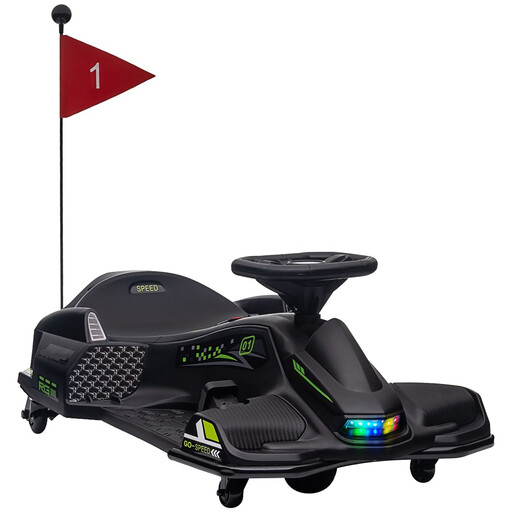
Why it suits this profile: This 12 V kart has a compact design and an adjustable speed of 3 to 8 km/h. It’s a good choice for families looking for a straightforward model to use on flat outdoor surfaces.
Its low speed range means the focus isn’t on reaching a high top speed. Even so, check the seat size and stated weight limit before buying.
12 V system, adjustable speed of 3–8 km/h and a kart design for controlled driving.

Why it suits this profile: Designed for children aged 5 to 12, this model combines a five-wheel design with app-based speed control. It can be used indoors and outdoors on suitable, flat surfaces.
The three speed settings of 5, 10 and 15 km/h make it easy to choose a suitable speed. The stated range of up to 15–20 km depends on the conditions of use.
120 W motor, 24 V 4.5 Ah battery, foldable design and a maximum weight limit of 60 kg according to the product details.
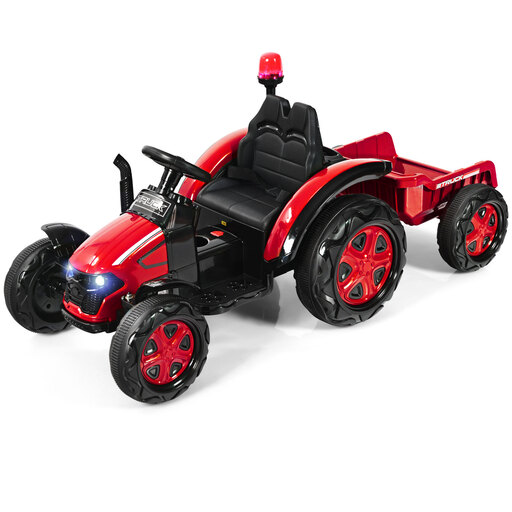
Why it suits this profile: This electric tractor for children is designed for imaginative play around the garden, farm or building site. The trailer, music features and remote control will appeal to families looking for a vehicle that offers several ways to play.
The product details specify a speed of 3–8 km/h, a two-point seat belt and a 2.4 GHz remote control. This makes it easier to plan the speed and supervision.
12 V 7 Ah battery, trailer, 30 kg weight limit and suitable for use on tarmac, grass or sand according to the product description.
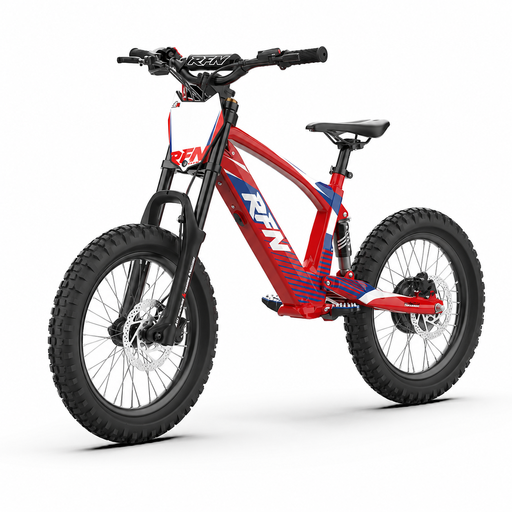
Why it suits this profile: With a 500 W motor, three speed settings and hydraulic brakes, this electric motorbike for children is designed for more demanding use under adult supervision.
The three settings are clearly stated as 15, 22 and 30 km/h. Given the high speeds, carefully check your child’s age and size, protective clothing, the route and the level of supervision required.
36 V, 500 W, hydraulic front and rear brakes, and a stated maximum weight limit of 70 kg.
We’ve put together a complete, regularly updated list of products that meet these strict selection criteria and fully comply with the safety regulations in force in the EU.
It depends on the type of vehicle, your child’s height and weight, and how easy it is to use. Simple 6 V models or push-along ride-ons may be suitable for toddlers. An electric vehicle for children aged 3 and over should only be used in accordance with the manufacturer’s instructions and under supervision. Faster motorbikes and off-road models are intended for older or more experienced children.
There’s no one-size-fits-all answer. Battery capacity, motor power, the surface, the load and the temperature all affect running time. After each use, charge the battery as instructed and don’t store it fully discharged for long periods.
The electricity cost per charge is usually modest. You should also factor in charging time, possible replacement batteries, tyres, the charger and spare parts. For vehicles with more powerful motors, battery and maintenance costs can add up more over time than they would for a simple electric car for children.