
Lieferung heute & morgen

Qualitätsgarantie

Willkommens-Angebote freischalten: KOSTENLOSE Lieferung | Bis zu 80 % RABATT | Kostenlose 30-Tage-JoyPlus-Testphase
App herunterladen
An electric vehicle can provide varied playtime outdoors and indoors. At the same time, a children’s electric car, an electric quad bike and an electric scooter differ considerably in terms of operation, speed, space requirements and safety features. If you focus only on design, motor power or additional music functions, it is easy to overlook important details.
This buying guide from the Joybuy Product Recommendation Officer explains which details you should check before buying and which models suit different family profiles.
For an electric vehicle for children aged 3 and over, controlled, age-appropriate speed is more important than a high maximum speed. A vehicle with gentle acceleration, several riding modes and an easily accessible stop function is easier to supervise in everyday use.
Models with noticeably higher speeds, such as a children’s electric motorbike, may seem appealing, particularly to older children. However, suitability does not depend on age alone. Height, riding ability, braking behaviour and the intended riding surface must also be taken into account.
An electric vehicle for children with remote control allows adults to intervene while the child is riding. This is practical for younger children, but it does not automatically guarantee safety. Before buying, check whether the remote control has an emergency stop switch, speed selection and a reliable connection.
For vehicles without a remote control, children must be able to operate the accelerator, brake or stop function and direction changes safely themselves. A test ride under direct supervision is therefore still advisable.
The range of a battery-powered children’s vehicle depends on factors including weight, speed, surface, temperature and gradient. A children’s vehicle with a 12V battery is often designed for lower speeds and shorter distances. That is why it is important to consider not only the voltage and Ah ratings, but also:
The manufacturer’s age recommendation is a useful starting point. You must also make sure that the seat height, footwell, handlebar position and maximum load are suitable. For a two-seater, do not confuse the stated total load with the weight of one child.
A children’s electric ride-on with a safety belt is often easier for younger users to control than a taller vehicle with a two-wheel design. A children’s vehicle with a safety belt should have an adjustable belt that holds the child comfortably but securely in the seat.
A motor with two-wheel drive can offer advantages on grass or slightly uneven ground. Even so, a toy vehicle does not automatically become a suitable off-road model. Check the following:
An off-road electric vehicle for children should only be used on surfaces expressly approved by the manufacturer. Wet paths, steep gradients and loose surfaces increase the risk of slipping or tipping over.
Before buying, consider the product page, user manual and warnings together. Look for clear manufacturer or importer details within the EU, the recommended age group, information about protective equipment and permitted use.
For toys, the CE marking is an important indication of declared EU conformity. However, it does not replace checking the vehicle’s construction, riding environment and supervision. Information such as ASTM or CPSIA relates to other jurisdictions and, on its own, does not prove compliance with European requirements.
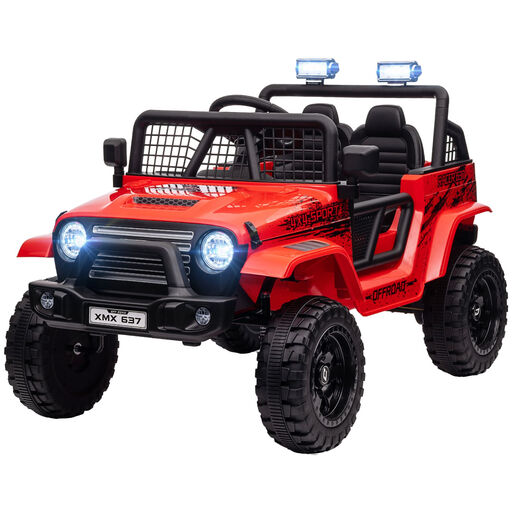
Why this product suits this profile: According to the product details, this 12-volt vehicle is designed for children aged 3 to 7 and combines a ride-on vehicle with remote control, lighting and music.
The remote control gives adults an additional way to intervene. Before use, check the range, emergency stop function and supervision guidance.
12-volt system, seat belt according to the product description, plus two-wheel drive and a stated speed of 3 to 8 km/h.

Why this product suits this profile: According to the product details, this model is designed for children aged 5 to 12 and features a foldable design, app control and a five-wheel configuration.
Three selectable speed settings of 5, 10 and 15 km/h, together with an app for limiting the speed, support a gradual introduction to riding.
120-watt motor, 24-volt battery with 4.5 Ah, foldable design and, according to the supplier, a load capacity of up to 60 kg.
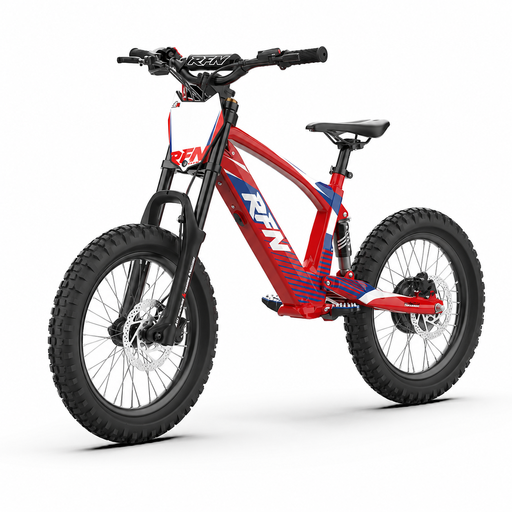
Why this product suits this profile: This off-road children’s electric motorbike is aimed at families looking for a more powerful vehicle for suitable private land.
Three riding modes of 15, 22 and 30 km/h allow the speed to be adjusted. Given the stated power and speed, age, protective equipment, riding surface and supervision should be checked particularly carefully.
500-watt rated power, 18-inch tyres, hydraulic brakes, front-wheel suspension and, according to the product data, a maximum load of 70 kg.
We have put together a complete, regularly updated list of products that fully meet these strict selection criteria and the safety regulations applicable in the EU.
The ongoing costs of an electric vehicle for children consist of more than just electricity. Wear parts, replacement batteries, tyres, chargers and possible transport costs are also relevant. A battery with a larger capacity takes longer to charge, but may provide longer riding times depending on how it is used. Its actual service life depends on charging cycles, storage, temperature and care.
Before every ride, check the tyres, seat fastening, belt, cables, charging socket and casing. After use, the vehicle should be stored dry and in accordance with the instructions. Chargers must be kept out of children’s reach; charging should take place on a suitable, non-flammable surface and in line with the manufacturer’s instructions.
That depends on the model. Many ride-on vehicles are marked as electric vehicles for children aged 3 and over, while more powerful scooters, quad bikes and motorbikes are designed for older children. Height, weight, ability to operate the vehicle and direct adult supervision are also crucial.
There is no universal answer. Battery capacity, motor power, load, riding mode and surface all affect the runtime. Check the manufacturer’s stated riding time and bear in mind that frequent riding at high speed can reduce the runtime.
The design alone does not determine safety. A children’s electric car often has a seat, bodywork and belt, while a quad bike or motorbike may require greater balance and more active control of the vehicle. Choose according to age, experience, speed, braking system and intended terrain – and always use suitable protective equipment.