
Lieferung heute & morgen

Qualitätsgarantie

Willkommens-Angebote freischalten: KOSTENLOSE Lieferung | Bis zu 80 % RABATT | Kostenlose 30-Tage-JoyPlus-Testphase
App herunterladen
An electric air pump can make inflating car tyres, bicycle tyres, balls or air beds much easier. However, devices vary considerably in terms of pressure, airflow, power supply and accessories. A small cordless air pump for bicycle tyres is not automatically suitable for car tyres, while a powerful air-bed pump usually does not generate sufficient pressure for tyres.
Understanding advertising claims such as “150 PSI” or “fast inflation” correctly helps you avoid unsuitable purchases. The following selection from the Joybuy Product Recommendation Officer explains what matters when choosing the right electric air pump.
A figure such as 150 PSI, or approximately 10.3 bar, describes the stated maximum pressure. On its own, it says little about how quickly a device can inflate a car tyre, motorcycle tyre or bicycle tyre. As back pressure increases, the delivery rate normally decreases.
For a bicycle tyre, high pressure and a compatible valve are crucial. With car tyres, motor power, battery capacity, hose length and inflation time per tyre are also important. A 150 PSI air pump may be suitable for several applications, but it should not be selected based on this figure alone.
Air beds, paddling pools and inflatable items often require a high airflow at comparatively low pressure. Devices with specifications such as 420 l/min or 1100 l/min are more suitable for this purpose than a compact cordless compressor designed to achieve high tyre pressure.
An electric inflator and deflator for air beds should also have suitable nozzles and, ideally, a deflation function. Conversely, a conventional air-bed pump is not suitable as an electric tyre pump.
A cordless air pump works without a mains socket, but it needs to be charged before a journey or cycling trip. Check the following:
Battery-powered models, such as those using six C batteries, involve additional ongoing costs. In return, there is no need to charge an integrated battery beforehand.
The delivery rate in litres per minute is particularly relevant for air beds and large inflatable items. For car tyres, however, the combination of pressure range, actual inflation time and remaining battery capacity is more important.
A pump for bicycles and cars should come with suitable valve adapters. For bicycles, particular attention should be paid to Presta and Schrader valves. Car tyres generally use Schrader valves. Balls usually require an additional needle.
A tyre inflator with a digital display makes it easier to set a target pressure. Ease of use depends not only on the display size, but also on the available units, such as PSI, BAR or kPa.
The automatic shut-off stops the process as soon as the preset pressure is reached. This reduces the amount of monitoring required during inflation. Nevertheless, you should check the valve, hose connection and tyre pressure before and after use. The pressure specified by the vehicle, bicycle or tyre manufacturer is the one that matters.
There are three options for mobile use:
Also look for clear operating instructions, suitable nozzles, a sturdy hose connection and reliable heat dissipation. A CE mark is specified for the products listed; however, the manufacturer’s specific safety instructions remain decisive.
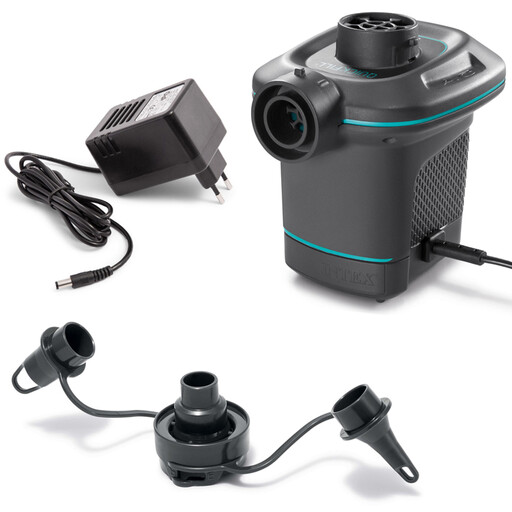
Why this product suits this profile: For occasional use with air beds, inflatable boats or other inflatable products, this compact battery-powered air pump offers a straightforward solution indoors and outdoors.
Its intended use is clear: this model is designed for inflatable items, not for inflating car tyres. This avoids creating false expectations based on the maximum pressure.
The specifications state at least 420 l/min, three connection nozzles and a weight of 0.6 kg. Six C batteries at 1.5 V are not included.
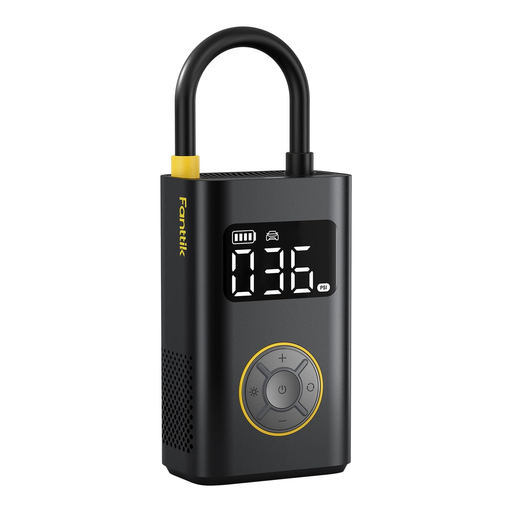
Why this product suits this profile: Drivers, motorcyclists and bicycle and e-bike riders get a device with several preset modes and a digital pressure display for use on the go.
The automatic shut-off operates according to the preset pressure. The hose is also integrated into the housing, so fewer loose parts need to be carried.
The manufacturer states up to 150 PSI, a 7.4-V, 2.5-Ah battery and up to 23 minutes of continuous runtime. The display offers several modes.
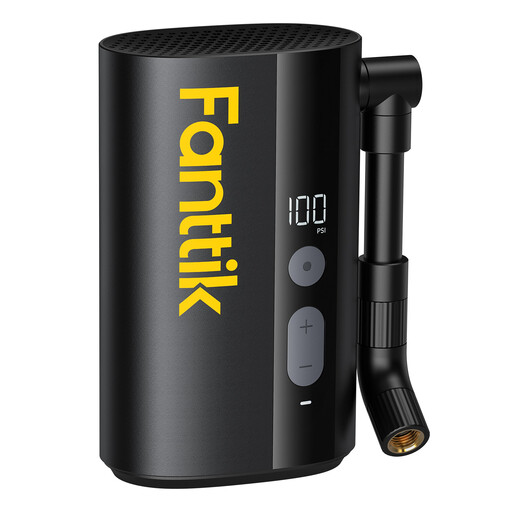
Why this product suits this profile: Its compact design is aimed at cyclists who want to carry an electric bicycle pump in a rucksack or with their equipment.
The product description explicitly states that it is intended for bicycles only. This prevents it from being mistakenly chosen as a universal car tyre pump.
The specifications state 150 PSI, a 5000-mAh battery, Presta and Schrader valves, plus automatic shut-off when the target pressure is reached.
Why this product suits this profile: For campsites, gardens, homes or large air beds, mains operation is suitable when a 220–240-volt socket is available.
The mains connection makes it clear that the pump does not rely on a small battery or disposable batteries. This model is not intended for tyres.
The specifications state more than 1100 l/min, three connection nozzles, a hose, a carry handle and integrated thermal overload protection. Inflation and deflation are possible.
We have put together a complete, regularly updated list of products that fully meet these strict selection criteria and the safety regulations applicable in the EU.
Before use, make sure the appropriate adapter is firmly attached and that the air outlet remains unobstructed. For tyres, checking the pressure with the vehicle or bicycle handbook as a reference is recommended. If a battery- or motor-powered device becomes noticeably hot, allow it to cool down and observe the maximum runtime specified by the manufacturer.
Electrical components must not come into contact with water. Batteries should be removed from battery-powered pumps if they will not be used for an extended period. Store cordless devices in a dry, frost-free place and check their charge level regularly. This helps prevent common failures caused by moisture, deep discharge or loose accessories.
For car tyres, an electric tyre pump with a Schrader connection, a sufficient pressure range, a digital display and automatic shut-off is a sensible choice. Also check the battery capacity and stated inflation time. A dedicated air-bed pump with a high airflow rate is not automatically suitable for this purpose.
Runtime depends on battery capacity, tyre pressure, ambient temperature and workload. Depending on the model, product specifications range from specific operating times to details of how many tyres can be inflated. For longer journeys, the cordless air pump should be fully charged and the charging cable carried with you.
With an integrated battery, the main cost is the electricity required for charging. Battery-powered models, on the other hand, incur the cost of six C batteries if these are not already available. A 220–240-volt device requires a mains socket, but can be used for frequent air-bed inflation without needing to recharge a battery.