
Lieferung heute & morgen

Qualitätsgarantie

Willkommens-Angebote freischalten: KOSTENLOSE Lieferung | Bis zu 80 % RABATT | Kostenlose 30-Tage-JoyPlus-Testphase
App herunterladen
Electrical kitchen appliances can make everyday life easier, but they do not automatically require little space, energy or maintenance. In small kitchens, student accommodation or the office, it quickly becomes clear whether an appliance really suits your needs. That is why our selection focuses on clear, meaningful specifications such as power, capacity, dimensions, controls, safety features and cleaning requirements.
A high wattage initially sounds impressive. However, on its own, it says little about how suitable an appliance is for its intended purpose. A 2,200-watt kettle will generally heat water quickly, while a food processor also depends on motor control, the mixing mechanism and its ability to handle demanding tasks. With an electric cooking pot, capacity, temperature settings and overheating protection are equally important.
Compact kitchen appliances are often judged solely by their footprint. In practice, storage also needs to accommodate cables, lids, bowls, inserts and detachable parts. A food steamer with several tiers requires considerably more vertical space when in use than when assembled for storage. Before buying, you should therefore measure the footprint, appliance height and available storage space.
Non-stick coatings can make cleaning easier, but they require careful handling with wooden or silicone utensils. Electrical components must not be immersed in water. With a coffee grinder, the grinding container and blades should be easy to access; with a food processor, dishwasher-safe attachments are useful. Overlooking these points may mean you use an appliance less often in everyday life than originally planned.
In Germany, appliances rated at 220–240 volts and 50–60 hertz are designed for standard household sockets, provided these specifications are stated on the product. Power is measured in watts:
Actual suitability depends on how the appliance will be used. For a single-person household, a 600-watt appliance with a capacity of 1.6 litres may be more suitable than a much more powerful model with a large housing.
Capacity should match your usual portion sizes. 1 to 1.6 litres is practical for many kitchen appliances used by individuals and couples. For family meals or preparing several components in one go, appliances with a capacity of 5 to 14 litres are more suitable. However, a larger container needs more space and may use unnecessarily large amounts of energy when preparing small portions.
Look for clearly described features such as overheating protection, boil-dry protection, automatic switch-off, a safety lock or child lock. With an induction hob, the cookware must be magnetic. A kettle should switch off automatically once the water has boiled. For appliances that produce steam or have hot surfaces, heat-insulated handles, a stable base and a securely removable lid are important.

Why this product suits the profile: This compact electric cooking pot is aimed at individuals, students and couples who want to prepare noodles, soups or simple one-pot meals.
The 1.6-litre capacity helps keep space requirements to a minimum. Automatic switch-off and boil-dry protection are specified as concrete safety features.
600 watts, one-button operation and a non-stick coating; designed for small portions and limited storage space.
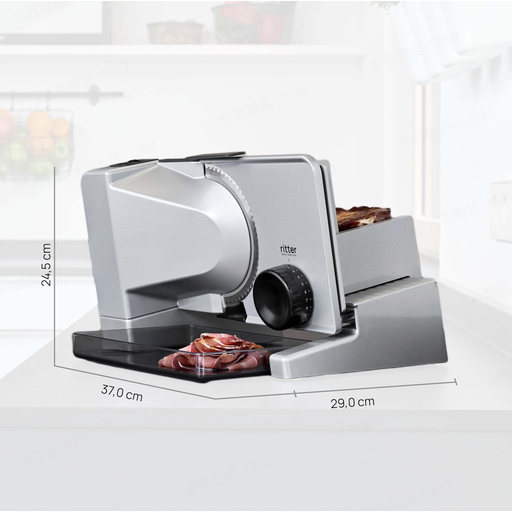
Why this product suits the profile: Anyone who regularly slices bread, vegetables or cured meats gets an appliance with a metal construction, adjustable speed and two blades.
The cutting thickness is specified as up to 23 mm. A removable carriage and collection tray make cleaning and handling easier.
All-metal construction, 24 cm cutting path, electronically adjustable speed and safety controls.
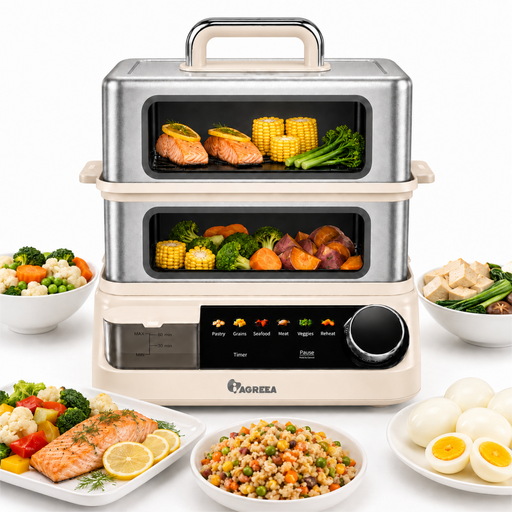
Why this product suits the profile: Families and users who want to steam several ingredients at once benefit from two tiers and an external water tank.
The 14-litre capacity and two stainless-steel containers are clearly specified. Viewing windows reduce the need to open the appliance frequently during cooking.
2,000 watts, 2.5-litre water tank, six pre-set programmes and removable stainless-steel containers.

Why this product suits the profile: This appliance is suitable for rented homes, office kitchens, campsites and households that need an additional cooking zone.
You can check whether your cookware is compatible before buying: a magnetic base is required. A child lock and boil-dry protection are specified.
2,000 watts, ten power levels, six functions, touch controls and a space-saving housing.
For breakfast and drinks, compact appliances are often all you need: a 1.7-litre kettle is suitable for several cups, while a coffee grinder with a 75-gram bean capacity is better suited to individual brewing sessions. A hand mixer with five speed settings takes up little storage space, whereas a food processor with a 6-litre bowl is designed for larger quantities of dough.
A sandwich maker should have heat-insulated handles, non-slip feet and an easily accessible non-stick surface. With a built-in oven, the cooking chamber, installation dimensions, connected load, timer and cleaning function all matter. What matters most is whether the features genuinely suit the way you cook, rather than simply sounding convincing on the packaging.
We have put together a complete, regularly updated list of products that fully meet these strict selection criteria and the safety regulations applicable in the EU.
For individuals and couples, a 1- to 1.6-litre multi-cooker, a compact kettle, a hand mixer or a portable induction hob is often practical. Before buying, compare the footprint, power and number of features you actually need.
Costs depend on the appliance’s power, how long it is used and your electricity tariff. The simple calculation is: wattage divided by 1,000 × operating hours × electricity price per kilowatt-hour. An appliance rated at 600 watts that runs for 30 minutes uses 0.3 kilowatt-hours in theory.
It is not possible to give a fixed lifespan for every product category. Careful cleaning, unobstructed ventilation openings, correct filling levels and following the operating instructions can help extend an appliance’s useful life. Wear parts, coatings and moving components should be checked regularly for visible damage.