
Lieferung heute & morgen

Qualitätsgarantie

Willkommens-Angebote freischalten: KOSTENLOSE Lieferung | Bis zu 80 % RABATT | Kostenlose 30-Tage-JoyPlus-Testphase
App herunterladen
Electrical kitchen appliances can save space in small flats, student accommodation, office kitchens or when camping, while making everyday meals easier. At the same time, unclear power specifications, containers that are too small or components that are difficult to clean often lead to poor purchases. What matters is not the number of advertised functions, but whether the capacity, controls, safety features and footprint suit your everyday needs.
A multi-function cooker can boil, steam and braise. However, that does not automatically mean that every function is equally suitable for its intended purpose. For example, a small 1.6-litre electric cooker is suitable for pasta, soup or a single portion, but it cannot replace a large saucepan for several people.
Look for specific details about capacity, power, temperature settings and accessories. Terms such as “multi-function” should be supported by clearly explained programmes or adjustable heating power.
A non-stick cooker can make cleaning easier. However, the coating will only remain intact for longer if suitable kitchen utensils are used. Metal cutlery can damage the surface. If there are visible scratches or flaking material, stop using the pot.
Also check whether the inner pot can be removed and, where stated, whether it is dishwasher-safe. This makes daily care considerably easier.
Overheating protection, dry-boil protection, automatic switch-off and a child lock are useful features. They still do not mean that an appliance can be operated unattended. Hot surfaces, steam and liquids can cause burns.
For use in Germany, you should also check that the appliance has the correct mains voltage of 220–240 volts and a suitable plug. The instruction manual must provide clear information on cleaning, the maximum fill level and positioning.
Capacity is one of the most useful points of comparison:
The stated litre capacity does not always indicate the actual usable volume. Pay attention to the maximum fill marking inside the pot and allow for the necessary safety margin when preparing soups or starchy foods.
The wattage indicates how much electrical power an appliance consumes. A 1.2-litre mini rice cooker with 860 watts operates differently from a portable cooker with 600 watts. Higher power can speed up heating, but on its own it says nothing about temperature distribution or the quality of the controls.
For versatile use, several power settings, a dial or preset programmes are often more useful than the highest possible wattage. Someone who only cooks rice needs different functions from someone who regularly prepares soup, porridge and steamed vegetables.
Measure the available worktop space before buying. A slim induction hob is easier to store after use than a built-in cooker. For small flats, detachable cables, folding handles and removable containers are particularly practical.
With a food steamer or air fryer, you should also check whether the drawer, baskets or inserts are easy to access. An electric grill requires a stable, heat-resistant surface and sufficient clearance from flammable objects.

Why this product suits this profile: This compact pot is designed for individuals and couples and is suitable for ramen, pasta, soup or simple braised dishes. With a capacity of 1.6 litres and 600 watts, it takes up comparatively little space.
The capacity and one-knob controls are clearly specified. Overheating protection and automatic switch-off are stated in the product description; supervision is still required.
1.6-litre container, non-stick coating, 600 watts, dry-boil protection and automatic switch-off.
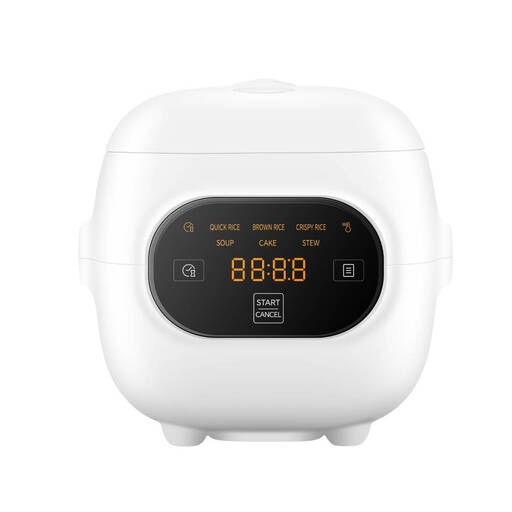
Why this product suits this profile: For singles and couples who prefer predictable cooking, this mini rice cooker offers six programmes, a 24-hour timer and a keep-warm function.
The programmes are clearly named instead of simply being marketed with a general multi-function claim. According to the product description, the removable inner pot is dishwasher-safe.
1.2 litres for 1–2 people, LED display, six one-touch programmes and included steaming insert.
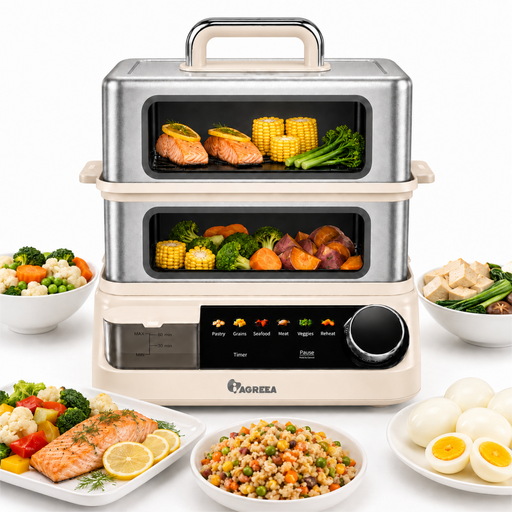
Why this product suits this profile: Two tiers and a 14-litre capacity are designed for family meals, vegetables, fish or several side dishes in one cycle.
The separate stainless-steel trays and external 2.5-litre water tank make the intended use clear. Viewing windows reduce the need to open the steamer unnecessarily during cooking.
14 litres, two tiers, 2,000 watts, six programmes and two removable stainless-steel trays.
An air fryer is worth considering when you want to prepare small quantities with a short preheating time. An induction hob requires magnetic cookware and is suitable as a flexible single cooking zone. An electric grill is suitable for indoor use only if the manufacturer’s specifications expressly permit it; a charcoal tabletop grill belongs outdoors and requires a fireproof, stable base.
For larger kitchens, an integrated oven with fan-assisted cooking, a grill and a timer can replace several individual appliances. Before buying, check the installation dimensions, electrical connection and ventilation. If you often slow-cook or prepare soup in advance, you could consider a slow cooker or a larger multi-function cooker.
We have put together a complete, regularly updated list of products that fully meet these strict selection criteria and the safety regulations applicable in the EU.
For singles and couples, mini rice cookers of around 1.2 litres or electric cooking pots with capacities of 1.6 to 2.4 litres are usually sufficient. The key factors are the actual portion sizes, the available space and your preferred cooking method. An appliance with a steaming insert can cover several functions, but it requires more storage space.
The cost depends on the power rating, usage time and electricity tariff. The basic calculation is: wattage divided by 1,000 × operating hours × electricity price per kilowatt-hour. An appliance rated at 1,000 watts that runs for 30 minutes uses 0.5 kilowatt-hours in theory. Thermostats, heating breaks and programmes can affect actual consumption.
There is no single lifespan that can be applied to every appliance. It depends on the design, usage, cleaning and care. Allow appliances to cool down before cleaning them, do not immerse the housing in water, and use wooden or silicone utensils with non-stick coatings. Damaged cables, plugs or housings should be checked before further use and replaced if necessary.