
Lieferung heute & morgen

Qualitätsgarantie

Willkommens-Angebote freischalten: KOSTENLOSE Lieferung | Bis zu 80 % RABATT | Kostenlose 30-Tage-JoyPlus-Testphase
App herunterladen
Freshly ground beans can make preparing espresso, filter coffee, moka or French press much more personal. An electric coffee grinder takes the manual effort out of grinding and, depending on the model, enables time-based or quantity-based dosing. However, grinders differ considerably when it comes to burr type, operation, capacity and cleaning.
Anyone who focuses only on wattage or a high number of grind settings may overlook important details. Three common buying misconceptions are particularly relevant:
A coffee grinder with burrs breaks the beans down between two grinding surfaces. Conical and flat burr grinders generally allow a defined particle size to be selected. In an electric coffee grinder with conical burrs, the ground coffee is produced between conical grinding surfaces. Models with flat burrs use two flat grinding discs.
Blades, on the other hand, chop the beans depending on the running time and movement. This can produce coarse and fine particles at the same time. For occasional coffee made with a filter machine, a coffee grinder with stainless steel blades may be sufficient. For espresso, pour-over or repeatable extraction, an adjustable burr grinder is usually the more controllable option.
An adjustable grind size should suit your intended brewing method:
However, the scale alone says little about the actual result. A setting of “10” is not comparable across different manufacturers. What matters is that the grinder can be adjusted finely enough and that the selected setting remains stable. If you are looking for a coffee grinder for espresso, you should also look for precise dosing and as little retained coffee as possible in the outlet.
For a small household, a bean capacity of 50 to 75 grams is often sufficient. Depending on the dose, this equates to several cups. Appliances with a capacity of 200 to 240 grams are more suitable for families, offices or users who want to grind several portions in succession.
Removable containers, a supplied cleaning brush and an easily accessible burr set are practical features. Internal burrs should generally not be rinsed with water. Before cleaning, a mains-powered appliance must be disconnected from the power supply. With a battery-powered coffee grinder, you also need to consider charging time, the USB-C connection and the possible number of grinding cycles. A portable coffee grinder should be compact yet sufficiently stable to stand securely when used away from home.
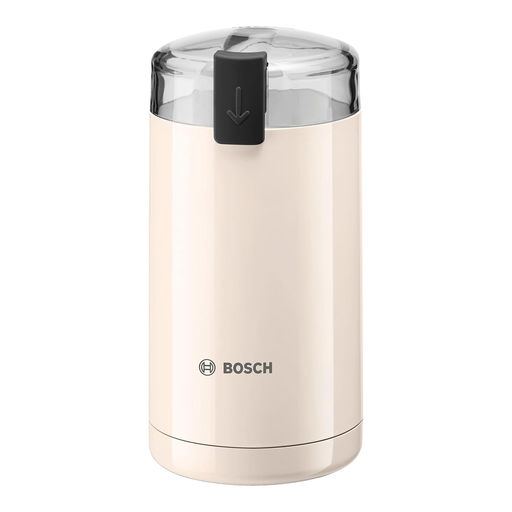
Why this product suits this profile: This compact appliance uses 180 watts, a stainless steel blade and has a capacity of 75 grams. It is operated via a push button, while a safety system prevents operation if the lid is not fitted correctly.
The technical specifications make it clear that this is not a grinder with continuous grind-size adjustment. Fineness is influenced by the running time, keeping expectations about adjustment realistic.
Compact dimensions of 9 × 9 × 17 cm, a weight of 618 grams and an integrated lid lock.
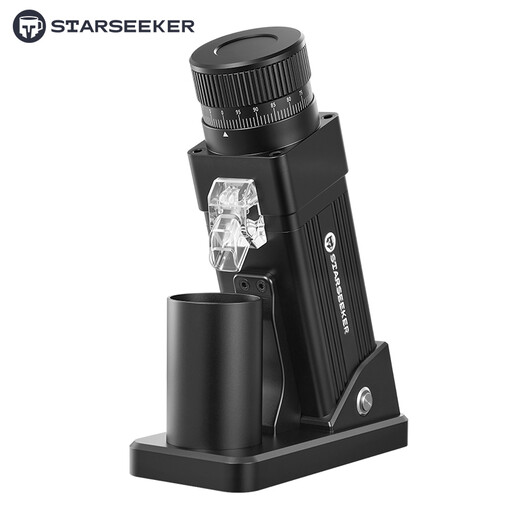
Why this product suits this profile: According to the product specifications, this model features 55 mm titanium-alloy conical burrs, a metal body and continuous grind-size adjustment. It is aimed at users who want to make fine adjustments when switching between espresso and pour-over.
The grind size is not selected simply by pressing the button for different lengths of time; instead, it is adjusted using a continuous adjustment ring. This makes small changes easier when switching beans or brewing methods.
55 mm conical burrs and a metal construction; the outlet is magnetically detachable, making it easy to access for cleaning.
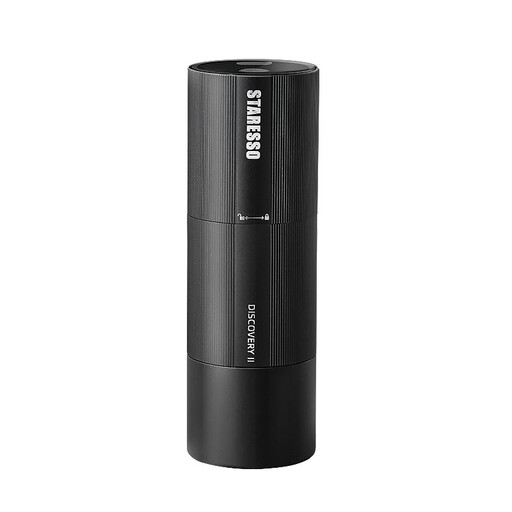
Why this product suits this profile: This compact, battery-powered coffee grinder has a 1000 mAh battery, a USB-C charging port and one-button operation. It is designed for use at home, in the office, while camping and on the go.
Its portability is supported by specific details about the battery, charging method and dimensions. Cleaning is carried out using removable parts and a dry brush; the burrs must not be rinsed with water.
Stainless steel burrs, adjustable grind size, a metal body and a stated charging time of approximately 2.5 hours.
We have put together a complete, regularly updated list of products that fully meet these strict selection criteria and the safety regulations applicable in the EU.
With a mains-powered coffee grinder for home use, electricity consumption per grinding cycle is usually only brief. Regular cleaning, the possible replacement of burr components and the motor’s service life are therefore more important for ongoing costs. Higher power alone does not provide a reliable indication of durability.
Noise should also not be judged solely by advertising claims. Conical burrs, motor speed, the housing and bean hardness all affect the sound. If you grind coffee in a flat in the morning, look for short grinding cycles, non-slip feet and a stable surface.
For care and maintenance: empty the bean hopper and grounds container according to the manufacturer’s instructions, remove coffee residue with a dry brush and do not immerse the motor housing in water. If the grinder becomes blocked, switch it off and disconnect it from the power supply. Foreign objects, spices, nuts and damp beans do not belong in a coffee grinder.
For espresso, a finely adjustable burr grinder is useful, as small changes can affect the preparation. A grinder with continuous or finely stepped adjustment offers more flexibility than a basic blade appliance. You should also check whether the dosing is suitable for your portafilter and the portion size you want.
There is no reliable way to state a standard service life. It depends on the motor, burrs, daily use, bean hardness and care. Regularly removing coffee residue, following the recommended running times and avoiding foreign objects can reduce the strain on the grinder.
Yes, provided it can be set to a coarse grind. For French press, the grounds should be noticeably coarser than those used for espresso. With blade grinders, this setting is usually approximated through short running times, while an adjustable conical or flat burr grinder enables more direct selection of the grind size.