
Lieferung heute & morgen

Qualitätsgarantie

Willkommens-Angebote freischalten: KOSTENLOSE Lieferung | Bis zu 80 % RABATT | Kostenlose 30-Tage-JoyPlus-Testphase
App herunterladen
Freshly ground coffee beans do not automatically require expensive equipment. What matters is whether the electric coffee grinder suits your preferred brewing method, daily quantity and available space. Espresso, pour-over and classic filter coffee require noticeably different grind sizes.
As a Joybuy Product Recommendation Officer, I filter the most important details from product descriptions and assess them according to practical usage scenarios. This helps you avoid common unsuitable purchases.
Motor power is often prominently advertised. However, the burr design, rotational speed and adjustment options are also important for the result. An electric coffee grinder with stainless-steel burrs can work reliably if it has been designed appropriately, while a device with blade cutters is more likely to chop the beans into uneven pieces.
A coffee grinder with 48 grind settings offers a wide choice on paper. What matters is whether the settings are sensibly distributed and remain stable during use. With espresso, even a small change can affect the extraction time. For filter coffee, coarser increments are often sufficient.
Fine coffee grounds can stick to the outlet, container or burrs. A removable outlet, brush and low static build-up make maintenance easier. As a general rule, water must never get inside an electric grinder.
An electric coffee grinder with conical burrs guides the beans between two cone-shaped grinding elements. According to the product details, models such as the Starseeker E55 Pro use 55 mm titanium-alloy conical burrs. This type of specification may appeal to users who want to switch between espresso and pour-over.
Flat burr grinders use two flat grinding discs. According to its description, the Ollygrin BG705 is equipped with flat burrs and 14 settings. Blade cutters, as found in products such as the Bosch TSM6A014R and Melitta Amigo, chop the beans using rotating blades. The grind size is mainly affected by the running time and is less repeatable.
A coffee grinder with grind-size adjustment should suit your brewing method:
According to the product data, the HiBREW G7 offers 48 grind settings, a timer adjustable in 0.1-second increments and three modes for 51, 54 and 58 mm portafilters. This is particularly relevant if you want to use a coffee grinder for espresso with different portafilter sizes.
For a two-person household, a bean hopper holding between 50 and 75 grams is often sufficient. According to the manufacturer’s information, the Bosch TSM6A014R can process up to 75 grams per cycle, while the BODUM BISTRO is designed for 60 grams. For larger quantities, buyers should also check the recommended breaks and operating time.
Useful features include:
For devices intended for use in Germany, 220–240 volts, a suitable mains plug, German-language instructions and manufacturer or importer details are also important checks. Safety features must not be bypassed.
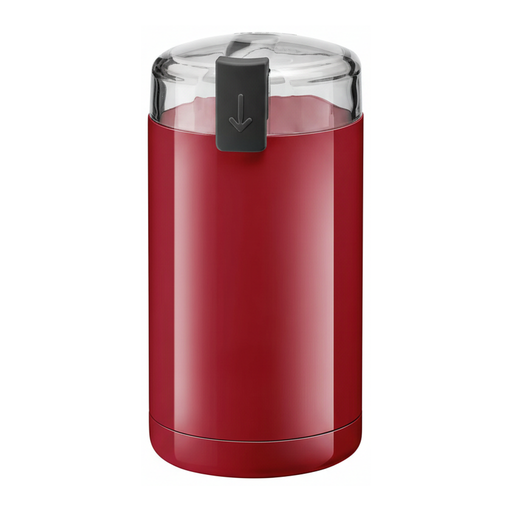
Why this product suits the profile: This compact coffee bean grinder is designed for simple household portions and can process up to 75 g of beans, according to the product data.
The safety system only starts when the lid is correctly fitted. The blade grinder also makes it clear that you should not expect stepless fine adjustment for espresso.
180 W motor, 75 g capacity, compact dimensions and automatic shut-off according to the product description.

Why this product suits the profile: The metal housing, 55 mm conical burrs and stepless grind adjustment are aimed at users who want to prepare both espresso and pour-over coffee with flexibility.
Stepless adjustment avoids large jumps between two grind settings. A magnetically removable outlet makes cleaning easier, while the plasma unit is designed to reduce static build-up, according to the description.
55 mm titanium-alloy conical burrs, 0.01 mm fine adjustment according to the product details and a metal construction.

Why this product suits the profile: Digital operation, three portafilter modes and settings ranging from espresso to pour-over make this a good choice for households using several brewing methods.
The grinding time can be adjusted in 0.1-second increments. This makes dosing easier to understand and repeat than with a simple timer without a display.
48 grind settings, 420 stainless-steel conical burrs, 150 W power and modes for 51, 54 and 58 mm portafilters according to the product data.
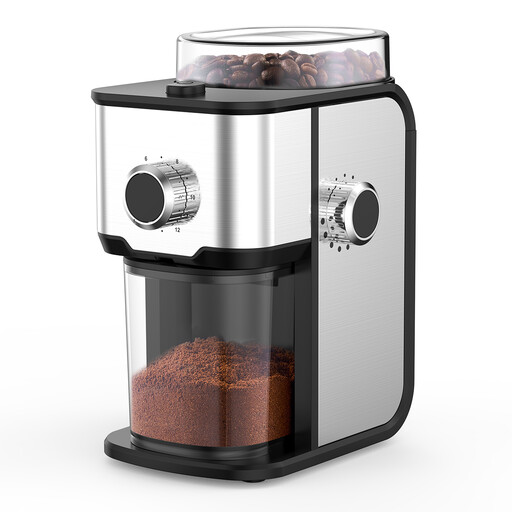
Why this product suits the profile: Its compact design and capacity for two to twelve cups make it suitable for regular use without taking up much worktop space.
The 14 clearly specified grind settings make the range of functions transparent. Buyers should nevertheless check whether the finest setting is suitable for their espresso.
Flat burrs, 14 grind settings, compact construction and capacity for 2 to 12 cups according to the description.
We have compiled a complete, regularly updated list of products that fully meet these strict selection criteria and the safety regulations applicable in the EU.
An electric coffee grinder is more likely to remain fully functional when it is cleaned regularly without water. This includes:
Oily beans can build up more heavily around the outlet, particularly when using a coffee grinder for espresso. In this case, an accessible design is more important than an additional convenience feature.
For filter coffee, a grinder with a medium to coarse adjustment range is sufficient. Conical or flat burrs with several clearly defined settings make adjustment easier. A blade grinder can work, but it delivers less repeatable results.
Many small increments are useful if you want to switch between filter coffee and espresso. A coffee grinder with 48 grind settings offers more adjustment options than a device with only a few positions. What matters is whether the relevant range is fine enough for espresso and coarse enough for your preferred filter method.
Most electric coffee grinders run for only a few seconds per portion. Electricity consumption per grinding cycle therefore remains low in most cases. For running costs, maintenance, wear parts and the correct dose are more important than wattage alone. A grinder should only be operated for as long as necessary to produce the required quantity.