
Lieferung heute & morgen

Qualitätsgarantie

Willkommens-Angebote freischalten: KOSTENLOSE Lieferung | Bis zu 80 % RABATT | Kostenlose 30-Tage-JoyPlus-Testphase
App herunterladen
An electric fan heater can warm individual rooms quickly without requiring fixed installation. It is particularly useful as a portable supplementary heater in the bedroom, office, study or living room. However, your choice should not be based solely on wattage or advertising claims. Room size, controls, noise levels, safety features and actual electricity consumption are all important factors.
A 2000 W fan heater generally delivers more maximum heating power than a 1500 W model. That does not mean it is the more sensible choice for every room. In a small, well-insulated office, a lower power setting may be sufficient. Larger or less well-insulated rooms may require higher output.
Adjustable power consumption is also important. A device that operates exclusively at full power will cost more to run over longer periods than a fan heater with several settings, a thermostat or an Eco mode.
An electric heater converts electrical energy into heat. The cost can be calculated easily:
Power in kilowatts × operating time in hours × electricity price per kilowatt-hour = cost
For example, a 2000 W fan heater consumes 2 kWh per hour when operating at full power. A thermostat can reduce the running time once the set room temperature has been reached. However, it does not reduce the physical power consumption during active heating. Claims such as ‘up to 40% energy saving’ should therefore be understood as the manufacturer’s stated figure for the relevant control or motor design, rather than a general guarantee for every household.
A quiet fan heater is worth considering for bedrooms and workspaces. Look for a specific decibel rating and check whether it applies to all operating levels. With fan-assisted devices, airflow, oscillation and power settings can affect the perceived noise level. The models listed state values between 25 and 50 dB; a direct comparison is only meaningful when the measurement conditions are the same.
A ceramic fan heater, also known as a PTC fan heater, uses a ceramic heating element with temperature-dependent properties. This design is often combined with fast start-up and several power settings. However, it does not replace an assessment of the actual room conditions.
Consider the following:
A fan heater with thermostat adjusts the heating output according to the measured room temperature. A setting range of 5 to 35 °C allows precise adjustment, but it does not indicate how evenly a room will actually be heated.
A fan heater with timer can limit the operating time or schedule automatic switch-off. A remote control makes it easier to operate the heater from your desk or bed. For everyday use, a clear display, simple buttons and an activatable child lock are also important.
Look for overheat protection, tip-over protection, a heat-resistant housing and automatic switch-off. These features reduce risks, but they do not replace safe operation.
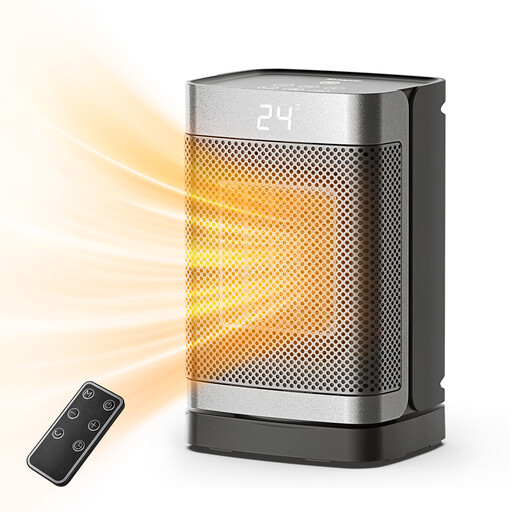
Why this product suits this profile: This compact model is aimed at shoppers looking for a portable supplementary heater for the bedroom, office or study, with essential convenience features.
Two heating modes and a 12-hour timer help tailor the operating time to your actual needs, rather than heating continuously at full power.
PTC heating element, remote control, LED display, plus tip-over and overheat protection according to the product description.

Why this product suits this profile: Suitable for shoppers who want to combine precise temperature selection and oscillation with a stated low noise range.
The manufacturer’s specifications state 25–42 dB, temperature control from 5–35 °C, 70° oscillation and eight safety features.
2000 W PTC heating, remote control, 12-hour timer and, according to the supplier, designed for 15–25 m².
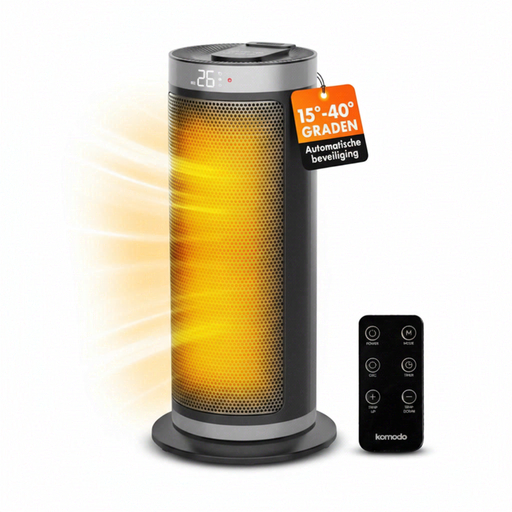
Why this product suits this profile: The three power settings and Eco mode are suitable for changing requirements in small to medium-sized rooms.
The adjustable settings of 750, 1500 and 2000 W mean you do not have to use maximum power for every situation.
90° oscillation, thermostat, remote control and IP66 according to the product description. Check the instructions and local conditions before using it in damp rooms.
We have put together a complete, regularly updated list of products that fully meet these strict selection criteria and the safety regulations applicable in the EU.
A 2000 W device requires 2 kWh per hour when operating at full power. A 1500 W model correspondingly uses 1.5 kWh per hour. A thermostat, timer and Eco mode can reduce the average running time. To calculate your individual cost, multiply the consumption by your electricity tariff.
A quiet fan heater with a thermostat, timer and tip-over protection may be suitable for limited use in the bedroom. The device must stand freely, must not be covered and should not be operated unattended. Also follow the manufacturer’s guidance on noise levels, minimum clearances and overnight use.
Its lifespan depends on how long it is used, exposure to dust, storage and build quality. Clean the air inlets only when the device is switched off and disconnected from the mains. If the cable is damaged or you notice an unusual smell, smoke or unusual noises, the electric room heater should be taken out of use immediately and must not be opened yourself.