
Lieferung heute & morgen

Qualitätsgarantie

Willkommens-Angebote freischalten: KOSTENLOSE Lieferung | Bis zu 80 % RABATT | Kostenlose 30-Tage-JoyPlus-Testphase
App herunterladen
An electric food chopper can make everyday food preparation much easier: onions, vegetables, herbs, nuts and meat can be processed in portions without a large food processor taking up permanent space. However, the choice can be overwhelming. Wattage, blade design and capacity are often prominently advertised, but on their own they reveal little about how suitable a product will be in practice.
Before buying, you should therefore avoid three common pitfalls:
Motor power is stated in watts. Models in the compact segment, for example, range from 240 to 550 watts, while larger multifunction choppers can offer considerably more. Wattage is a technical indication, but it is not proof of quality on its own.
More important is the combination of:
A chopper with a single press-operated function may be sufficient for onions, herbs and soft vegetables. Two speed settings offer more control, for example when switching between soft ingredients and firmer foods. For appliances with a limited operating time, the manufacturer’s instructions must be followed. The Bear QSJ-D03W5, for example, specifies a maximum continuous operating time of 40 seconds, followed by a pause.
For everyday household use, 0.5 to 0.8 litres is often suitable when preparing small quantities for salads, sauces, herb mixes or onions. Families or anyone who regularly processes larger quantities may benefit from a bowl with a capacity of 2 litres or more.
Pay attention to the difference between nominal and genuinely usable capacity. Ingredients need room to move so that the blades can reach them. Overfilling can lead to uneven pieces and place greater strain on the motor.
Plastic bowls are light and easy to handle. Glass containers are heavier, but allow you to monitor the contents directly and are less likely to absorb odours. With glass, details about heat resistance, microwave use and temperature changes must be stated explicitly in the product description. Not every glass container is suitable for hot or boiling food.
A chopper with stainless steel blades is designed for many typical ingredients. The number of blades can affect processing, but does not automatically guarantee a particular result. For meat, nuts or harder vegetables, a sturdy blade mount and a suitable speed setting are important.
You should also check:
A vegetable or onion chopper with a safety lock should ideally only start when the lid has been fitted correctly. The sharp blades should only be handled by the plastic mount. The appliance should be unplugged before cleaning.
A kitchen chopper with a compact bowl is ideal for small kitchens and quick preparation tasks. A mini food processor with several settings can be useful if you regularly want to switch between coarse chopping and finer puréeing. For larger family portions, a multifunction chopper with several attachments and a larger container is more practical, but it requires more storage space.
For baby food, always follow the relevant instructions for use. Ingredients must be allowed to cool sufficiently, and the container and blades must be cleaned thoroughly after every use. An appliance marketed as a baby food processor is not automatically suitable for every preparation method or for hot liquids.
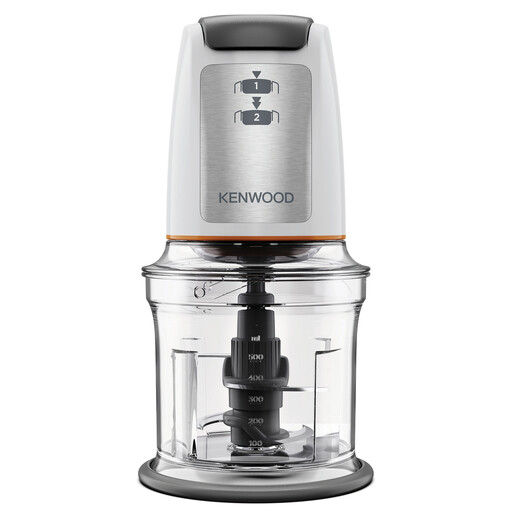
Why this product suits this profile: This compact kitchen chopper combines 500 watts with two speed settings and a 0.5-litre working bowl. That makes it suitable for small portions and occasional food preparation at home.
The two speed settings offer more control than a simple one-button operation. The clearly stated capacity helps prevent overfilling.
The 500 watts, 0.5-litre bowl and two speed settings are sensibly sized for small to medium kitchen tasks.
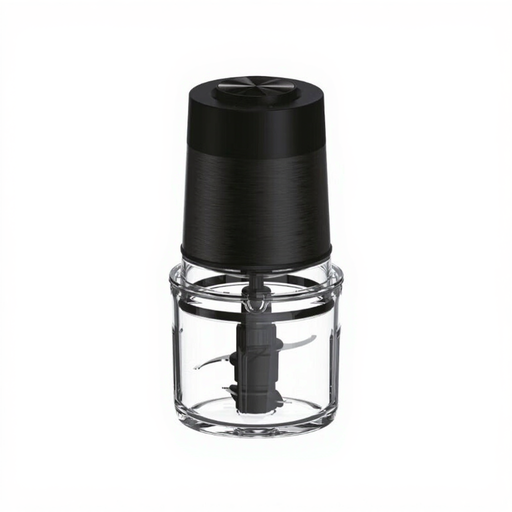
Why this product suits this profile: According to the product specifications, this onion chopper has 550 watts, four stainless steel blades, a 0.5-litre glass container and two speed settings with a pulse function.
The product description explicitly states that the bowl and blade units are dishwasher-safe. This clearly distinguishes the removable parts from the motor unit.
The glass container, four stainless steel blades and pulse function support visible, controlled processing of small quantities.

Why this product suits this profile: Two glass bowls with capacities of 0.6 and 2 litres, together with two stainless steel blade sets, allow small and large quantities to be prepared separately.
The two bowls help reduce the mixing of flavours. At the same time, according to the product specifications, the bowls are not heat-resistant or microwave-safe – this limitation should be taken into account.
300 watts, two speeds, two glass containers and dishwasher-safe bowls according to the product description.
We have put together a complete, regularly updated list of products that fully meet these strict selection criteria and the safety regulations applicable in the EU.
Cut large ingredients into smaller pieces first, and do not fill the bowl to the brim. For more even results, short pulses are often better than running the appliance continuously for a long time. An electric vegetable chopper should be operated according to the instructions provided by the relevant manufacturer.
Before cleaning:
Very hard foods such as bones and ice cubes, or unsuitable frozen ingredients, may only be processed if this is expressly permitted. A meat chopper is also not automatically designed for every quantity of meat or every operating time.
For onions, herbs and soft vegetables, compact appliances from around 240 watts may be sufficient. For more frequent use with firmer ingredients, models offering 300 to 550 watts and several settings provide additional power reserves. The permitted types of ingredients and maximum operating time remain the key considerations.
The actual running costs depend on the appliance’s power and how long it is used. As these appliances usually run for only a few seconds or minutes per task, their absolute electricity consumption per use is limited. For a rough estimate, you can multiply the motor power by the daily operating time.
There is no reliable way to state a standard service life. It depends, among other things, on operating time, quantity, ingredients, cleaning and storage. Avoiding overfilling, observing pause times, handling the blades carefully and keeping the motor unit dry will help reduce typical strain. The warranty and service conditions offered by the relevant supplier are also important.