
Lieferung heute & morgen

Qualitätsgarantie

Willkommens-Angebote freischalten: KOSTENLOSE Lieferung | Bis zu 80 % RABATT | Kostenlose 30-Tage-JoyPlus-Testphase
App herunterladen
An electric meat grinder can make kitchen tasks considerably easier – provided its design, accessories and operating limits suit your needs. However, many households choose a model based on a high wattage rating or a long list of accessories, overlooking important details. This can result in a machine that is too small for everyday use, difficult to clean or unsuitable for longer operating intervals.
Manufacturers often state a maximum power that can only be reached briefly. The rated power is more meaningful, as it gives a better indication of normal operation. A machine with a maximum power rating of 1,200 or 2,000 watts is therefore not automatically designed for large quantities or long operating times.
You should also check:
Compact machines in particular often operate in pulse mode. For example, the operating cycle of a Bear QSJ-D03W5 is limited to a maximum of 40 seconds, after which pauses are required. This is sufficient for a small portion, but preparing larger quantities will take correspondingly longer.
A multifunctional meat grinder can process not only minced meat but also sausages, kebbe and biscuit dough. However, what matters is whether the appropriate attachments are actually included. A meat grinder with sausage filler also requires a suitable filling opening and clear assembly instructions.
Check the exact specification:
A machine with different cutting discs allows fine, medium and coarse textures. By contrast, a food chopper with a blade attachment works differently: it chops ingredients, but does not create the same structure as a traditional meat grinder with an auger and cutting disc.
Meat residue, fat and spices can easily become lodged in blades, augers and cutting discs. Removable parts make cleaning easier. The motor unit, however, must never be immersed in water.
When choosing materials, specific details are more helpful than general terms such as “premium”:
For occasionally making your own minced meat, a compact machine with around 300 to 500 watts of rated power is often sufficient. If you regularly process larger portions, compare not only the power rating but also the size of the filling opening, bowl capacity and cooling intervals.
A meat grinder for home use does not necessarily have to be large. For single-person households or small families, a working capacity of 0.5 to 1.5 litres may be suitable. For meal preparation or several portions, 2 to 3 litres is more practical. Do not exceed the maximum filling quantity, as ingredients may otherwise be processed unevenly or place additional strain on the motor.
An electric meat chopper with rotating blades is suitable for smaller quantities of meat, vegetables, herbs, cooked ingredients, purées or sauces. For evenly graded minced meat textures, a meat grinder with cutting discs is more suitable.
Before buying, you should be clear about whether you mainly want to process:
Not every model is designed for bones, ice, frozen meat or dry grains. The relevant instruction manual always takes precedence.
A safe design includes a stable base, a suitable pusher and a locking mechanism for the lid or grinding head. Never put your hands or cutlery into the filling opening. Unplug the machine before changing blades, cutting discs or attachments.
For German households, 220–240 volts, a suitable EU plug and clear manufacturer or responsible-person details are also important points to check. In everyday use, a quick cleaning process after each use is often more valuable than an additional speed setting.

Why this product suits this profile: The 2-litre bowl and two speed settings are suitable for everyday small to medium-sized portions of meat or vegetables.
The stated 40-second operating limit makes it clear that this machine is designed for portion-by-portion preparation, not continuous operation.
300 watts, a 2-litre glass container and 304 stainless steel blades; suitable for meat and vegetables.

Why this product suits this profile: This model is aimed at households that regularly want to prepare minced meat, sausages or kebbe using several attachments.
The specification lists three cutting discs measuring 3, 4.5 and 8 millimetres, as well as a reverse function to help deal with blockages.
2,000 watts according to the product details, two speed settings, two sausage-filling attachments and a kebbe attachment.
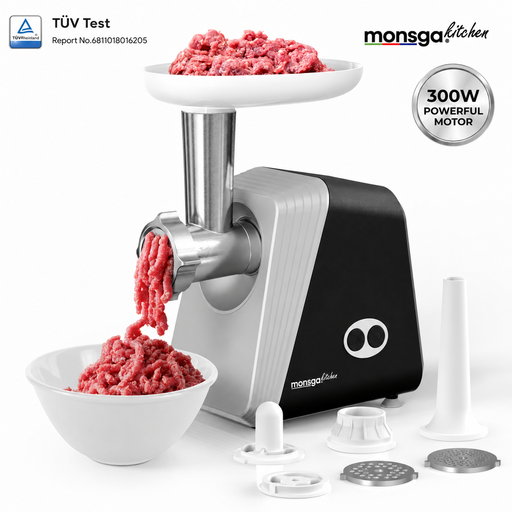
Why this product suits this profile: Suitable for users who want to prepare not only different minced meat textures but also sausages, kebbe and biscuits.
The three cutting discs are designed for fine, medium and coarse results; overheating and overload protection are specified.
Reverse function, sausage filler, kebbe and biscuit attachments, plus removable parts that can be washed by hand.
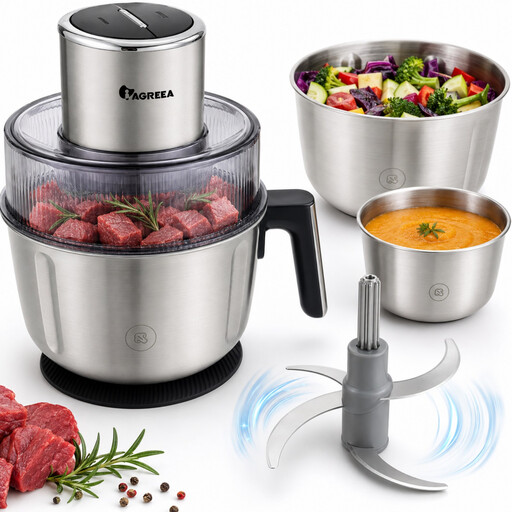
Why this product suits this profile: Three stackable stainless steel bowls support separate quantities for preparing vegetables, meat, purées and cooked ingredients.
The product details specify bowl capacities of 2.5, 2.2 and 1.8 litres, as well as pulse operation of up to 30 seconds per cycle.
350 watts, two speed settings, a triple-curved stainless steel blade and a non-slip base ring.
We have put together a complete, regularly updated list of products that fully meet these strict selection criteria and the safety regulations applicable in the EU.
For even results, cut meat and vegetables into suitably sized pieces before adding them. Do not process sinews, bones, hard cartilage or frozen ingredients that the machine is not approved for. When using a traditional meat grinder, chilled meat is recommended, but it should not be frozen solid.
After use:
If you want to make your own sausages, you should also choose the correct filling tube size, use well-chilled ingredients and fill the casing slowly and in a controlled manner.
For occasional small portions, 300 to 500 watts of rated power may be sufficient. For larger quantities or frequent use, a higher rated power, a larger filling opening and documented overload protection are advisable. Maximum power alone does not provide a reliable indication of continuous power.
Its service life depends on operating intervals, cleaning, storage and whether the permitted ingredients are used. Overfilling, bones, hard foreign objects and excessively long operating times can place strain on the motor and cutting mechanism. Regular cleaning and dry storage help support the intended use.
Electricity costs depend on the actual rated power and operating time. With short pulses, consumption is generally lower than during continuous operation. For a rough estimate, multiply the power in kilowatts by the operating time in hours and your electricity price per kilowatt-hour. Rest and cooling periods are not counted as active operating time.