
Lieferung heute & morgen

Qualitätsgarantie

Willkommens-Angebote freischalten: KOSTENLOSE Lieferung | Bis zu 80 % RABATT | Kostenlose 30-Tage-JoyPlus-Testphase
App herunterladen
An electric ride-on vehicle for children can combine imaginative play, physical activity and quality time outdoors. The selection ranges from compact ride-on cars and children’s electric cars to electric scooters for kids. However, design is not the only factor that matters. Age, height, intended environment, battery specifications and parental control options determine whether a model is genuinely suitable for everyday family life.
A higher top speed is not automatically beneficial for younger children. More important are controlled acceleration, an easily accessible stop function and a speed appropriate for both the child and the surroundings. With a children’s ride-on vehicle equipped with a remote control, the accompanying adult should be able to intervene at any time.
The “from 3 years” recommendation is only an initial point of reference. Parents should also check the maximum load, seat size, controls and any small parts. For example, the F1 remote-control car is described as suitable for children from 18 months to 5 years, while the supplier simultaneously highlights small parts and a warning for children under 3. Such information must be cross-checked before purchase and before use.
Suppliers often state a range or operating time under specific conditions. Weight, surface, temperature, inclines and driving style all affect actual runtime. Charging time should also be part of the comparison: a battery-powered children’s vehicle is of limited practical value if it requires many hours of charging after only a short period of use.
Toddlers benefit from simple vehicles with straightforward controls and a low speed. For a children’s ride-on vehicle suitable from age 3, a foot pedal, forward/reverse switch and remote control may be useful depending on the child’s developmental stage.
For siblings, a two-seater kids’ car can be an appealing option. Parents must take the total load capacity and seat width into account. The combined weight of both children must not exceed the stated maximum load. According to the product description, the two-seat model with a maximum load of 50 kg is designed for children aged 3 to 8.
Look for:
An electric children’s buggy or children’s electric car should generally be used only under supervision and on suitable private property. Public roads, cycle paths and pavements are generally not intended for toy vehicles. Before use, also check the CE marking, manufacturer information, EU responsible person and relevant safety instructions. A CE marking does not replace supervision.
Voltage alone says little about actual performance. Also check battery capacity, charging time, spare-parts availability and charging instructions. According to the supplier, the RICTOR C8 features a 120 W motor and a 24 V, 4.5 Ah battery. It is specified with three speed settings of 5, 10 and 15 km/h, as well as a range of 15 to 20 kilometres per charge. These figures should be understood as manufacturer or supplier specifications and may vary in everyday use.
The battery should only be charged with the designated charger. Do not charge it unattended, keep the device away from moisture and store the battery according to the manufacturer’s instructions.
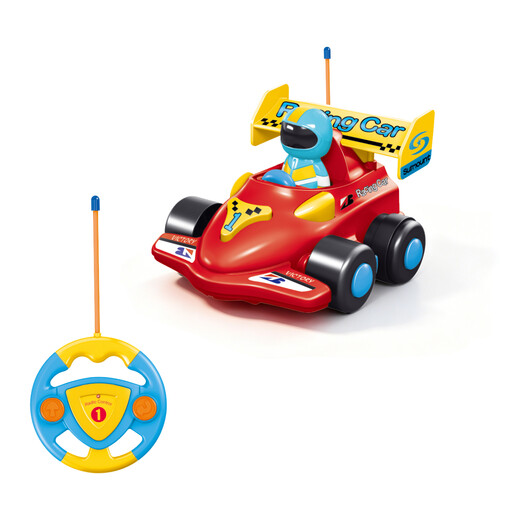
Why it suits this profile: This compact vehicle is designed for short play sessions and requires three AA batteries. It is a suitable choice for families looking for a simple electric ride-on vehicle with remote control as a first step.
The straightforward controls, with forward, reverse and left steering, reduce unnecessary complexity. The warning concerning small parts must be observed before use.
Compact dimensions of 20.6 × 10.6 × 30.2 cm; light, music and sound effects according to the product description.

Why it suits this profile: According to the supplier, this foldable model is designed for children aged 5 to 12 and suitable for both indoor and outdoor use. An app allows adults to set speed limits.
The supplier specifies five-wheel anti-tip protection, a low centre of gravity and adjustable speeds of 5, 10 or 15 km/h.
Maximum load according to the supplier: 60 kg; puncture-proof solid rubber tyres and a foldable design.
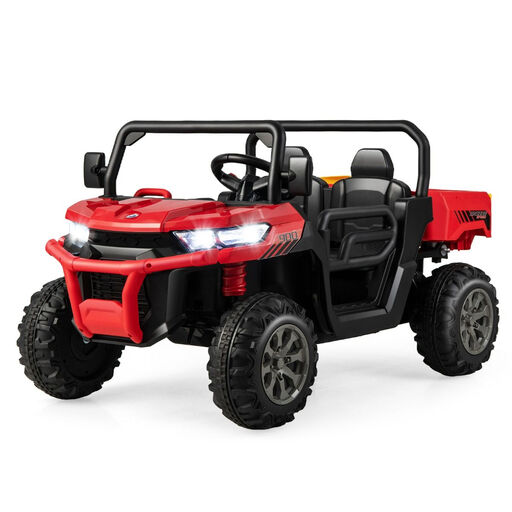
Why it suits this profile: According to the product description, this two-seater kids’ car is designed for two smaller children aged 3 to 8, with a total load capacity of up to 50 kg.
The listed features include a 2.4 GHz remote control, three speed options, an emergency braking function, a safety belt and soft start.
12 V battery, two motors, four-wheel suspension and a specified speed range of 3 to 8 km/h.
An electric scooter for children takes up less storage space than a car, but it requires secure balance and suitable protective equipment. An electric children’s buggy offers greater seating comfort and storage space, but is often heavier. A non-motorised ride-on car is suitable for younger children and shorter journeys around the home. Always compare the intended environment, the vehicle’s weight and whether it can be stored conveniently after playtime.
Discover a current selection of children’s ride-on vehicles and compare models by age, features, battery and number of seats.
This depends on the individual model. According to the supplier, some vehicles are designed for toddlers, while others are suitable only from age 3 or 5. The key considerations are ease of use, load capacity, safety warnings and the child’s ability to understand instructions. Use should always be supervised.
There is no universal answer. Battery, motor power, total weight, surface and temperature all affect runtime. The range stated by the supplier should therefore be treated as a guideline. Also check the charging time and whether a replacement battery or charger is available.
For younger children, low speeds that can be limited are generally easier to control. On vehicles with multiple settings, the accompanying adult should initially select the lowest speed. A clear, level riding surface, a properly fitted safety belt and the ability to take control via remote at any time remain essential.