
Lieferung heute & morgen

Qualitätsgarantie

Willkommens-Angebote freischalten: KOSTENLOSE Lieferung | Bis zu 80 % RABATT | Kostenlose 30-Tage-JoyPlus-Testphase
App herunterladen
An electric vehicle for children can provide plenty of varied entertainment in the garden, on private paths or indoors. The choice ranges from electric ride-on cars and electric children's quads to electric ride-on toys. However, differences in recommended age, speed, battery, seating and controls determine whether a model is genuinely suitable for everyday use.
Many products look similar at first glance. Typical buying mistakes happen when parents focus solely on the design or a high motor output. It is therefore worth considering the following points before buying.
An age recommendation is only a guide. Seat height, interior dimensions, handlebar position and maximum load capacity are also important. A vehicle for ages 3 to 8 may already be too cramped for a taller child, while a model for ages 5 to 12 may require a longer familiarisation period for younger children.
You should therefore check:
The range of a battery-powered children's vehicle depends on factors including weight, surface, outdoor temperature, gradient and driving mode. A stated distance is therefore not a guaranteed figure for every use. Charging time should also be considered: with some 12-volt models, a full charge can take several hours.
A 12V children's vehicle is often suitable for moderate speeds and shorter trips. Depending on their design, models with a 24V battery may allow higher speeds or longer use. However, voltage alone says nothing about the overall quality of the drive system. Also check the battery capacity in Ah, motor output and availability of replacement parts.
Music, LED lights, USB ports and an app can enhance the play value. However, they do not replace built-in safety features. A children's vehicle with a safety belt, controllable speed, a stable seating position and an easily accessible brake should be given greater priority when choosing a model than purely additional features.
For younger children, a low speed setting is generally easier to control. An electric vehicle for children with remote control allows adults to accompany the ride, stop the vehicle or limit its speed when necessary. It is important to check whether the remote control only operates steering and movement or also includes an emergency braking function.
Vehicles with their own accelerator pedal should offer a gentle start. This prevents the vehicle from accelerating suddenly when the pedal is pressed. Children should initially practise using the controls on a flat, clear surface.
A low vehicle with a wide base provides a different level of stability from a narrow scooter. With an electric children's quad, wheelbase, tyre width and centre of gravity are particularly important. Grass, paved paths and tarmac each require suitable wheels and an appropriate ground clearance.
Look out for:
An electric Jeep for children should also only be used on surfaces suitable for the particular model. Public roads, cycle paths and pavements are generally not appropriate places for toy vehicles.
Before buying, the product page and the enclosed instructions should provide information about age, load capacity, battery, charger, assembly and care. Also check the available labelling and the supplier's information about the relevant EU requirements. A CE marking is not a quality seal; it indicates the manufacturer's declaration of conformity. It does not replace checking the specific features of the product.
For plastic parts, material specifications such as PP are useful. Load-bearing components may include metal parts as part of the construction. What matters is whether the connections, doors, seats and covers are robustly made and free from sharp edges.
The following models differ significantly in terms of age suitability, seating, speed and controls. The details are based on the respective product information and should be checked against the current product page before ordering.
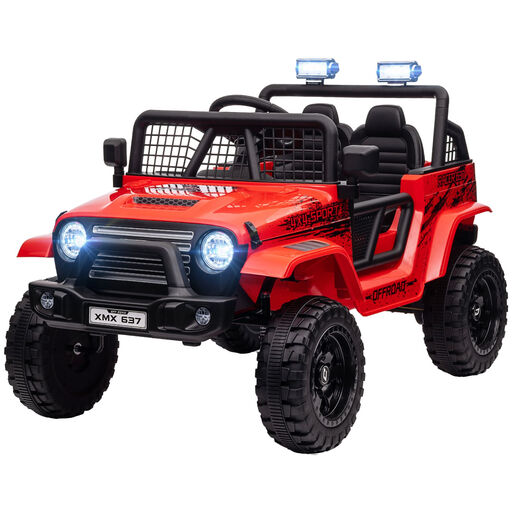
Why this product suits the profile: According to the product details, this 12-volt model is designed for children aged 3 to 7 and combines a straightforward vehicle design with remote control, lights and music.
The voltage, age range and remote-control function are clearly stated. Nevertheless, you should check the dimensions, charging time and contents before buying.
12V dual drive, remote control, lights and music, plus a safety belt stated in the product name.

Why this product suits the profile: According to the product details, this foldable electric ride-on vehicle is designed for children aged 5 to 12 and offers three adjustable speeds of 5, 10 and 15 km/h.
The speed can be limited. A five-wheel design, low centre of gravity and wide foot platform are stated as design features.
120W motor, 24V-4.5Ah battery, foldable design, app control for parents and a stated load capacity of up to 60 kg.
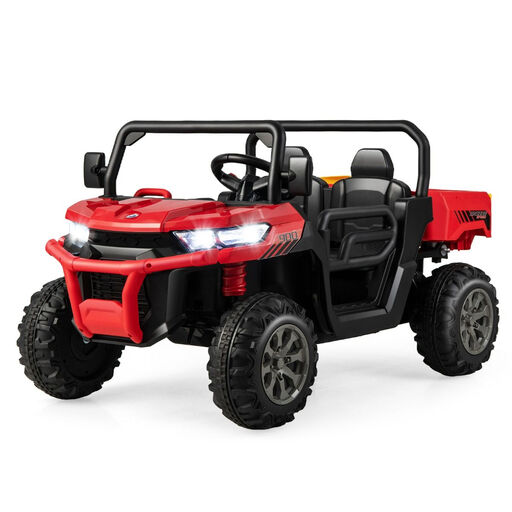
Why this product suits the profile: According to the product details, this two-seater children's vehicle is designed for children aged 3 to 8 and features two motors, suspension and a 2.4GHz remote control.
The speed is stated as 3 to 8 km/h. The safety belt, soft-start function and emergency brake button on the remote control address common problems caused by sudden acceleration.
Two seats, 50 kg load capacity, 12V-7Ah battery, suspension and three selectable speeds according to the product details.
We have put together a complete, regularly updated list of products that fully meet these strict selection criteria and the safety regulations applicable in the EU.
The ongoing costs of a children's vehicle mainly consist of electricity, wear parts and potential replacement batteries. Only charge the battery with the specified charger and follow the instructions regarding charging time. After use, the vehicle should be stored dry and protected from direct exposure to the elements.
Check the following regularly:
A battery loses capacity as the number of charging cycles increases. How long it remains usable depends on use, storage and charging habits. A replacement battery should only be used if its voltage, capacity, connector and charger are compatible with one another.
This depends on the specific model and the child's development. Many vehicles are designed for ages 3 to 8, while more powerful or larger models have an age recommendation from 5 years. Height, ability to operate the controls, load capacity and the possibility of using the vehicle under supervision are also important factors.
There is no standard riding time. Weight, driving mode, surface and temperature all affect usage. The battery specifications in volts and ampere-hours, together with the charging time stated by the supplier, provide an initial guide. For regular use, a model with a replacement battery available may be a sensible choice.
No. The remote control is an additional control option for adults and not a substitute for supervision. The vehicle should only be used on suitable, clear and private surfaces. The operating instructions specify how to use the remote control, emergency stop and manual controls.