
Lieferung heute & morgen

Qualitätsgarantie

Willkommens-Angebote freischalten: KOSTENLOSE Lieferung | Bis zu 80 % RABATT | Kostenlose 30-Tage-JoyPlus-Testphase
App herunterladen
An electric vehicle for children can provide engaging entertainment in the garden, on private paths or in suitable indoor areas. The selection ranges from two-seater electric ride-on cars and electric excavators to children’s electric scooters. However, design is not the only factor that matters. The recommended age, speed, seating position, battery and control options must suit both the child and the intended environment.
A children’s vehicle with a top speed of 15 km/h may appear powerful on paper, but that does not automatically make it suitable for every child. Younger children often need a lower, easily controlled speed setting and sufficient space to stop safely. Check whether the speed can be limited and whether a remote control with stop function is included.
“For children aged 3 to 8” is only a general guideline. Height, leg length and weight can vary considerably within the same age group. A seat that is too small, pedals that are difficult to reach or insufficient load capacity can make the vehicle impractical sooner than expected.
Manufacturers’ range specifications usually refer to specific conditions. Frequent starts, inclines, a higher total weight and uneven surfaces can increase energy consumption. Pay attention to battery voltage, capacity, charging time and whether a replacement battery is available. An electric vehicle with a rechargeable battery is only practical for everyday use if the charging location and charging times fit into your family’s routine.
For an electric vehicle for children aged 3–8, low-speed settings, a gentle start and easily accessible controls are important criteria. With a two-seater electric ride-on car, both seats should provide enough space. The maximum load capacity applies to the combined weight of the children and any items being carried.
For older children between approximately 5 and 12 years of age, a children’s electric scooter with adjustable speed settings may be worth considering. A wide deck, low centre of gravity and intuitive braking controls are particularly important here. A model with app control should only be used if the app is compatible with the smartphone and parents regularly check the settings.
A children’s vehicle with a safety belt can help keep the child in the intended seating position while riding. The belt does not replace supervision or suitable protective equipment. Doors, locks, wheels and pedals should also be checked before every use.
Suspension, profiled tyres and a stable stance can be helpful on paved outdoor surfaces. Nevertheless, check whether the manufacturer explicitly specifies asphalt, concrete or other surfaces as suitable. For indoor use, dimensions, turning circle and noise levels are relevant. Public roads, cycle paths and pavements are generally not automatically approved for these toy vehicles.
Look for the CE marking and the information provided in the German-language operating instructions. The ASTM and CPSIA certifications mentioned for one of the models below originate from the US regulatory environment and should not be equated with a European conformity assessment.
A 12-volt battery is standard in many smaller ride-on vehicles. Voltage alone, however, says little about actual running time. Amp-hours, motor output, weight and surface conditions are also relevant. The charger should only be used in accordance with the manufacturer’s instructions. Store the vehicle and battery in a dry place and protect them from extreme heat and frost.
A foldable electric children’s vehicle can be advantageous when storage space is limited. Before buying, measure the available space in the basement, garage or boot. A two-seater children’s vehicle is practical for siblings, but is usually larger and heavier than a single-seater model.
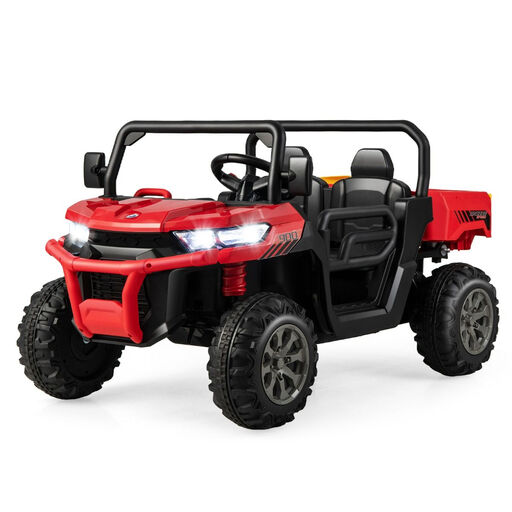
Why this model is a good fit: For families with two children aged approximately 3 to 8 who are looking for a larger vehicle for private outdoor areas.
The specified top speed is between 3 and 8 km/h. A 2.4 GHz remote control offers three speed settings and an emergency braking function.
Two seats, specified load capacity of 50 kg, 12 V battery, safety belt, soft start, suspension and dimensions of 119 × 68 × 65 cm.

Why this model is a good fit: For children aged approximately 5 to 12 and households with limited storage space, as the scooter can be folded away.
The speed settings are specified as 5, 10 and 15 km/h. Parents can set limits and monitor usage data via the dedicated app.
120 W motor, 24 V battery with 4.5 Ah capacity, specified range of 15 to 20 km, five wheels, non-slip deck and puncture-proof solid rubber tyres.
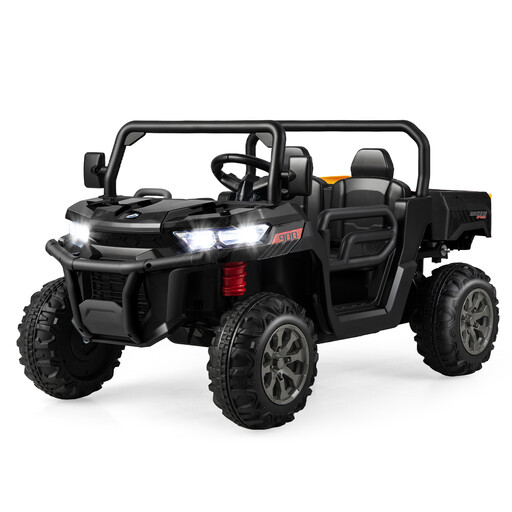
Why this model is a good fit: For families who prefer a two-seater children’s vehicle with a loading bed, additional features and remote control.
The product specifications state a load capacity of 50 kg, soft start and an adjustable safety-belt restraint. Check the dimensions against your available storage space before buying.
Automatic tipping loading bed, removable shovel, two motors, suspension, music, USB and AUX ports, plus three speed settings on the 2.4 GHz remote control.
We have put together an up-to-date selection of products that meet these criteria and the relevant safety requirements for Germany. For each model, check the specific age recommendation and product description.
Running time depends on battery capacity, motor output, load, temperature and surface conditions. A 12 V, 7 Ah battery, as used in the dump truck models mentioned above, is specified with a charging time of approximately 8 to 12 hours. Allow sufficient time for charging between rides and follow the manufacturer’s instructions.
An electric children’s vehicle is generally designed as a toy rather than a road-legal vehicle. Use it only on suitable private property and under supervision. Public paths are subject to different legal requirements; the relevant operating instructions and local regulations are decisive.
The electricity cost per charge is usually manageable and can be estimated from the battery specifications: volts multiplied by amp-hours gives approximately the watt-hours. Additional costs may arise for a replacement battery, charger, tyres or remote-control batteries. Before buying, it is therefore worth checking whether replacement parts and accessories are available.