Bass-conscious music fans
If you listen to electronic music mainly for its deep bass, a subwoofer could be a good option – as long as you can position it sensibly and adjust the bass.


If you mainly listen at your desk, a stereo pair is a natural choice, provided you can position both speakers properly and connect them to your computer. If powerful bass is your priority and you have room for a subwoofer, a 2.1 system could be worth considering. However, the room and how close the speakers are to the walls will also affect the low frequencies. Before buying, check the connections you need, what’s included and the dimensions.
If you listen to electronic music mainly for its deep bass, a subwoofer could be a good option – as long as you can position it sensibly and adjust the bass.
A stereo pair gives you two speakers to place on either side of your screen. Check that you can angle both towards your listening position and adjust the sound to suit their placement.
If you switch between your computer and smartphone, make sure their connections match the inputs on the specific speakers you’re considering.
A good fit if: You can accommodate two speakers at your usual listening position and angle them towards where you sit.
Bear in mind: Compare low-frequency specifications only when the measurement limits are the same. The speakers’ proximity to the walls will also affect the bass.
A good fit if: Bass is your priority, you have room for an extra speaker and you want to adjust the bass level.
Bear in mind: The subwoofer needs space, and its low-frequency performance will also depend on where you place it.
A good fit if: You have enough space, listen from somewhere other than directly in front of your screen, or want to connect multiple audio sources.
Bear in mind: The term “bookshelf speakers” alone doesn’t tell you whether a model will fit on a small desk.
| Priority | What to check before buying | Who is this important for? |
|---|---|---|
| Bass for electronic music | Space for the subwoofer and a way to adjust the bass. | If deep bass matters most to me, I want to be able to position and adjust the subwoofer to suit my setup. Bass is the top priority for around 36% of consumers. |
| Sound at a fixed listening position | Whether both speakers can be angled towards your seat; take their proximity to the walls into account when positioning them. | If I mainly listen at my desk, I want to be able to angle a stereo pair towards my listening position. For around 29% of consumers, speaker placement is the main consideration. |
| Connections for audio sources | Check that the inputs suit your computer and other devices, and that the required cables are included. | If I switch between my computer and smartphone, I want inputs that suit my devices. Around 21% of consumers focus primarily on connection options. |
| Desk space and what’s included | Check the dimensions and any positioning aids, and whether the offer includes a pair or a single speaker. | If space is limited on my desk, the complete system needs to fit there. For around 14% of consumers, the space required is the most important consideration. |
Manufacturers may specify frequency figures using different measurement limits, such as −3 dB, −6 dB or −10 dB. A lower Hz figure on its own therefore doesn’t prove that a speaker will deliver more or better bass at your desk.
Compare figures only when they use the same measurement definition, and take the room and speaker placement into account.
A 2.1 system includes a separate speaker, and where you place it will also affect the low frequencies.
Plan where it will go before buying, and check whether you can adjust the bass level on the system.
The term “speaker” doesn’t reliably tell you whether an offer includes a pair or just one speaker. The available connections also vary between models.
Check the quantity, inputs and cables you’ll need for your devices.
The D3V is an active desktop stereo pair with USB-C audio, balanced TRS inputs and controls to adjust for speaker placement.
The HS4 is a compact active monitor pair with analogue inputs and a Room Control switch.
The MR4 is an active stereo pair with analogue inputs and monitor and music modes.
The Z407 is a 2.1 PC system with a separate subwoofer and a wireless control dial.
The ULTIMA 25 AKTIV 2 is an active bookshelf speaker pair with a range of connection options.
The following Joybuy models are described as suitable for listening at your computer or desk. The selection includes active speakers and a 2.1 system with a separate subwoofer.
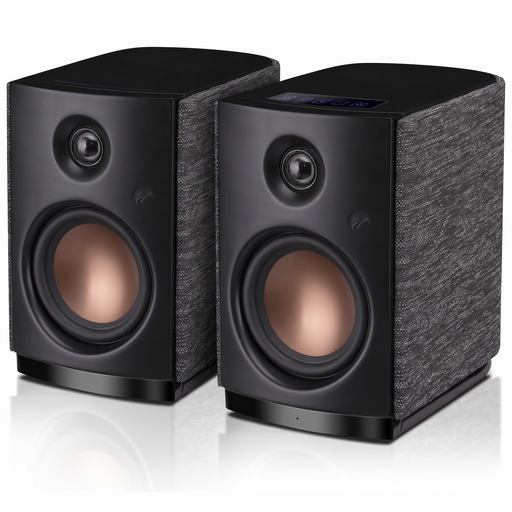 No image available
Described as suitable for computer and desk listening; Bluetooth and AUX offer connection options for compatible audio sources.
Bluetooth 5.0, 4-Inch woofer, 62 W RMS and touch controls.
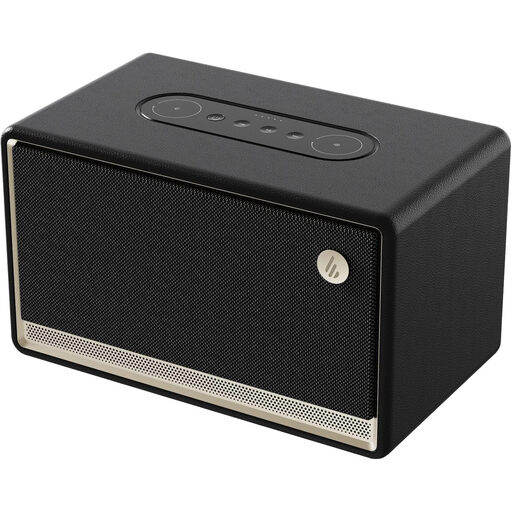 No image available
Described as a tabletop speaker for home working and desktop use; check that the connections suit your audio sources.
Bluetooth, USB and AUX playback are listed.
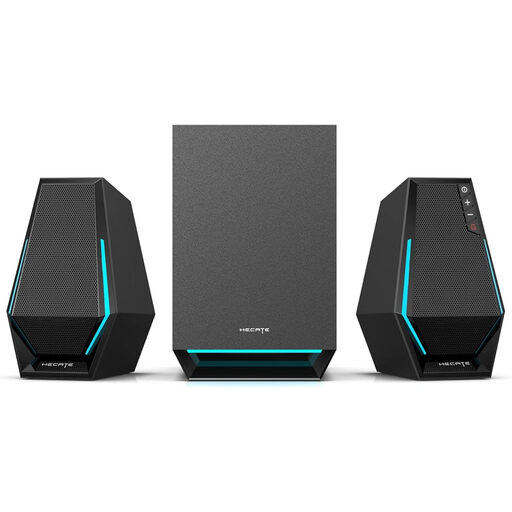 No image available
Described as suitable for computer use and could be an option if you have room for a separate subwoofer system.
60 W, Bluetooth 5.3, USB, Type-C and 3.5-mm AUX; the subwoofer needs extra space.
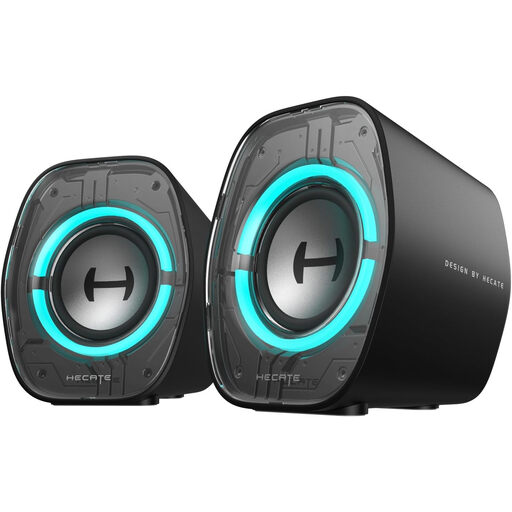 No image available
Described as suitable for desk use; the listed Music mode is a feature to consider, not an independent sound test.
2.5-Inch full-range drivers, Bluetooth 5.4, USB-C and AUX.
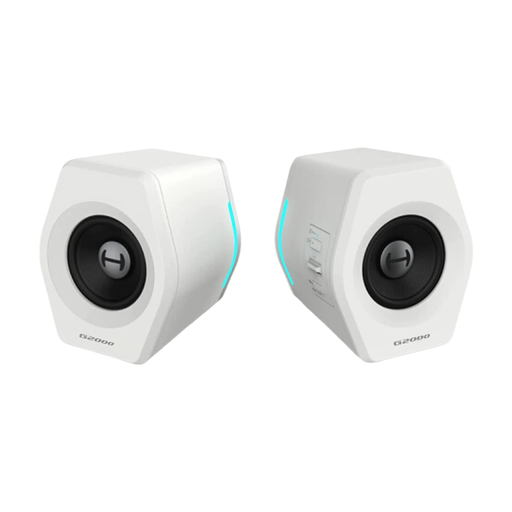 No image available
Described as suitable for PCs and other devices; check whether USB sound card, Bluetooth or AUX is right for your connection.
32 W, Bluetooth, USB sound card, 3.5-mm AUX and a Music mode.
Angle both speakers towards your listening position and, where possible, place them symmetrically. Genelec recommends a 60-degree angle between monitor speakers; this is a guide rather than a rule that can be followed precisely at every desk. If the bass sounds pronounced, check the distance between the speakers and the walls, and any room adjustment settings available.
According to the manufacturer, the Teufel ULTIMA 25 AKTIV 2 doesn’t need an additional amplifier. For other models, check whether they’re active or passive and whether the offer includes a pair.
Your statutory rights are against the seller, while a guarantee is an additional voluntary service with its own terms. The Verbraucherzentrale explains that, if a product is faulty, you’re initially entitled to request that the seller put things right.
When monitoring affected products on the market, the Bundesnetzagentur includes the CE marking, manufacturer details and German-language instructions among the points to check. The CE mark is based on a declaration made by the manufacturer under its own responsibility; it isn’t an independent assessment of sound quality. A product description alone doesn’t confirm that a specific offer complies with the relevant requirements.
In Germany, old electrical equipment shouldn’t go in household waste; take it to an authorised collection point instead. The Bundesumweltministerium lists local collection points and other authorised organisations as options. Whether a retailer accepts it for disposal depends on the conditions in force at the time.