
Lieferung heute & morgen

Qualitätsgarantie

Willkommens-Angebote freischalten: KOSTENLOSE Lieferung | Bis zu 80 % RABATT | Kostenlose 30-Tage-JoyPlus-Testphase
App herunterladen
Choosing the right filament is crucial for the success of any 3D print. However, the market is flooded with options that often promise more than they deliver. Many users know the frustration of a multi-hour print failing at the last moment due to subpar material. As your Joybuy Product Recommendation Officer, I'll help you navigate the common pitfalls and make an informed decision.
Consumables like filament are especially prone to hidden costs that only become apparent after purchase:
To avoid these problems, you should check a few objective parameters before buying. These criteria are the foundation for reliable and repeatable printing results.
The most critical aspect of a good FDM filament is its dimensional accuracy. For most common printers, a 3D printer filament 1.75mm is the standard. Pay close attention to the specified diameter tolerance. A value of +/- 0.02 mm is considered the industry standard for high-quality filament. This minimal deviation ensures a constant material flow, which leads to clean layer adhesion, a smooth surface finish, and significantly reduces the risk of nozzle clogs.
Polylactide (PLA) is the most popular material for beginners and advanced users alike, thanks to its ease of use and low tendency to warp. An enhanced version is PLA+, such as PLA+ black, which often boasts higher impact resistance and strength, making it suitable for functional parts.
Equally important is the spool itself. A neat, mechanically wound spool prevents tangling. Increasingly, manufacturers like Elegoo are opting for an eco-friendly spool made of cardboard. Not only is this more sustainable than plastic spools, but it often includes practical viewing windows to check the remaining filament level.
The PLA filament 1kg specification has become the established standard. This quantity offers a good balance of price and volume, allowing you to print larger projects without interruption and without constantly needing to buy new material.
Based on the criteria mentioned, we have identified several Elegoo filaments that are well-suited for different user needs.
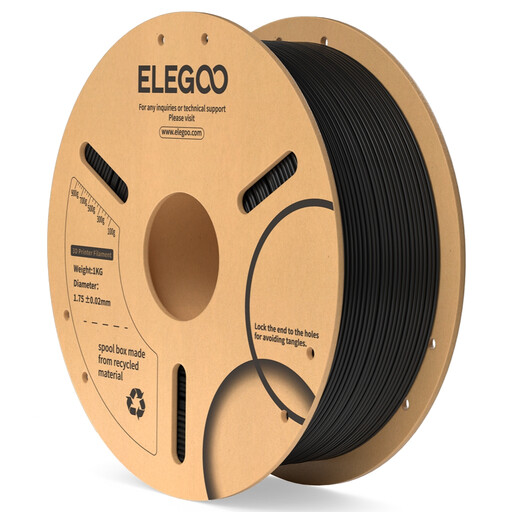
Why it's a match: Ideal for users seeking a reliable and easy-to-print material for prototypes, models, and everyday objects. The black color is universally versatile.
Mechanical winding and manual inspection minimise the risk of tangles. The specified tolerance of +/- 0.02 mm ensures consistent extrusion.
Low warping and minimal odour make it very user-friendly. The eco-friendly cardboard spool is an added bonus.
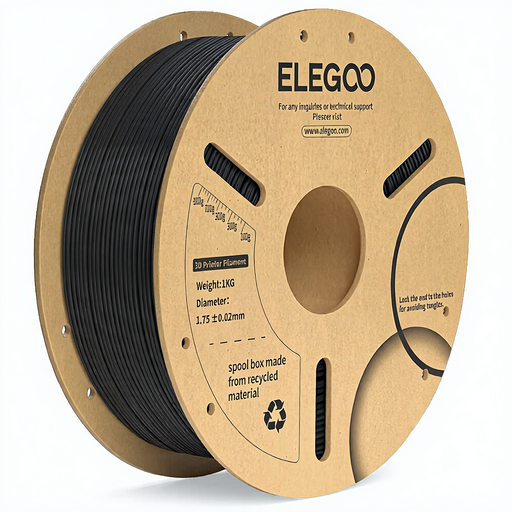
Why it's a match: For users printing functional parts with higher load-bearing requirements, such as brackets, enclosures, or mechanical components. PLA+ offers improved material strength.
Offers the same benefits in dimensional accuracy (+/- 0.02 mm) and winding quality as standard PLA, but avoids the pitfall of misleading claims by clearly positioning itself as PLA+ with enhanced mechanical properties.
Higher strength and flexibility compared to standard PLA, resulting in more durable and resilient printed objects.
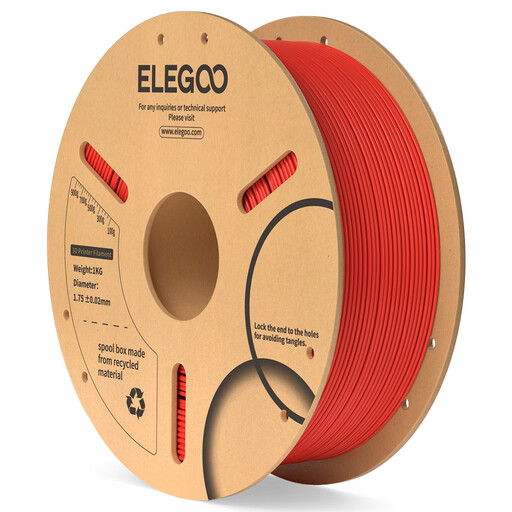
Why it's a match: Perfect for makers who prioritise aesthetics and create colourful decorative objects, figurines, or visual prototypes. The 1 kg spool also allows for large, single-colour projects.
High dimensional accuracy ensures even colour distribution and surface quality, without the streaking that can occur with inconsistent filament.
Vibrant and consistent colour across the entire spool for visually appealing results. Available in a wide range of colours like red, yellow, orange, and more.
In addition to high-quality filament, other accessories are essential for any workshop or make an ideal gift for makers.
We have compiled a complete, real-time updated list of products that fully meet these strict selection criteria and German safety regulations.
1. How do I store PLA filament correctly to maintain its quality? PLA is hygroscopic, meaning it absorbs moisture from the air. Damp filament leads to poor print quality (e.g., bubbling, brittle material). Therefore, always store your filament spools in a dry, cool, and dark place. Resealable bags with a desiccant (silica gel), often included with the filament, are ideal.
2. What is the difference between PLA and PLA+ filament? Standard PLA is an easy-to-print but rather brittle material, well-suited for decorative objects. PLA+ is a modified version that typically offers higher impact resistance, better layer adhesion, and greater strength. It's a good choice for mechanical parts that need to withstand some stress. The exact properties can vary by manufacturer.
3. Is the Elegoo cardboard spool compatible with all spool holders? Elegoo's cardboard spools are designed to be compatible with most standard spool holders on FDM 3D printers. Their inner and outer diameters conform to common industry standards. For some very specific or enclosed printer systems, an adapter or an external spool holder might be necessary, but this is the exception.