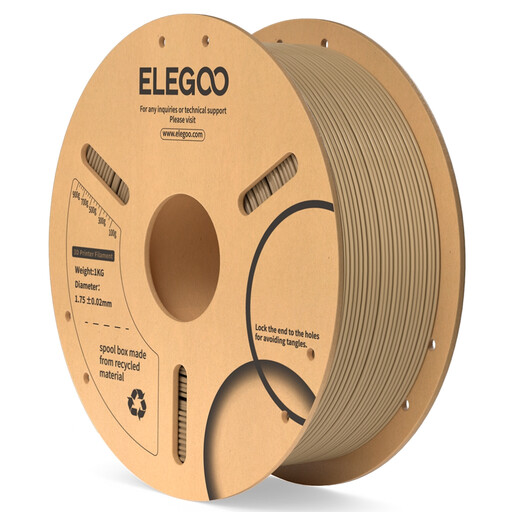
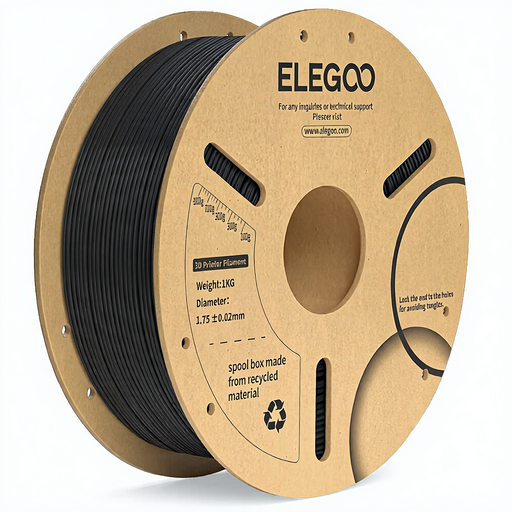
The quality of a 3D print is critically dependent on the properties of the filament used. For users of FDM (Fused Deposition Modeling) printers, selecting a material with consistent specifications is crucial for achieving repeatable and precise results. Elegoo PLA Filament is positioned in this segment as a material designed for defined technical parameters and reliability. This article analyses the key features and presents a selection of products for various use cases.
Buyer's Guide: Technical Selection Criteria for 3D Printer Filament
The choice of a filament should be based on objective, measurable criteria. The following parameters are of critical importance for print quality and process reliability.
Material Foundation: Polylactide (PLA)
Polylactide, or PLA, is a thermoplastic derived from renewable resources such as corn starch. Its popularity in FDM 3D printing is based on several technical advantages:
- Low Melting Point: Enables printing at lower temperatures (typically 190-220°C), which reduces energy consumption and increases compatibility with a wide range of 3D printers.
- Low Warping Tendency: PLA exhibits minimal thermal shrinkage. This reduces the risk of the print object's corners lifting off the print bed and often makes a heated print bed optional.
- Odor Emission: There is virtually no perceptible odor during the printing process.
Diameter Tolerance and Its Impact
The consistency of the filament diameter is a critical factor for uniform extrusion. A standard for 1.75mm FDM Filament is a specified tolerance of ±0.02 mm. Deviations beyond this value can lead to irregular material flow, manifesting as visible lines (inconsistencies in the surface texture) or, in the worst case, nozzle clogging. Precise manufacturing ensures process stability.
PLA vs. PLA+ Filament
PLA+ Filament is a modified version of standard PLA. The addition of additives improves certain mechanical properties. Compared to standard PLA, PLA+ typically offers:
- Increased Impact Resistance: The material is less brittle and more resistant to shocks.
- Improved Strength: Tensile and flexural strength are often higher, qualifying it for functional components. The printing parameters for PLA+ may differ slightly from those for standard PLA, usually requiring a slightly higher nozzle temperature.
Winding and Spool Design
A neat, mechanical winding of the filament on the spool prevents tangles and knots that can interrupt the printing process. Modern spools, like the Paper Spool, also offer an ecological advantage over traditional plastic spools. Practical features such as viewing windows or holes in the spool allow for easy monitoring of the remaining material.
Our Selection of Elegoo Filaments
Based on the technical criteria mentioned above, we present three variants of Elegoo filament designed for specific requirements.
1. Elegoo PLA Filament 1kg Paper Spool - Black

- Why we recommend this product: This black PLA filament is a standard material for a wide range of applications. It is distinguished by its adherence to the strict diameter tolerance of ±0.02 mm, which ensures high process reliability. The neat winding on a paper spool minimises the risk of print failures and supports smooth operation.
- Advantages:
- Precise diameter tolerance of ±0.02 mm for consistent extrusion.
- Low warping tendency and minimal shrinkage.
- Neat mechanical winding to prevent tangles.
- Eco-friendly Paper Spool with a fill level indicator.
- Who it's for: Users who need a reliable 1kg filament for daily use, such as for prototypes, design models, and non-functional components. It is a solid foundation for beginners and experienced users alike.
2. Elegoo PLA Filament 1kg Paper Spool - Wood Color

- Why we recommend this product: This filament combines the proven technical properties of Elegoo PLA with an aesthetic component. The wood-effect PLA filament allows for the creation of objects with a natural, wood-like appearance, without the complexity of printing with real wood-particle filaments.
- Advantages:
- Offers all the technical benefits of standard Elegoo PLA.
- Creates an appealing, matte surface with a wood-like finish.
- Consistent colouration and material properties.
- Compatible with standard PLA print settings.
- Who it's for: Designers, architects, model makers, and hobbyists who want to create decorative objects, architectural models, or visual prototypes with a special aesthetic.
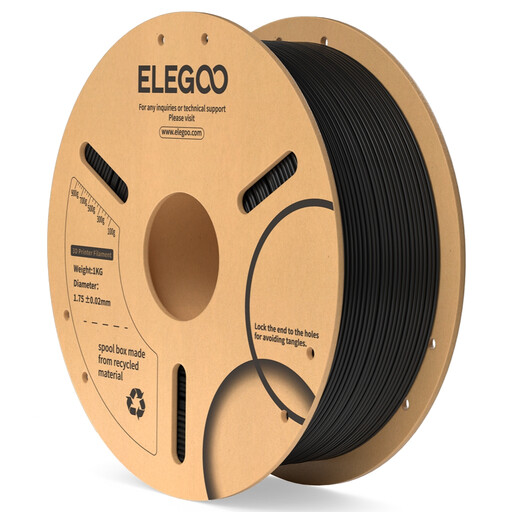
3. Elegoo PLA+ Filament 1kg Paper Spool - Black

- Why we recommend this product: The PLA+ Filament is engineered for applications requiring higher mechanical strength. It offers improved strength and flexibility compared to standard PLA, while maintaining ease of printing and dimensional accuracy with a tolerance of ±0.02 mm.
- Advantages:
- Increased strength and impact resistance for functional parts.
- Excellent layer adhesion for robust prints.
- Maintains the low warping tendency of PLA.
- Precise winding on a sturdy paper spool.
- Who it's for: Engineers, technicians, and advanced makers who print functional prototypes, tool holders, enclosures, or mechanical components that need to withstand moderate stress.
Alternatives and Other Materials
While PLA and PLA+ cover a broad range of 3D printing applications, specialised projects may require different material properties. For users whose projects extend beyond 3D printing and require, for example, special printing media, our Paper Prints category offers a selection of other materials.
Frequently Asked Questions (FAQ)
1. What is the primary difference between Elegoo PLA and PLA+ filament? The main difference lies in the mechanical properties. PLA+ Filament is modified with additives to achieve higher strength and impact resistance. It is less brittle than standard PLA, making it better suited for functional parts subject to mechanical stress. Standard PLA is ideal for visual prototypes and decorative objects.
2. How should I store Elegoo PLA filament to maintain its quality? PLA is hygroscopic, meaning it absorbs moisture from the air. Improper storage can lead to brittle filament and printing issues (e.g., steam bubbles forming in the nozzle). Store the filament in a cool, dry place, preferably in a resealable bag with the included desiccant (silica gel). Avoid direct sunlight.
3. Is Elegoo filament compatible with my 3D printer? The Elegoo filament featured here has a diameter of 1.75 mm. It is compatible with the vast majority of FDM 3D printers on the market that are designed to process 1.75 mm filament. This includes models from brands like Creality, Prusa, Anycubic, and many others. To be certain, check your printer's specifications.
Authored by: Joybuy Product Recommendation Officer