
Lieferung heute & morgen

Qualitätsgarantie

Willkommens-Angebote freischalten: KOSTENLOSE Lieferung | Bis zu 80 % RABATT | Kostenlose 30-Tage-JoyPlus-Testphase
App herunterladen
As a Joybuy Product Recommendation Officer, I see pet owners searching daily for solutions to improve the feeding experience for their dogs and cats. An elevated pet bowl is often at the center of this search. However, the market is flooded with products whose practical utility doesn't always live up to their marketing promises. This guide will help you identify common pitfalls and make an informed decision based on objective criteria.
Before investing in a new feeding solution, it's crucial to understand the typical flaws that often only become apparent with daily use.
To avoid a poor purchase, you should focus your selection on a few crucial technical features.
The correct feeding height is unique to each pet. As a rule of thumb, the top edge of the bowl should be roughly level with the bottom of your pet's chest. The animal should be able to lower its head comfortably without overextending its neck or bending it sharply.
A height-adjustable dog bowl offers the greatest flexibility. It can be adapted to a young animal's growth or adjusted for different pets in a multi-pet household. Look for a solid adjustment mechanism that won't give way under pressure. The entire dog feeding station must have sufficient weight or a wide, non-slip base to ensure stability.
The bowl's material directly impacts hygiene and durability.
Some bowls offer more than just elevation. A slow-feeder bowl has built-in obstacles that force the animal to eat more slowly. This can aid digestion in pets that eat too quickly. For pets that spill a lot of water while drinking, a spill-proof dog water bowl is a worthwhile investment. Models with a floating disk or a splash-guard rim effectively reduce water spillage.
Here are some product recommendations tailored to solve specific problems.
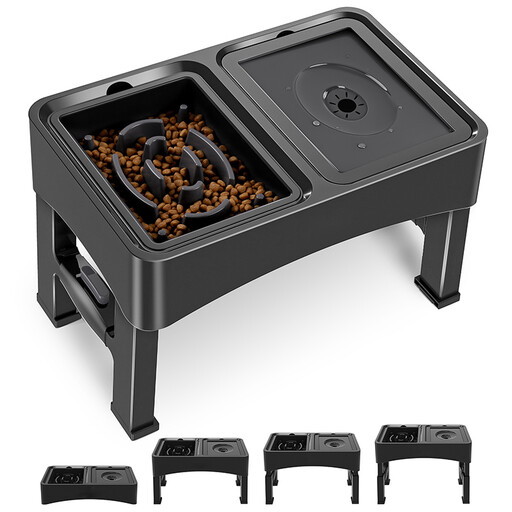
Why it's a match: This station combines a solution for fast eaters with a splash-proof water bowl. Its four-level height adjustment makes it suitable for growing dogs or households with pets of different sizes.
The adjustable height bypasses the problem of a fixed, improper size. The combination of a slow-feeder and a spill-proof function directly addresses specific behavioural issues.
2-in-1 Design: Integrated slow-feeder bowl and floating water bowl. Four Height Settings: 10 cm, 23 cm, 27 cm, 31 cm.
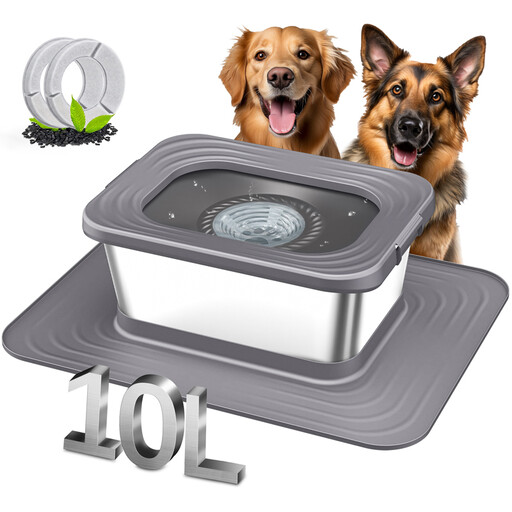
Why it's a match: This model is designed purely as a water bowl, engineered for maximum stability and cleanliness. Its significant weight and large non-slip mat prevent it from sliding, even with enthusiastic drinkers.
It counters the instability pitfall with a heavy product weight (approx. 1.63 kg) and a large anti-slip mat (51x38 cm). The stainless steel bowl avoids the disadvantages of low-quality plastic.
High Stability: Heavy construction and a large, non-slip base. Splash Guard: The floating structure and rim guard reduce water spillage.
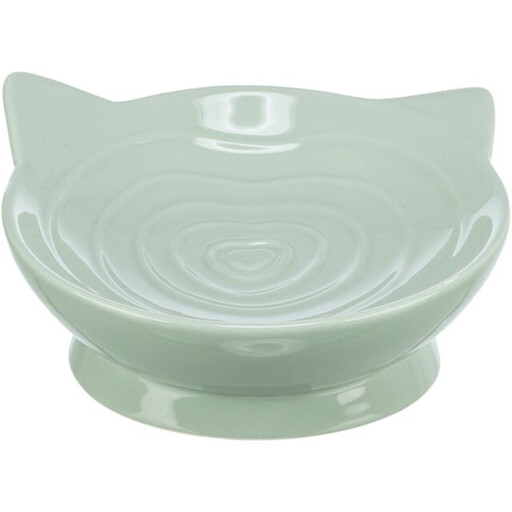
Why it's a match: For cat owners seeking a hygienic, stable, and aesthetically pleasing solution. The fixed height is suitable for most adult cats, and the ceramic material is easy to maintain and visually appealing.
The heavy ceramic material provides excellent stability, bypassing the pitfall of cheap, lightweight designs. As a material, it is superior to plastic in terms of hygiene and durability.
Hygienic Material: The smooth, non-porous ceramic surface is easy to clean and resistant to odours. Stable Design: Its weight prevents sliding.
We have compiled a complete, up-to-date list of products that fully meet these strict selection criteria and safety standards.
The ideal height depends on the size of your pet. A common recommendation is for the top edge of the bowl to be level with the bottom of the pet's chest. The animal should be able to eat by tilting its head slightly, without having to stretch its neck up or bend it sharply down. Measure the height from the floor to your standing pet's breastbone to get a good starting point. A height-adjustable dog bowl is a practical solution for finding the perfect height through trial and error.
While many pets benefit from an elevated feeding position—especially large breeds, senior animals, or those with arthritis—it is not a mandatory requirement for every pet. For healthy, smaller dogs and cats, the main advantages often lie in a cleaner feeding area and a tidier appearance. For pets with certain health conditions, such as megaesophagus, elevated feeding is often recommended, but this should always be discussed with a veterinarian.
Cleaning depends on the material. Bowls made of stainless steel or ceramic are usually dishwasher-safe, which greatly simplifies hygienic cleaning. The frames or stands of the feeding station should be wiped down regularly with a damp cloth and mild detergent. Daily cleaning of the bowl after each meal is recommended to prevent the build-up of bacteria.