
Lieferung heute & morgen

Qualitätsgarantie

Willkommens-Angebote freischalten: KOSTENLOSE Lieferung | Bis zu 80 % RABATT | Kostenlose 30-Tage-JoyPlus-Testphase
App herunterladen
The search for a suitable at-home EMS device can quickly become overwhelming. The market offers a plethora of models promising everything from pain relief and muscle building to cosmetic treatments. However, not every device lives up to its advertising claims. Many consumers invest in a product that fails to meet their expectations because it lacks crucial features or is unsuitable for its intended purpose.
As your Joybuy Product Recommendation Officer, I'm here to help you avoid the common pitfalls. Instead of being swayed by marketing promises, we'll focus on the technical features that truly matter for effective and safe use.
To make an informed decision, you should examine three core aspects. These will help you objectively evaluate a device's performance and suitability.
The abbreviations can be confusing, but they represent fundamentally different areas of application.
The number and variety of programmes are a clear indicator of quality. A good device should offer specific programmes for different body regions (e.g., shoulder, lower back, legs) and application goals (e.g., strengthening, relaxation, pain relief). A high number of adjustable intensity levels (e.g., 40 or more) allows you to tailor the treatment precisely to your personal sensation and progress. Without this fine-tuning, the application is either too weak to be effective or uncomfortably strong.
The shape of the device and the included electrodes determine how and where you can use it effectively.
Here are some product recommendations tailored to specific user profiles and the quality criteria mentioned above.
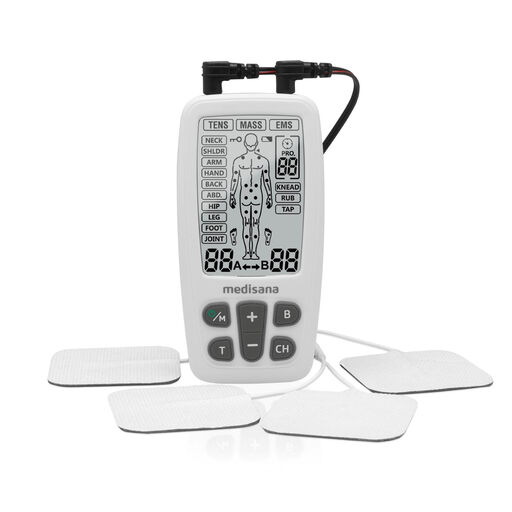
Why This Fits Their Persona: Ideal for users seeking a versatile solution for general pain relief, muscle relaxation, and light stimulation without committing to a single function.
This device bypasses the "all-in-one" trap by offering 22 preset programmes and 40 intensity levels despite its 3-in-1 functionality. This allows for specific and customisable treatment rather than just generic modes.
Combines TENS, EMS, and massage functions in one compact device. The wide selection of programmes for 10 (TENS) and 9 (EMS) body parts makes it a flexible companion for the entire body.

Why This Fits Their Persona: Perfect for individuals who want to treat lower back discomfort in a targeted and intensive way and are looking for a more practical solution than individual adhesive electrodes.
This device solves the problem of incorrect electrode placement on the back. The integrated belt system with 8 massage heads ensures correct, stable, and wide-area application exactly where it's needed.
Combines mid-frequency EMS+TENS with heat compresses and red light therapy. App control and 14 massage modes allow for a highly personalised treatment of lumbar issues.

Why This Fits Their Persona: Suitable for users looking for an at-home device to improve the appearance of cellulite and tighten the skin on the body and face.
This is not a vague beauty gadget, but a specialised tool. It specifically combines EMS microcurrent, vacuum negative pressure, and red light therapy—three established technologies for cosmetic use—in one device.
Offers separate modes for the body (EMS + Vacuum + Red Light) and face (EMS + Red Light). The handy design and rechargeable battery make it flexible for use at home.

Why This Fits Their Persona: Designed for users seeking a non-invasive solution to improve skin elasticity and contour the face and neck.
Unlike devices with cumbersome standard electrodes, this model is specially shaped for facial contours with its ergonomic 85° wave design. This ensures optimal skin contact and effective application.
Combines EMS microcurrent with heat and cold therapy, as well as 3-colour light therapy. The heat function opens pores for better absorption of skincare products, while the cold function soothes the skin.
We have compiled a complete, up-to-date list of products that fully meet these strict selection criteria and German safety regulations.
1. How often can you use an EMS device? The recommended frequency of use depends on the goal and the type of device. For pain therapy with TENS, a daily application of 20–30 minutes is common. For muscle training with EMS, 2–3 sessions per week per muscle group are often recommended, similar to a normal workout schedule. Always follow the manufacturer's instructions and start with a low intensity to get used to the sensation.
2. How long do the electrode pads last and what care is required? The lifespan of the pads varies depending on skin type, care, and frequency of use, but is typically between 20 and 30 applications. To maintain their adhesiveness, the pads should only be applied to clean, dry, and oil-free skin. After use, stick them back onto the supplied protective film and store them in a cool place. If the adhesion diminishes, moistening the gel layer with a drop of water can temporarily reactivate its stickiness.
3. Can I also build muscle with a TENS device? No, a pure TENS device is not designed for that purpose. TENS works with specific frequencies and pulse shapes that act on the nerve pathways to interrupt pain signals. For muscle building, you need an EMS device or a TENS EMS combo device that explicitly offers programmes for triggering muscle contractions.