Detail-focused pin photographers
If you want fine enamel edges and metal outlines to appear large in the frame, the close-up performance of the specific lens matters more than a high megapixel count alone.


If you’re photographing individual pins and don’t want to change lenses, a compact camera with a close-up mode is an easy place to start. If you want to fill the frame with very small details, consider a mirrorless camera with a suitable macro lens. OM SYSTEM states that the TG-7 can focus from 1 cm, while Sony and Nikon each list a 1:1 reproduction ratio for certain macro lenses. With glossy enamel, lighting, shooting angle and a stable setup are still key.
If you want fine enamel edges and metal outlines to appear large in the frame, the close-up performance of the specific lens matters more than a high megapixel count alone.
If you photograph several pins for a consistent product listing, you’ll benefit from a repeatable composition and lighting that lets you control reflections.
If you want to get started without a large collection of lenses, try using window light and a camera you already own to see whether the framing and reflections work for you.
First decide whether you want to photograph whole pins or very small details. This will determine whether a close-up mode is enough or whether you’ll need a suitable macro lens.
| Buying consideration | What to look for | Who is it important for? |
|---|---|---|
| Capturing small details | Check the reproduction ratio of the specific lens and the framing you need; for close-ups, also consider focusing and working distance. | If I want to show fine lines or embossing on a pin in close-up, I need a lens that can achieve the framing I want. Around 36% of consumers put detail reproduction first. |
| Controlling reflections and colour | Test the lighting position and shooting angle with one of your own pins, and check the surface before taking a photo. | If shiny metal reflects the window and its surroundings, I want to be able to adjust the lighting and perspective. Around 29% of consumers prioritise reflections and colour reproduction. |
| Photographing a consistent range of pins | Check whether you can set up the camera and framing consistently, and control the focus. | If I’m photographing lots of pins for a consistent product listing, a repeatable angle and stable setup matter more than maximum magnification in a single shot. Around 21% of consumers prioritise taking a series of photos. |
| Keeping the overall setup simple | Compare what’s included and which lenses you’ll need; a built-in lens and an interchangeable-lens system offer different options for expanding your setup. | If I want to get started without choosing extra lenses, what matters is what’s included in the kit and whether the camera I already own will do for now. Around 14% of consumers prioritise a straightforward setup. |
The reproduction ratio depends on the lens you actually use and its settings. According to Canon, the Canon RF-S 18–45 mm reaches a maximum magnification of 0.16x at the 45 mm end with autofocus, or 0.26x with manual focus.
Check the stated reproduction ratio of the lens included, taking into account the size of your pin and the framing you want.
Shiny metal can reflect windows and its surroundings; distracting reflections or a dirty surface can obscure details.
Try adjusting the lighting position and shooting angle, and check the surface of your pin before choosing additional camera accessories.
With an interchangeable-lens camera, close-up performance depends on the lens. A camera body and a separate macro lens aren’t automatically sold as a set.
Compare everything included and budget for a compatible lens and, if needed, a tripod.
An additional lens and, if needed, a tripod take up space and make your setup more involved.
The TG-7 is a compact camera with a built-in microscope mode for close-up photography.
The EOS R50 with an RF-S kit zoom offers an entry point to the RF interchangeable-lens system; close-up performance depends on the lens used.
The ZV-E10 II uses the E-mount; the separately available E 30 mm F3.5 Macro is a 1:1 option for detail shots.
The Z50II gives you a Z-mount option; according to Nikon, the NIKKOR Z MC 50 mm 1:2.8 can also be used with DX-format Z cameras.
The H-HS030 is a Micro Four Thirds macro option for a compatible LUMIX G camera.
The selection includes a mini action camera and a mirrorless APS-C camera with a 16–50 mm power zoom lens. For fine pin details, check the closest focusing distance and the framing you want.
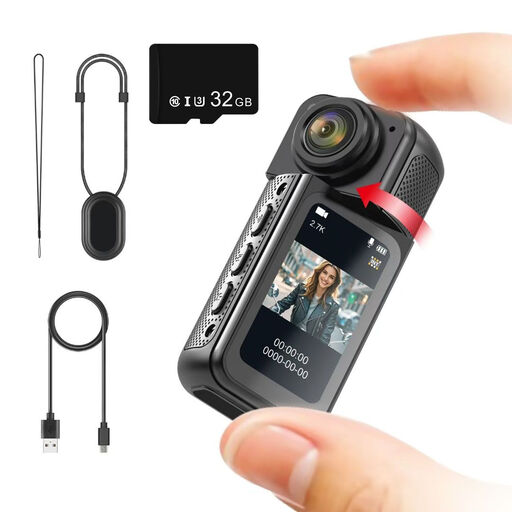 No image available
Described as a mini action camera with a rotatable lens; for small pin details, check whether its closest focusing distance allows you to achieve the framing you want.
Features stated in the product name: 2.7K, 180° rotatable lens and 32GB memory card.
 No image available
For shoppers who want an interchangeable-lens kit with a standard zoom; the framing you can achieve for fine pin details depends on the lens used.
The product specifications list a 24.2 MP sensor, Sony E-mount, an adjustable display and a weight of 396 g.
No. The megapixel count alone doesn’t tell you how large a pin will appear with the lens you’re using. Check the framing you can achieve, and bear in mind that focusing becomes more demanding at high magnifications.
Start with a stable, repeatable setup and take a test shot. If reflections are distracting, change the lighting position or shooting angle, and check that the pin’s surface is clean.
It depends on the specific lens included and the reproduction ratio it can achieve. Compare the resulting framing with the size of the pin you want to photograph; a kit zoom isn’t automatically a macro lens.
For online purchases made by consumers, a 14-day right to cancel generally applies from the day the goods are received; exceptions may apply. The European Consumer Centre explains this rule. If goods are faulty, you have a statutory right to a minimum two-year legal guarantee from the date you receive them, as described by Your Europe for purchases in the EU.